
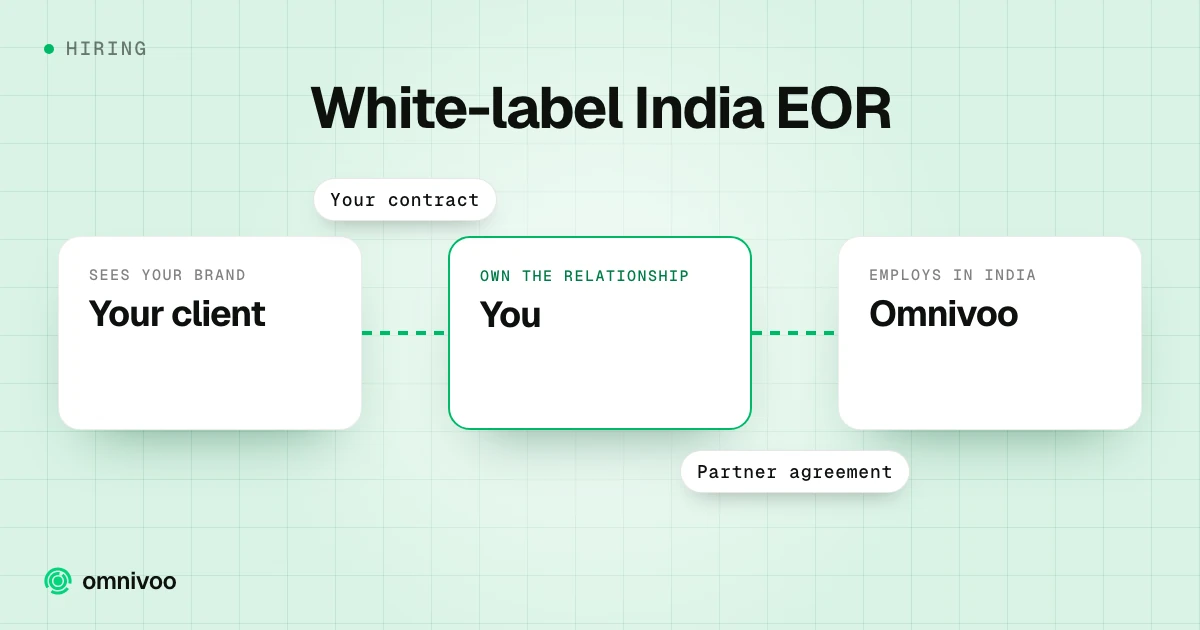
A client asks you to hire in India. You do not have an Indian entity, and setting one up would take months. Most agencies in that spot pass the deal to a global provider and lose the client relationship with it. A white label India EOR is the other option: you keep the client, the contract and the price, and an employer of record runs the employment behind you. This guide covers how that works, the two partner models, and what your client actually sees. If you already know you want it, the Omnivoo partner programme explains the terms.
What a white label India EOR is
An employer of record is the legal employer of a worker on behalf of another company. In India it signs the Indian employment contract, runs monthly payroll, deposits EPF, ESI, Professional Tax and TDS, and handles gratuity and Form 16. If you are new to the model, start with how an employer of record works in India.
White label adds one layer. The EOR does all of that work, but the client never sees the EOR’s name. They see yours. You sign the client contract, you send the invoice, and you are the only company they talk to.
That makes it useful for four kinds of firms:
- EOR and HR platforms that cover other regions but have no India entity. A client asks for India, and the deal usually goes to a global aggregator.
- Recruiters and staffing firms placing Indian talent with foreign clients. The candidate is ready, the client has no entity, and the placement stalls.
- Incorporation and accounting firms whose founder clients start hiring in India within a year of forming.
- Consultants and agencies told by a client to “figure out India.”
The two partner models
Every India EOR partner programme comes down to one choice: refer or resell.
Refer
You introduce the client. The EOR contracts them directly, runs onboarding and payroll, and pays you for every active employee. You do no operational work after the introduction.
Referral suits firms whose core work is something else, such as accountants and incorporation services. You help the client and get paid for it, but the client relationship for the hiring sits with the EOR.
Resell
You sign one agreement with the EOR and contract your client yourself, under your own brand. The EOR invoices you under that agreement. You decide what your client pays.
Reselling suits EOR providers and staffing firms, where India hiring is part of what you sell. It also carries more responsibility. You usually fund payroll in advance each month and hold the client relationship from start to finish.
Most programmes let you choose on the application and switch later. Start with whichever matches how you already work.
Who sets the price
Agencies always ask the same question first: who decides what the client pays? In a real resell model, you do.
Three things matter more than any single number:
- Who sets the end price. If the provider dictates what your client pays, you are referring under another name.
- How the provider invoices you. One partner agreement and one monthly invoice keep your books and your client’s books simple.
- What you would lose without it. A placement or client that walks away because you could not offer India costs more than the effort of adding a partner.
Ask every provider how it invoices partners, and do not accept a programme that sets your client’s price for you.
What your client sees
This is where a white label India EOR is won or lost. The client should see:
- Your brand on the proposal, the contract and the invoice.
- One contract with you, not a second one with a company they have never heard of.
- One point of contact, which is you.
The employee is employed properly in India. They get an Indian employment contract with IP assigned to the end client, payroll and payslips every month, statutory deposits and returns, gratuity and Form 16. None of that needs the client to know who runs it.
The one hard rule is contact. The EOR should never approach your clients, for an upsell, a survey or anything else. Get that written into the partner agreement.
Who actually employs the worker
The legal employer is the EOR’s Indian entity, so ask who that entity belongs to. Some providers own their entity. Others rent capacity from a local partner and add a second layer between you and the employee. If you run an EOR platform and need India coverage, see what to ask an India in-country partner.
At Omnivoo the employer is our own India entity, founded and run by the same people as Omnivoo, not a third-party partner. Contracts are signed by us, payroll runs under our registrations, and statutory filings go out in our name. One layer between you and the employee keeps problems short.
How fast a partner can start
Speed decides whether a placement closes. With Omnivoo, the employment contract is ready the same day you add an employee on the dashboard, and the first payroll runs in 5 to 6 business days. You fund payroll in advance each month, plus a refundable deposit of one month’s salary per employee.
A checklist before you sign
- Does the provider own its India entity?
- Who sets the price your client pays?
- Is “no contact with your clients” written into the agreement?
- How does the provider invoice you, and how often?
- Is there a minimum volume to start?
- Can you see payroll approvals and payments on a dashboard?
Offering India under your own brand
If your clients already ask about India, a white label India EOR lets you say yes without building an entity. Apply to the Omnivoo partner programme, take a short call, and we walk you through the programme and the agreement. Questions first? Email contact@omnivoo.com.