
An EOR moves the employer, not the tax question
The most common thing a foreign company believes about hiring in India through an Employer of Record is that it removes permanent establishment risk. It is close to true, and the gap between close and true is where the money is.
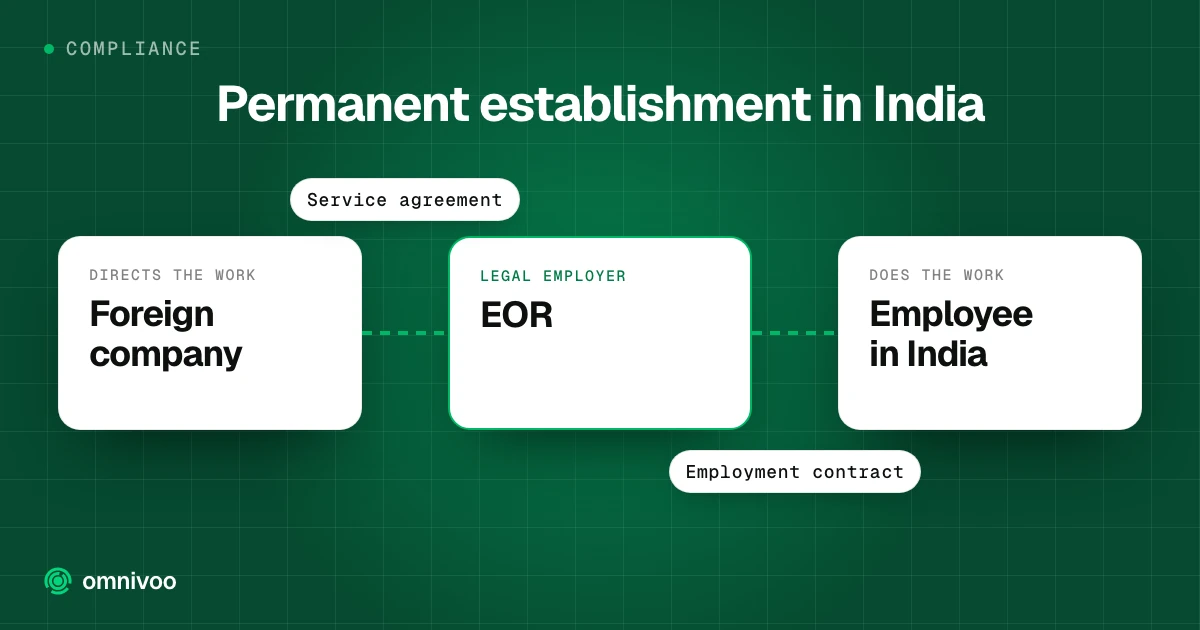
What the EOR genuinely does is take the employment footprint off your balance sheet. The EOR is a registered Indian entity, it holds the employment contract, it runs payroll, it withholds TDS, it remits PF and ESI, and it issues Form 16. You pay for a service and deduct it as a business expense. For a large majority of hires, particularly engineering, product, design and support, that is the end of the analysis and the EOR really is the lower-risk structure.
But PE does not turn on whose payroll processes the salary. It turns on what the person does in India, and what your company does through them. A salesperson who negotiates and closes deals creates the same exposure on an EOR’s payroll as on your own. The EOR is not a shield you hold up in front of the activity; it is a different way of employing the person doing it.
This guide covers the three triggers that matter, which hires are actually risky, and what to do about it.
Where the rule comes from
Two sources, and which one applies depends on where your company is resident.
If your country has a double tax treaty with India, Article 5 of that treaty defines permanent establishment and the treaty definition governs. It is the narrower of the two tests and generally the more protective. India has a wide treaty network, so most foreign companies hiring in India are working from a treaty definition.
If no treaty applies, the Income-tax Act’s business connection provisions govern instead. That test is broader than the treaty definition, which is worth knowing because companies from non-treaty jurisdictions sometimes assume the analysis is the same and it is not.
Either way, PE is the switch that lets India tax a foreign company’s business profits. Below the threshold, India taxes nothing of your worldwide income. Above it, the profits attributable to the Indian presence become taxable here, and assessments look backwards over the years in which the PE existed.
Trigger one: fixed place of business
The classic form. A fixed place of business in India through which the enterprise carries on its business, wholly or partly. An office, a branch, a workshop, a place of management.
For a company hiring through an EOR this is usually the easiest trigger to avoid, and it is mostly avoided by not doing the obvious things. Do not sign a lease in your own name for an India office. Do not put your company name on a door. Do not describe an address in India as your office in your own marketing or filings.
The awkward middle case is the home office. A single employee working from their own flat is not normally a fixed place of business of the foreign enterprise, because the enterprise does not have the space at its disposal. That reading gets weaker when the company pays for the space, requires it to be used, treats it as an address, or has enough people in one city that a functional office exists in substance. Reimbursing internet is fine. Signing a lease is not.
Most treaties also exclude activities that are purely preparatory or auxiliary. That exclusion is real but narrower than most foreign companies assume, and Indian authorities read it narrowly. An activity that is an essential and significant part of what your business actually does is not auxiliary just because it is small or does not directly book revenue. Treat it as an argument you might have to make rather than as ground you can stand on without advice.
Trigger two: service PE and the day count
This is the one that catches companies who think they have no India presence at all, because it is triggered by travel rather than by hiring.
Service PE arises when an enterprise furnishes services in India through employees or other personnel for more than a threshold period. Across India’s treaties with major partners the common threshold is 90 days in a rolling twelve-month period for services to unrelated parties. Several treaties set a materially shorter threshold where the services are furnished to an associated enterprise, which matters if you have a related entity or a group company in India.
Two features of the counting cause most of the surprises.
First, days are aggregated across people. Two engineers onsite for 50 days each in the same twelve-month window can cross a 90-day threshold between them. Companies count per person, tax authorities count in aggregate.
Second, the window rolls. It is not a financial year that resets on 1 April. A pattern of quarterly visits that looks modest inside any single quarter can sit above the threshold on a rolling twelve-month view.
The practical consequence: if you hire in India through an EOR and then start flying your own staff in to work alongside them, you have introduced a trigger the EOR structure does nothing about. Track the days. A shared calendar with arrival and departure dates for every employee who enters India on business is unglamorous and it is the single cheapest control available.
Trigger three: dependent agent PE, the one that actually bites
If you read only one section, read this one.
Dependent agent PE arises where a person in India habitually exercises authority to conclude contracts on behalf of the foreign enterprise, or habitually plays the principal role leading to the conclusion of contracts that the enterprise then signs without material modification. Under India’s domestic business connection test the concept also reaches a person who habitually secures orders.
There is no office requirement. There is no day threshold. A person working from their own home in Pune, on an EOR’s payroll, can create this exposure.
Which is why the highest-risk India hire for most foreign companies is not the senior engineer. It is the first India-based salesperson.
The formal defence, that the contract is signed by someone at headquarters, is weaker than it sounds. The test reaches the person who plays the principal role leading to the conclusion of a contract that the enterprise routinely signs unchanged. If your India salesperson runs the deal, agrees the commercial terms and hands over a signature-ready agreement that head office approves as a formality, the substance is that they concluded it.
What changes the analysis is genuine limitation:
- Deal terms are set by a pricing policy the India person cannot vary.
- Discounts beyond a defined band require a real approval that is sometimes refused.
- Contracts are reviewed and materially amended outside India before signature.
- The India role is described, and actually operates, as demand generation and relationship management rather than closing.
Those distinctions have to be true in practice, not just on the job description. Email threads are the evidence that gets read in an assessment.
The related point for contractor engagements is covered in our guide to permanent establishment risk with foreign contractors, where the exclusive-agent problem shows up in a different form.
The control test, and why day-to-day direction is not the issue
There is a persistent piece of advice that foreign companies must not direct the day-to-day work of EOR-employed staff, or the arrangement will be recharacterised.
Handle this carefully, because it is half right and the half that is wrong causes companies to worry about the wrong thing.
Directing the work is the entire point of an EOR. You choose the person, you set their priorities, you review their output, they attend your standups. If that were fatal, the model would not exist. What matters for PE is not whether you direct work, it is whether the person exercises authority to bind you in contract, and whether your enterprise carries on business through a fixed place in India.
Where control does become relevant is a different risk with a similar shape: worker classification, and whether the EOR is genuinely functioning as the employer or is a payroll conduit around an employment relationship that is really yours. That question is worth taking seriously, and we cover it in contractor vs employee in India. But it is not the PE test, and conflating the two leads companies to solve the wrong problem.
A risk read on common India hires
Rough triage, not advice. Every one of these turns on facts.
Lower risk. Software engineers, data engineers, QA, designers, product managers, technical writers, customer support, back-office finance. They produce work product. They do not bind you to third parties. This is the bulk of what most companies hire in India for, and the EOR structure handles it cleanly.
Watch carefully. Solutions engineers and customer success staff who touch renewals and commercial terms. Partnerships roles. Anyone with a Country Manager or Head of India title, because the title alone invites the question and is often paired with real authority.
High risk without deliberate structure. Quota-carrying sales that negotiates and closes. Anyone with signing authority. Anyone holding stock or fulfilling orders in India on your behalf.
If you are hiring in the third group, the answer is not to avoid the hire. It is to get the structure looked at by a cross-border tax adviser before the first deal closes, rather than after three years of them.
Practical controls worth having
None of these are exotic and all of them are cheaper than an assessment.
- Write the authority limits down. A short document stating what the India role can and cannot commit to, with an approval path for anything beyond it. Keep it current and follow it, because it will be read against the email record.
- Count India days. Every employee who enters India for work, with dates, in one place, reviewed on a rolling twelve-month basis rather than by financial year.
- Keep the lease out of your name. No India office, address or registration held by the foreign entity.
- Do not let the EOR-employed worker sign. Whatever the internal title, contracts with customers are executed outside India by someone with actual authority who actually reviews them.
- Revisit when the team changes shape. The analysis you did for three engineers is not the analysis for fifteen people including two sellers. Team growth is the usual reason a clean structure drifts.
- Get advice keyed to your treaty. Thresholds and agency wording vary by treaty. The India-US position is not the India-UK position.
Where this leaves the EOR decision
The honest summary is narrower than the marketing claim and still favourable.
An EOR is a good structure for hiring in India, and for most roles it is the lower-risk one, because it puts the employment relationship inside a registered Indian entity that carries the statutory obligations. It removes an entire category of exposure that comes from employing people in a country where you have no entity.
It does not decide the PE question. PE is decided by what your people do in India and whether your enterprise carries on business through them. An EOR that tells you PE risk is eliminated is overselling, and the moment that claim costs you something is the moment you hire your first seller in Bengaluru.
If you are still choosing between structures, EOR vs setting up your own entity in India covers the wider trade-off, and what an EOR in India actually is covers the mechanics.
This is general information, not tax advice. PE turns on your specific facts and your specific treaty, and it is the part of India hiring most worth paying an adviser to look at.