
First Hire Offer. Hire full-time in India. Zero setup fee. First month 50% off. Claim →
Compliance

Permanent Establishment

Reviewed by Rohan Sasne on Apr 29, 2026

Permanent Establishment (PE) is the tax-treaty concept that creates corporate income tax liability for a foreign enterprise in a host country when the enterprise carries on business there through a fixed place of business or a dependent agent who habitually concludes contracts on its behalf.
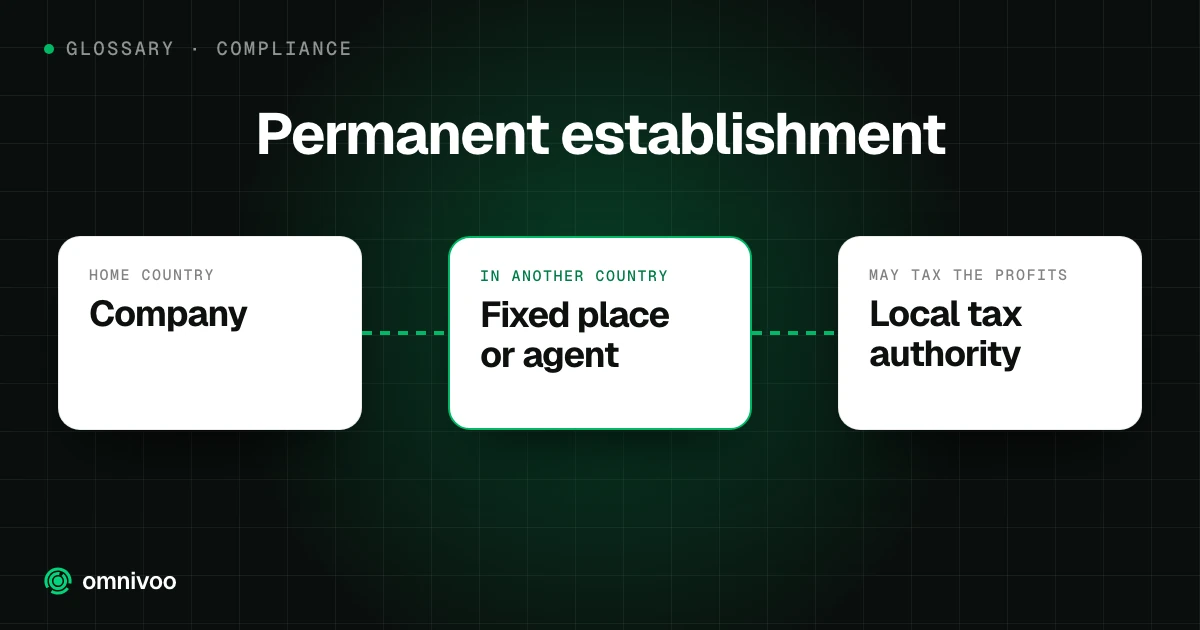
Permanent establishment: Company to Fixed place or agent to Local tax authority

Permanent Establishment (PE) is the tax-treaty trigger that converts a foreign enterprise’s presence in a country into a taxable nexus for corporate income tax. It is defined in Article 5 of the OECD Model Tax Convention on Income and on Capital, echoed (with modifications) in the UN Model Double Taxation Convention, and integrated into virtually every bilateral tax treaty in force. For US companies expanding internationally through contractors, sales reps, or remote employees, PE is the silent risk that can convert a clean low-cost market entry into a back-taxes-plus-penalty event.

How Permanent Establishment Works

PE has two main flavors and a handful of subsidiary ones:

  • Fixed-place-of-business PE (Article 5(1) and 5(2)). A physical location at the disposal of the enterprise, with a degree of permanence, through which business is carried on. Article 5(2) gives illustrative examples: place of management, branch, office, factory, workshop, mine or natural-resource extraction site.
  • Construction PE (Article 5(3)). A building site, construction, or installation project, but only if it lasts more than 12 months. Some treaties shorten this to 6 months.
  • Dependent agent PE (Article 5(5)). A person other than an independent agent who habitually concludes contracts, or plays the principal role leading to the conclusion of contracts, in the country on the enterprise’s behalf. The 2017 OECD update broadened this to address commissionaire structures.
  • Service PE (UN Model and many treaties). Furnishing of services in the host country by employees or other personnel of the enterprise for more than 183 days in any 12-month period.

PE status is decisive. Once a foreign enterprise has a PE in a host country, the host country can tax the profits attributable to the PE under domestic corporate income tax law (subject to the treaty’s profit-attribution rules in Article 7 of the OECD Model). For India this is 40 percent plus surcharge and cess on attributed profits. For the UK it is the corporation tax rate. For most EU countries it is between 15 and 30 percent. Withholding tax obligations and indirect tax (VAT or GST) registration often follow as well.

Who Is Exposed

  • Foreign enterprises with offices, factories, or warehouses abroad. Classic fixed-place exposure.
  • Foreign enterprises with sales agents, distributors, or contractors abroad. Dependent-agent exposure if the agent has and habitually exercises authority to conclude contracts.
  • Foreign enterprises with consultants or technical personnel on-site for extended projects. Service-PE exposure in treaties that include the UN-style provision.
  • Foreign enterprises with remote workers in another country. The 2025 OECD Update to Article 5 added explicit analytical guidance on when a home office can be a fixed place of business, raising the importance of this scenario.

The fact-specific nature of PE means each jurisdiction needs to be assessed on its own treaty text and domestic implementation.

What Activities Are Excluded

Article 5(4) of the OECD Model carves out specific activities, provided they are of a preparatory or auxiliary character:

  • Use of facilities solely for storage, display, or delivery of goods
  • Maintenance of a stock of goods solely for storage, display, delivery, or processing by another enterprise
  • Maintenance of a fixed place of business solely for purchasing or collecting information
  • Maintenance of a fixed place of business solely for other preparatory or auxiliary activities

The 2017 update added an anti-fragmentation rule preventing splitting a unified business into several separate “preparatory” offices. The 2025 Update further tightened analysis of home offices and remote work, per the OECD 2025 Update to the Model Tax Convention.

Penalties

PE does not produce a single penalty. It produces a cascade:

  • Back corporate income tax. Profits attributable to the PE for all years it has existed, often three to seven years backwards.
  • Withholding tax obligations. The PE may have been required to withhold on payments to non-resident vendors and employees.
  • Late-filing and underpayment penalties. Tied to domestic law, typically 10 to 100 percent of the tax depending on whether the failure was inadvertent or willful.
  • VAT or GST registration and back tax. A PE almost always triggers indirect-tax registration in the host country.
  • Payroll exposure. If employees are working through the PE, host-country employer obligations (social security, payroll withholding) attach.
  • Director and officer exposure. Many jurisdictions have personal-liability exposure for unfiled corporate returns.

Common Pitfalls

  • Hiring a sales contractor with closing authority. A contractor whose role is in substance to close deals creates dependent-agent PE risk regardless of contractual designation.
  • Long-running customer projects. Six- or twelve-month engineering or implementation projects on customer sites in treaty countries with service-PE provisions are a frequent trigger.
  • Treating an EOR engagement as full-stop PE protection. An EOR mitigates employment-law risk, but PE depends on the nature of the work the worker is doing on behalf of the foreign company, not on who employs them. A senior salesperson hired through an EOR with deal-closing authority can still create dependent-agent PE.
  • Forgetting remote workers. The 2025 OECD Update made remote-work PE analysis explicit. A senior remote worker in a treaty country with employer-funded home office and discretionary authority is real PE risk.
  • Employer of Record (EOR): a model that addresses employment law but only partially mitigates PE risk.
  • IR35: the UK regime that interacts with PE in the personal-service-company context.
  • EU Platform Work Directive: a parallel EU compliance regime focused on classification rather than tax nexus.
  • FATCA: another global compliance regime where the existence of a PE affects how withholding agents and intermediaries are scoped.

Omnivoo Contract Management captures the role, duration, and contracting authority of each cross-border worker, flags engagements that pattern-match dependent-agent or service-PE indicators, and produces the documentation a tax authority would expect in a PE inquiry.

Frequently asked questions

What is the OECD definition of permanent establishment?
Article 5(1) of the OECD Model Tax Convention defines permanent establishment as 'a fixed place of business through which the business of an enterprise is wholly or partly carried on.' Article 5(2) gives a non-exhaustive list including a place of management, branch, office, factory, workshop, and mine or other place of extraction of natural resources. Article 5(3) treats a building site or construction or installation project as a PE only if it lasts more than 12 months.
What is the dependent agent PE?
Under Article 5(5) of the OECD Model, an enterprise has a permanent establishment in a country if a person other than an independent agent acts on the enterprise's behalf in that country and habitually concludes contracts, or habitually plays the principal role leading to the conclusion of contracts that are routinely concluded without material modification by the enterprise. The 2017 Model widened this to capture commissionaire structures and agents that effectively close deals even where the formal signature happens elsewhere.
Is a service PE part of the OECD Model?
Not in the OECD Model itself, but service PE is in the UN Model Tax Convention and in many bilateral tax treaties, especially those involving developing countries. The UN Model's Article 5(3)(b) treats furnishing of services (including consultancy services) by an enterprise through employees or other engaged personnel in the host country as a PE if the activities continue for more than 183 days within any 12-month period.
What activities are excluded from PE?
Article 5(4) of the OECD Model excludes use of facilities solely for storage, display, or delivery of goods, maintenance of a stock of goods solely for storage, display, delivery, or processing by another enterprise, maintenance of a fixed place of business solely for purchasing goods or merchandise or for collecting information, and maintenance of a fixed place of business solely for the carrying on of any other activity of a preparatory or auxiliary character. The 2017 Model added an anti-fragmentation rule to prevent splitting one business across multiple 'preparatory' offices.
Does a remote worker create a permanent establishment?
It depends on the facts, the local law, and the applicable treaty. A single employee working from home occasionally is usually not a PE. A pattern of work from a country, especially if the home is at the company's disposal or if the worker concludes contracts, can create one. The 2025 OECD Update to Article 5 added a specific analytical framework for remote-work scenarios and made clear that home offices can constitute fixed places of business in certain conditions.

Related Terms

Employment

Employer of Record (EOR)

An EOR is a third-party organization that legally employs workers on behalf of another company, handling payroll, taxes, benefits, and compliance in the worker's country.

Compliance

EU Platform Work Directive

The EU Platform Work Directive (Directive (EU) 2024/2831) is a 2024 EU law that creates a rebuttable legal presumption of employment for platform workers and adds transparency rules for algorithmic management of workforce decisions.

Taxation

FATCA (Foreign Account Tax Compliance Act)

FATCA is a 2010 US law (sections 1471 to 1474 of the Internal Revenue Code, Chapter 4) that requires foreign financial institutions and certain non-financial foreign entities to identify US-owned accounts and report them to the IRS, backed by a 30 percent withholding tax on non-compliant payees.

Taxation

IR35 (UK Off-Payroll Working Rules)

IR35 is the UK rule set that treats payments to a contractor's personal service company as employment income when the underlying engagement looks like employment, requiring PAYE deduction by either the contractor's company (Chapter 8) or the end client/fee payer (Chapter 10).

Compliance

Beneficial Owner

Under the US Corporate Transparency Act, a beneficial owner is an individual who, directly or indirectly, exercises substantial control over a reporting company or owns or controls not less than 25 percent of its ownership interests, with the definition codified at 31 USC 5336(a)(3) and implemented through FinCEN regulations.

Compliance

Beneficial Ownership Information Report (FinCEN)

The Beneficial Ownership Information (BOI) report is the filing required by the US Corporate Transparency Act under which reporting companies disclose the identity of their beneficial owners and company applicants to the Financial Crimes Enforcement Network (FinCEN), with scope narrowed by a FinCEN interim final rule of 21 March 2025 to apply only to foreign entities registered to do business in a US State or Tribal jurisdiction.

Taxation

DAC7 (EU Directive on Administrative Cooperation)

DAC7 is Council Directive (EU) 2021/514, an amendment to the EU's Directive on Administrative Cooperation that forces digital platform operators to collect and report seller and contractor data to EU tax authorities each year.

Taxation

Effectively Connected Income (ECI)

Effectively Connected Income (ECI) is income a foreign person earns from a US trade or business, taxed on a net basis at graduated rates rather than the flat 30 percent that applies to FDAP income, and documented to a payer on Form W-8ECI to remove it from NRA withholding.

Related articles

Omnivoo handles this for you

Stop worrying about Indian payroll and compliance terms. Omnivoo manages everything (PF, ESI, TDS, professional tax, and more).

Get started