
The short answer
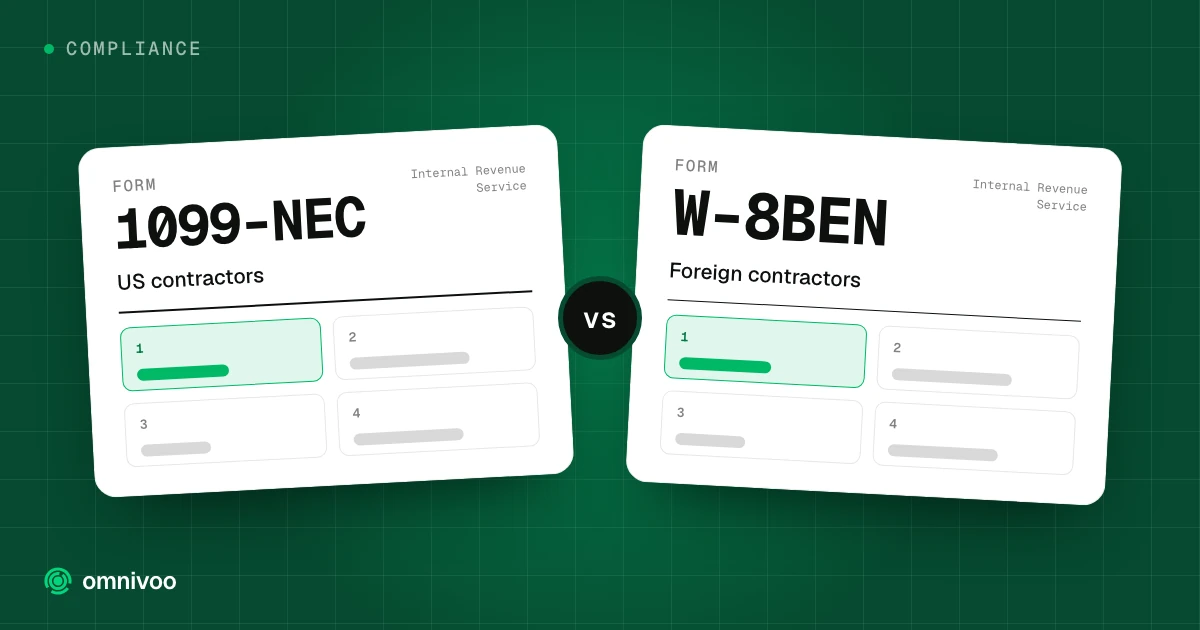
No, in almost every case you do not 1099 a foreigner. Form 1099-NEC is for payments to US persons, not foreign contractors. Instead of a 1099, you collect Form W-8BEN from a foreign individual or Form W-8BEN-E from a foreign entity, and you only file Form 1042-S (with a corresponding Form 1042) when the work was performed inside the United States.
A short caveat before we go deeper. This guide is general information based on public IRS guidance, not tax or legal advice. Withholding and reporting outcomes turn on the facts of your situation, so confirm the specifics with a qualified tax professional before you pay. This is one piece of the broader US-payer withholding picture, and the US withholding agent obligations covers 1042, 1042-S, NRA, FDAP vs ECI, and treaty rates together.
Use the form picker
The interactive decision tree above answers the question for your exact situation in under a minute, then routes you to the right IRS form and the right next step.
The four questions that decide it
Whether a foreign contractor needs any IRS form at all comes down to four questions, asked in this order.
- Is the contractor a US person? US citizens and US tax residents are always reported on a 1099-NEC over the threshold, no matter where they live, per the IRS Instructions for Forms 1099-MISC and 1099-NEC.
- Is the foreign payee an individual or an entity? Individuals give Form W-8BEN. Entities give Form W-8BEN-E.
- Where is the work physically performed? The IRS source-of-income rule for personal services says the place where services are performed determines source, regardless of where the contract was signed or where the payment is sent from.
- Is there a tax treaty that reduces the default 30% rate? Treaty positions are claimed on Lines 9 and 10 of Form W-8BEN, with rates summarized in IRS Publication 901.
Three of those four questions live on a single piece of paper. That paper is Form W-8BEN, which is why our W-8BEN collection checklist is the first thing we tell US payers to run before issuing a contractor invoice.
Form W-9 vs W-8BEN vs W-8BEN-E vs 1042-S
Four forms cover every realistic combination of US payer and foreign or domestic contractor. Here is how they line up.
| Form | Who fills it out | When you collect it | What gets reported | Default withholding | Filing deadline |
|---|---|---|---|---|---|
| Form W-9 | A US person (citizen, green-card holder, or US tax resident) | Before the first payment to any US contractor | Nonemployee compensation on Form 1099-NEC when paid at least the annual threshold | None on a correctly completed W-9, 24% backup withholding if the TIN is missing or incorrect per IRS Pub 1281 | 1099-NEC due to recipient and IRS by January 31, per IRS 1099-MISC/NEC Instructions |
| Form W-8BEN | A foreign individual | Before the first payment to any foreign individual | If US-source, on Form 1042-S. If foreign-source, generally nothing per IRS foreign-source guidance | 30% on US-source FDAP under IRS NRA withholding, reduced by treaty if one applies | 1042-S and Form 1042 due March 15, per About Form 1042-S |
| Form W-8BEN-E | A foreign entity (corporation, partnership, non-US LLC) | Before the first payment to any foreign entity | Same as W-8BEN treatment, 1042-S for US-source income, generally nothing for foreign-source | 30% on US-source FDAP, reduced by treaty if one applies and FATCA chapter 4 status permits | 1042-S and Form 1042 due March 15 |
| Form 1042-S | The US payer files this with the IRS for the foreign payee | Filed annually for any US-source income paid to a foreign person | Each payment of US-source FDAP, including in-US services compensation | Withholding already applied on the underlying payment, reported on the form | March 15, with the payer also filing Form 1042 by the same date |
A few notes on that table. The 1099-NEC reporting threshold was historically $600. Under the One Big Beautiful Bill Act, it rises to $2,000 starting in tax year 2026, summarized by the RSM US OBBBA tax alert. The IRS form instructions still show $600 and lag behind the bill, so confirm the current threshold against both the bill text and the most recent IRS 1099-MISC/NEC Instructions before you file.
Scenario 1: Foreign individual, all work outside the US
A US software company hires a backend engineer in Bengaluru. The engineer works entirely from India. There is a signed contract, a monthly invoice, and a US bank account paying via international wire.
Does this person get a 1099? No. The 1099-NEC is for US persons, and the engineer is a foreign national. Does this person get a 1042-S? Also no. Services performed entirely outside the United States are foreign-source income under the IRS source-of-income rule for personal services. Foreign-source income paid to a nonresident alien is normally not subject to US tax and is “normally not required to be reported on an information return,” per the IRS foreign-source income page.
The form you do collect is Form W-8BEN, filled out by the contractor before the first payment, and kept in your records. The form is the documentation behind the no-1099, no-1042-S treatment. You do not file the W-8BEN with the IRS. You hold it for as long as the related payment is relevant to your withholding-tax determination, which in practice means at least three years after the year of the last payment, per the IRS Instructions for the Requester of Forms W-8.
This is the single most common situation for US founders paying foreign contractors, and the cleanest. No 1099, no 1042-S, no withholding, one form on file.
Scenario 2: Foreign individual, all work inside the US
A US marketing agency flies in a videographer from Toronto for a one-week shoot in Los Angeles. The videographer is a Canadian tax resident, an individual, and the work is performed entirely on US soil.
Does this person get a 1099? Still no, because the videographer is a foreign individual, not a US person. Does this person get a 1042-S? Yes. The compensation is for personal services physically performed inside the United States, which makes it US-source under the IRS source-of-income rule for personal services. US-source services compensation paid to a nonresident alien is reportable on Form 1042-S, with the payer filing the annual Form 1042.
The default withholding rate on that payment is 30% under chapter 3, per IRS Publication 515 and the IRS NRA withholding overview. The US-Canada treaty contains a personal services article that may reduce or eliminate that withholding if the videographer’s day count and fixed-base position qualify, and the videographer claims the reduction on Lines 9 and 10 of the W-8BEN. Country-by-country treaty rates are in IRS Publication 901.
A note on Form 8233. For an independent personal services treaty exemption claimed by a nonresident alien individual on US-source services income, the IRS form is technically Form 8233, not Form W-8BEN. Many practitioners collect both: W-8BEN for the chapter 3 / chapter 4 certifications, and Form 8233 for the treaty claim on services income. Read the IRS Instructions for Form 8233 and confirm with your tax advisor which combination applies to your specific contractor.
Scenario 3: Foreign entity contractor
A US ecommerce company pays a UK-incorporated design studio (a private limited company) for branding work performed entirely in London.
Does the studio get a 1099? No, because the studio is a foreign entity. Does the studio get a 1042-S? No, because the work was performed entirely outside the US, making the income foreign-source under the IRS source-of-income rule for personal services.
The form you collect is different. Foreign entities give Form W-8BEN-E, not Form W-8BEN. The W-8BEN-E is longer, covers FATCA chapter 4 classifications (active NFFE, passive NFFE, certain participating FFI categories, and so on), and includes its own treaty-claim mechanics in Part III. The IRS About Form W-8BEN-E page links to the current form and the line-by-line instructions.
Two practical points. First, a non-US LLC is treated as a foreign entity for W-8 purposes even when the LLC has US owners, so the form choice still comes down to where the entity is incorporated. Second, if the studio is a disregarded entity for US tax purposes and the beneficial owner is an individual, you may end up collecting a W-8BEN from the individual owner instead. The IRS Instructions for Form W-8BEN-E walk through the disregarded-entity logic in detail.
Scenario 4: Mixed US and foreign work
A US SaaS company hires a German consultant for a 12-month engagement. Most months the consultant works from Berlin. Twice in the year they fly to the US for week-long onsites at the SaaS company’s office.
This is the messy case, and the one where US payers most often get the answer wrong. The 12 months of work do not collapse into a single source. Each calendar day apportions to the country where the consultant was physically located. The IRS Source of Income (Personal Services) page is explicit that the place of performance, not the contract, determines source, and IRS Publication 515 describes the apportionment of compensation between US-source and foreign-source where services are performed partly in the United States.
The practical method is a day-count apportionment. If the consultant performed services on 240 working days total during the year, of which 10 were inside the United States, then roughly 10/240 (about 4.2%) of the year’s compensation is US-source. That US-source slice is reportable on Form 1042-S and subject to 30% withholding unless reduced by the US-Germany income tax treaty. The remaining ~95.8% is foreign-source and generally not reported.
The contractor does not get a 1099 for any of this. The 1099-NEC is for US persons.
Two operational notes for the mixed case. First, document the day-count basis in writing, ideally before the year ends, with the consultant’s confirmation of US presence. Second, the 30% default applies to the US-source slice even if it is small, so do not wait until year-end to figure out whether to withhold on that single onsite week. If you are unsure, withhold at 30% on the onsite portion at payment time and refund through the treaty position on the W-8BEN or Form 8233 if it applies.
Tax treaties: when withholding drops below 30%
The 30% default is not destiny. The United States has income tax treaties with roughly 70 countries, summarized in IRS Publication 901. Most treaties contain an “independent personal services” or “business profits” article that exempts a foreign resident’s services compensation from US tax where the contractor does not have a fixed base or permanent establishment in the US, and where the contractor’s physical presence in the US falls below a treaty-specified day count.
A few examples to make this concrete:
- Under the US-India treaty, Article 15 (independent personal services) generally exempts services compensation where the Indian resident is present in the US for no more than 89 days during the tax year and has no fixed base in the US, per IRS Publication 901.
- Under the US-Canada treaty, the equivalent article applies a fixed-base test for independent personal services. Day-count thresholds and the precise mechanics vary by income type, again summarized in IRS Publication 901.
- Many treaties contain a “saving clause” that preserves the US’s ability to tax its own citizens and residents, which is why a US citizen abroad cannot use the treaty to escape US tax on their own income.
To claim the reduction, the foreign contractor completes Part II of Form W-8BEN (or Part III of W-8BEN-E), including the country of residence on Line 9 and any required treaty-article reference on Line 10, per the IRS Instructions for Form W-8BEN. For services treaty claims by nonresident alien individuals on US-source income, the contractor may also need Form 8233.
You, as the withholding agent, have a duty not to apply a treaty rate you have “actual knowledge or reason to know” is incorrect, per IRS Publication 515. In practice that means you read Line 9 and Line 10, confirm the article cited actually exists in the treaty, and confirm the contractor’s claimed residence is consistent with the rest of the form.
What happens if you skip the W-8BEN
The default rules are unforgiving when you have no W-8BEN on file.
If the payment is US-source FDAP income, the 30% chapter 3 withholding rate applies automatically, per the IRS NRA withholding overview and IRS Publication 515. You cannot honor any treaty rate without the form. The IRS Instructions for Form W-8BEN state that failure to provide a Form W-8BEN when requested may lead to withholding at the foreign-person rate of 30% or the backup withholding rate of 24% under section 3406.
The backup withholding angle is the one most US payers miss. If you cannot establish whether the payee is a US person or a foreign person, the presumption can flip toward US-person treatment and trigger the 24% backup withholding rate. IRS Publication 1281 walks through the backup withholding mechanics. You also expose yourself to penalties for failure to file Form 1042 and Form 1042-S, which include both late-filing and late-payment components.
The cleanup is painful. You may owe the tax that should have been withheld, plus interest and penalties, while you chase a W-8BEN from a contractor who may no longer be responsive. Collect the form before the first payment.
Deadlines you must hit
Three IRS deadlines cover almost every foreign-contractor reporting scenario.
- Form 1099-NEC: due to the recipient and the IRS by January 31 of the year following payment, per the IRS Instructions for Forms 1099-MISC and 1099-NEC. There is no extended deadline for paper-vs-electronic 1099-NEC filing.
- Form 1042 (annual return of withholding tax): due by March 15 of the year following payment, per the IRS About Form 1042 page.
- Form 1042-S (recipient information return): due to the recipient and to the IRS by March 15 of the year following payment, per the IRS About Form 1042-S page.
A few practical points around those dates. Form 1042 deposit obligations during the year follow a separate schedule based on accumulated withholding, described in IRS Publication 515. The payer is responsible for both the deposits and the annual return. Extension to file Form 1042 is available via Form 7004, but extension to pay is not, so deposits still need to land on time even if you are extending the return.
Common pitfalls
Patterns that trip up US payers more than any others:
- Sending a 1099-NEC to a foreign contractor anyway. Some teams default to “everyone gets a 1099.” The IRS 1099-MISC/NEC Instructions say to use Form 1042-S, not Form 1099-NEC, for payments to nonresident aliens. A foreign contractor with a valid W-8BEN does not get a 1099-NEC.
- Assuming a 1042-S is always required for foreign payees. It is not. The 1042-S applies only to US-source income. Foreign-source income paid to a foreign person is “normally not required to be reported on an information return,” per the IRS foreign-source income page.
- Confusing residency with location. A US citizen working from Portugal is still a US person and still gives a W-9, not a W-8BEN, per the IRS About Form W-9 page. Status decides the form, not address.
- Letting a W-8BEN expire. A W-8BEN is generally valid for the year signed plus the three succeeding calendar years, per the IRS Instructions for Form W-8BEN. A form signed in 2022 is no longer valid in 2026.
- Treaty claim with no TIN. A contractor cites a treaty article on Line 10 but leaves both Line 5 (US TIN) and Line 6a (foreign TIN) blank. The form is incomplete and the treaty claim cannot be honored under the IRS Instructions for Form W-8BEN.
- Using the wrong form for an entity. A foreign LLC or corporation files a W-8BEN by mistake. Entities use Form W-8BEN-E. The IRS will treat an entity W-8BEN as invalid.
- Forgetting to track the in-US work portion. If your contractor flew to the US even once for a sprint, the in-US slice of pay is US-source under the IRS source-of-income rule and may need a 1042-S, even if the rest of the year is clean.
What this is NOT
This guide is general information drawn from publicly available IRS guidance, not legal or tax advice. The right reporting and withholding outcome depends on your contractor’s specific facts (citizenship, residency, day count, treaty position, entity type, and the precise nature of the work), and on the most recent versions of the relevant IRS forms, instructions, and publications. Confirm your facts with a qualified tax professional before you file or withhold. This article was last reviewed by the Omnivoo Compliance Team on May 30, 2026.
Where to go next
If you want the hands-on next step, our W-8BEN collection checklist walks the six fields that matter on the form and flags the most common errors before you accept it. If you are filing for the first time and want each form covered in depth, start with the W-8BEN filing guide, then the Form W-9 guide for the US-person side, then the Form 1042-S guide for the US-source path. For the withholding mechanics, our NRA withholding deep dive covers the 30% default and chapter 3 plumbing, and the 2026 treaty rates by country post has the reduced-rate lookup tables.
Definitions are short on the glossary: Form W-8BEN, Form 1042-S, NRA withholding, and Form 1099-NEC.
A US founder paying one foreign contractor can run this analysis by hand. A US team paying contractors across several countries is tracking W-8BEN expirations, treaty positions, day-counts, and 1042-S filings, and that is where the manual approach starts to leak. Omnivoo Contract Management handles it for $29 per contractor per month. We collect the right tax form, validate it, run KYC, and pay your contractors in 220+ countries and territories end to end. Transaction fees are passed through at cost, with competitive FX and no fee for contractors, cancel anytime.