
COMPLIANCE
Are You a Withholding Agent When You Pay Foreign Contractors?
You are a withholding agent only if the payment is US-source income. Here is the IRS definition, the personal-liability rule, and when it bites.
Reviewed by Rohan Sasne on Apr 22, 2026
A withholding agent is any US or foreign person that has control, receipt, custody, disposal, or payment of US-source income to a foreign person, and is required to deduct, withhold, and pay over the tax under chapters 3 and 4 of the Internal Revenue Code, with personal liability for any tax not withheld.
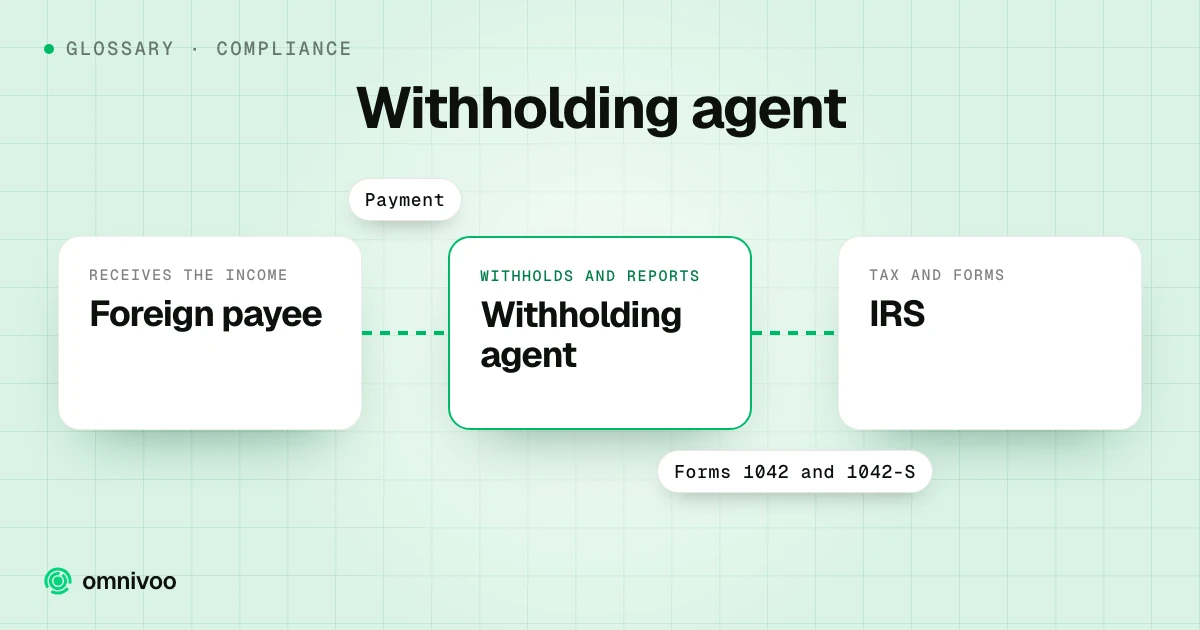
A withholding agent is the party the US tax system holds responsible for collecting tax on payments to foreign persons before the money leaves the country. The role is defined broadly and the liability is personal, which is why it matters so much for any US business paying contractors abroad. The IRS defines the role on its withholding agent page and details the duties in Publication 515. The statutory basis is Internal Revenue Code section 1441 and the related chapter 3 and chapter 4 provisions.
The IRS definition is wide. A withholding agent is “a person who is required to deduct, withhold, and pay over to the IRS any tax imposed under Chapter 3 or Chapter 4 of the Internal Revenue Code on income paid to a foreign person.” The agent “may be an individual, corporation, partnership, trust, association, or any other entity, including any foreign intermediary, foreign partnership, or U.S. branch of certain foreign banks and insurance companies.” And the core test: “you are a withholding agent if you are a U.S. or foreign person that has control, receipt, custody, disposal, or payment of an amount subject to withholding.”
In plain terms, if you pay US-source income to a foreign person, you are the withholding agent for that payment. A US company paying a foreign contractor for services performed in the US is the withholding agent. There is no minimum size and no opt-out.
The withholding agent’s job runs from onboarding through year-end reporting:
The IRS summarizes the reporting duty directly: the withholding agent “must report the income and tax withheld on Form 1042-S and file an annual return on Form 1042.”
The defining feature of the role is personal liability. The IRS states that “a withholding agent is personally liable for any tax required to be withheld,” and that “this liability is independent of the tax liability of the foreign person to whom the payment is made.” If the agent should have withheld 30 percent and did not, the IRS can pursue the agent for the full amount, plus interest and penalties, regardless of whether the foreign payee ever owed or paid US tax. The cost does not pass to the contractor. It stays with the payer.
This is the reason documentation is not optional. A valid W-8 on file is what lets an agent withhold at a reduced rate or treat income as foreign-source with no withholding. Without it, the safe position is to withhold the full 30 percent.
Being a withholding agent does not mean withholding on every cross-border payment. If the income is foreign source income, because the foreign contractor performed the services entirely outside the US, there is generally no withholding and no Form 1042-S. The agent’s duty there is to hold documentation proving the foreign status and foreign source. The source of income rules decide which payments are in scope.
Omnivoo Contract Management collects the right W-8 or W-9 at onboarding, applies the correct rate per payment, and generates the Form 1042-S and Form 1099 records a withholding agent must file, so the personal liability stays covered.
Collect W-8BEN and W-9, sign country-aware contracts, and pay contractors in 220+ countries and territories.
FDAP income is fixed, determinable, annual, or periodical income from US sources, such as interest, dividends, rents, royalties, and compensation for services, that is paid to a foreign person and is subject to 30 percent NRA withholding on the gross amount unless a treaty applies.
Form 1042-S is the IRS information return a US withholding agent files to report US-source income paid to a foreign person and the tax withheld under chapters 3 and 4 of the Internal Revenue Code.
IRS Publication 515, Withholding of Tax on Nonresident Aliens and Foreign Entities, is the annual IRS guide for withholding agents that pay income to foreign persons, covering who must withhold, what income is subject to withholding, the applicable rates, and the reporting obligations under chapters 3 and 4.
NRA withholding is the chapter 3 regime under Internal Revenue Code sections 1441 through 1443 that requires a US withholding agent to deduct tax, generally at a 30 percent statutory rate, from US-source FDAP income paid to a nonresident alien or foreign entity, unless a treaty or other exemption reduces the rate.
Chapter 3 and Chapter 4 are the two US withholding regimes that apply to payments to foreign persons. Chapter 3 is NRA withholding under Internal Revenue Code sections 1441 through 1443, on US-source FDAP income. Chapter 4 is FATCA withholding under sections 1471 through 1474, aimed at certain foreign financial institutions and entities. Both generally use a 30 percent rate, and when both could apply, Chapter 4 takes priority.
An Employer Identification Number (EIN) is a federal tax identification number that the IRS issues to identify a business entity. A US company generally needs an EIN before it can hire employees, run payroll, withhold and deposit employment taxes, and file the information returns the IRS requires.
Form 1042 is the IRS Annual Withholding Tax Return for U.S. Source Income of Foreign Persons. A withholding agent files one Form 1042 each year to report and reconcile the tax it withheld under chapters 3 and 4 of the Internal Revenue Code on US-source income paid to foreign persons.
Withholding tax is tax that the payer deducts from a payment at the source and remits to the government on the recipient's behalf, rather than the recipient paying it later. In the United States the main forms relevant to paying people are income-tax withholding from employee wages, NRA (chapter 3) withholding on US-source income paid to foreign persons at a 30 percent default rate, and backup withholding at 24 percent when payee documentation is missing or incorrect.
Collect the right tax form before you pay, sign a country-aware contract, and pay contractors in 220+ countries and territories. $29 per contractor per month.
Get startedFull details in our Terms of Service →