
COMPLIANCE
US-Source vs Foreign-Source Contractor Income: The One Rule That Decides US Tax
Whether a contractor payment triggers US tax turns on one rule: where the work is performed. The source test, a decision table, and IRS citations.
Reviewed by Rohan Sasne on Mar 5, 2026
The source of income rules are the US tax rules that assign income to a US or foreign source by income type, and they are decisive for foreign payees because personal services income is sourced to where the services are physically performed, not where the payer or the contract sits.
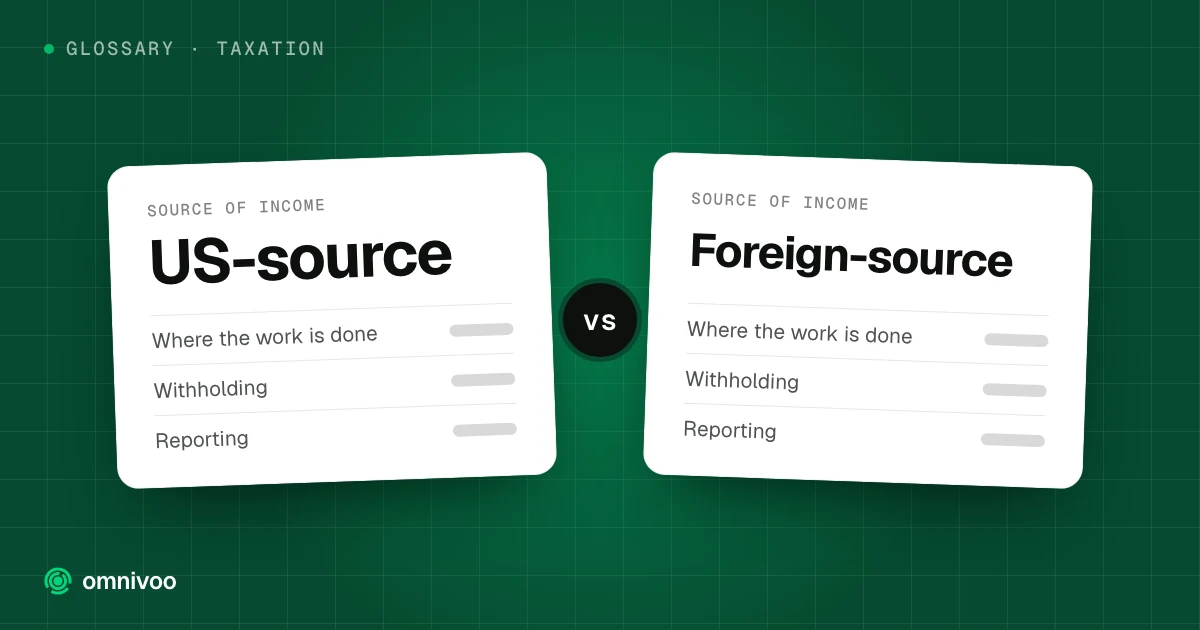
The source of income rules decide whether a payment is US-source or foreign-source, and that single determination drives whether US withholding and reporting apply to a foreign person at all. The rules differ by income type, but for contractor payments the controlling rule is the one for personal services: income is sourced to where the work is physically performed. The IRS sets this out on its source of income, personal service income page, and the underlying statute is Internal Revenue Code section 861. For a US company paying contractors abroad, these rules are the gate that everything else passes through.
The Internal Revenue Code assigns a source to each kind of income through sections 861 through 865. The general pattern:
For paying foreign contractors, the personal-services rule is the one that matters. It overrides intuition about where the money comes from.
The IRS is explicit on this point: “The source of income from labor or personal services is determined by where the services are performed, not where the contract is made, the place of payment, or the residence of the payer.” That means a contractor sitting in Manila who does all the work from Manila earns foreign-source income, even though a US company sends the payment from a US account under a contract governed by US law.
This is why most remote foreign contractor work falls outside US withholding. The income is foreign source income, so it is not US-source FDAP income, so NRA withholding does not reach it and there is nothing to report on Form 1042-S. The payer should still hold a valid Form W-8BEN or Form W-8BEN-E to document the foreign status and support the no-withholding position.
When the same contractor flies to the US and works onsite, the days worked in the US produce US-source income for those days. That portion is US-source FDAP income, subject to 30 percent withholding unless a treaty reduces it.
There is a narrow carve-out for short US visits. Under section 861(a)(3), compensation for services performed in the US by a nonresident alien is not treated as US-source if all of these hold:
The IRS describes this as the position where the income “is not considered U.S. source income” when those conditions are met. The thresholds are low, so the exception rarely covers a meaningful engagement, but it can apply to brief incidental US presence.
The order of analysis for any foreign contractor payment is:
Skip step 2 and a payer either over-withholds on foreign-source income or under-withholds on US-source income. Both are errors a withholding agent is liable for.
Omnivoo Contract Management records where each contractor performs the work and applies the source rules per payment, so US-source and foreign-source amounts stay separated and documented for any IRS review.
Collect W-8BEN and W-9, sign country-aware contracts, and pay contractors in 220+ countries and territories.
FDAP income is fixed, determinable, annual, or periodical income from US sources, such as interest, dividends, rents, royalties, and compensation for services, that is paid to a foreign person and is subject to 30 percent NRA withholding on the gross amount unless a treaty applies.
Foreign source income is income assigned to a non-US source under the US source rules, and for a nonresident alien it is generally not subject to US tax, NRA withholding, or Form 1042-S reporting, which is why services performed entirely outside the US by a foreign contractor fall outside US withholding.
Form 1042-S is the IRS information return a US withholding agent files to report US-source income paid to a foreign person and the tax withheld under chapters 3 and 4 of the Internal Revenue Code.
NRA withholding is the chapter 3 regime under Internal Revenue Code sections 1441 through 1443 that requires a US withholding agent to deduct tax, generally at a 30 percent statutory rate, from US-source FDAP income paid to a nonresident alien or foreign entity, unless a treaty or other exemption reduces the rate.
Effectively Connected Income (ECI) is income a foreign person earns from a US trade or business, taxed on a net basis at graduated rates rather than the flat 30 percent that applies to FDAP income, and documented to a payer on Form W-8ECI to remove it from NRA withholding.
Collect the right tax form before you pay, sign a country-aware contract, and pay contractors in 220+ countries and territories. $29 per contractor per month.
Get startedFull details in our Terms of Service →