
COMPLIANCE
What Is a Tax Treaty, and How Does It Affect Paying a Foreign Contractor?
A tax treaty can cut US withholding for treaty-country residents. How to claim it on Form W-8BEN, and why work done abroad usually never needs it.
Reviewed by Rohan Sasne on Jun 18, 2026
A US income tax treaty is a bilateral agreement between the United States and a foreign country that reduces or eliminates US withholding on certain income, allocates taxing rights between the two countries, and lets a treaty-country resident claim a reduced rate or exemption on US-source income through a W-8BEN or Form 8233.
Related: IRS Publication 901 treaty rates.
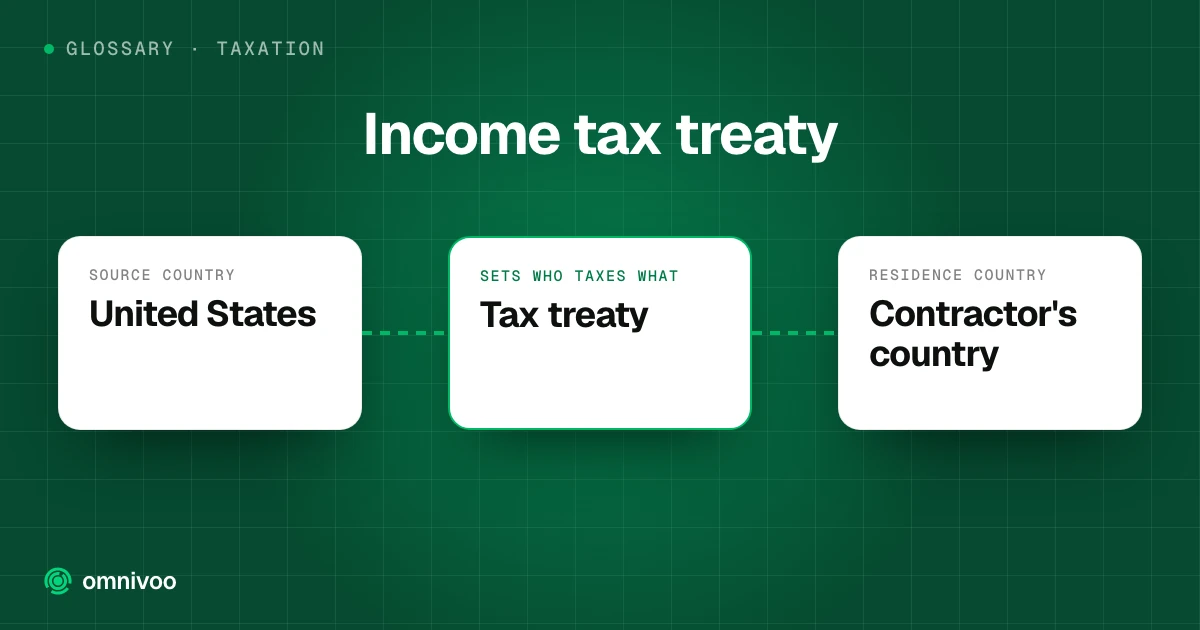
A US income tax treaty is a bilateral agreement that changes how the US taxes residents of the other country, usually by lowering the tax that would otherwise apply. For a foreign contractor with US-source income, a treaty can cut the NRA withholding rate below the 30 percent statutory default the IRS applies to US-source FDAP income, sometimes to zero. The IRS maintains the full list on its United States income tax treaties A to Z page. For US payers, treaties are the legitimate path to paying foreign workers more of their fee instead of remitting it to the IRS.
The IRS tax treaties page describes the core benefit directly: “under these treaties, residents (not necessarily citizens) of foreign countries may be eligible to be taxed at a reduced rate or exempt from U.S. income taxes on certain items of income they receive from sources within the United States.” It also notes that “these reduced rates and exemptions vary among countries and specific items of income.”
A treaty does several things at once:
For contractor payments, the relevant treaty article is usually the one covering independent personal services or business profits. The pattern in most treaties is that a resident of the treaty country is taxable in the US on personal-services income only if they have a fixed base or permanent establishment in the US, or are present for more than a set number of days. The exact article and threshold vary, so the specific treaty text controls. The US-India treaty, for example, addresses independent personal services in its own dedicated article, published in the US-India treaty document. A US payer should read the actual treaty article rather than assume a uniform rule.
A treaty benefit is not automatic. The foreign payee must claim it with valid documentation given to the withholding agent:
To claim, the payee must be the beneficial owner of the income and generally must provide a US TIN, or a foreign TIN where the rules allow. Without a valid claim on file, the payer must withhold the full 30 percent.
Most treaties include a saving clause that preserves each country’s right to tax its own residents as if the treaty did not exist. The practical effect is that a resident generally cannot use the treaty to reduce tax their own country of residence imposes. The IRS guidance on claiming tax treaty benefits notes that “the exceptions to the saving clause in some treaties allow a resident of the United States to claim a tax treaty exemption on U.S. source income,” which is why treaty benefits are read carefully against residency and the specific exceptions listed in each treaty.
The US does not have a treaty with every country. A resident of a non-treaty country has no reduced rate to claim and is subject to the 30 percent statutory rate on US-source FDAP income. The A-to-Z page is the authoritative list of which treaties are in force. For a contractor in a non-treaty country, the analysis usually shifts to whether the income is US-source at all under the source of income rules, since foreign-source work is outside withholding regardless of any treaty.
Omnivoo Contract Management captures each contractor’s treaty country and the W-8BEN or Form 8233 claim, applies the correct treaty rate per payment, and keeps the documentation a withholding agent needs to support a reduced rate.
TDS, professional tax, and Form 16 filings handled inside one payroll workflow.
Form 8233 is the IRS form a nonresident alien individual gives a US withholding agent to claim a tax treaty exemption from withholding on compensation for personal services performed in the United States.
Form W-8BEN is the IRS certificate a non-US individual gives a US payer to establish foreign status and claim any reduced withholding under an income tax treaty.
NRA withholding is the chapter 3 regime under Internal Revenue Code sections 1441 through 1443 that requires a US withholding agent to deduct tax, generally at a 30 percent statutory rate, from US-source FDAP income paid to a nonresident alien or foreign entity, unless a treaty or other exemption reduces the rate.
Permanent Establishment (PE) is the tax-treaty concept that creates corporate income tax liability for a foreign enterprise in a host country when the enterprise carries on business there through a fixed place of business or a dependent agent who habitually concludes contracts on its behalf.
A Tax Residency Certificate is an official document issued by a country's tax authority confirming a taxpayer's residency, used to claim relief under a Double Taxation Avoidance Agreement (DTAA).
Double taxation is when the same income is taxed by two jurisdictions. For cross-border income, it is relieved mainly by income tax treaties, which allocate taxing rights and reduce withholding, and by the foreign tax credit, which lets a person offset US tax with foreign income tax already paid on the same income.
The foreign tax credit is the main US mechanism for relieving double taxation. It lets a US taxpayer credit income taxes paid or accrued to a foreign country against the US tax owed on that same income, dollar for dollar. Individuals, estates, and trusts claim it on Form 1116, and corporations claim it on Form 1118.
The reverse charge is a VAT mechanism under which the business customer, rather than the supplier, accounts for the VAT on a cross-border B2B supply of services. It shifts the obligation to report and self-assess the tax from the seller to the buyer.
Stop worrying about Indian payroll and compliance terms. Omnivoo manages everything (PF, ESI, TDS, professional tax, and more).
Get startedFull details in our Terms of Service →