
A treaty is not a loophole, it is a traffic rule
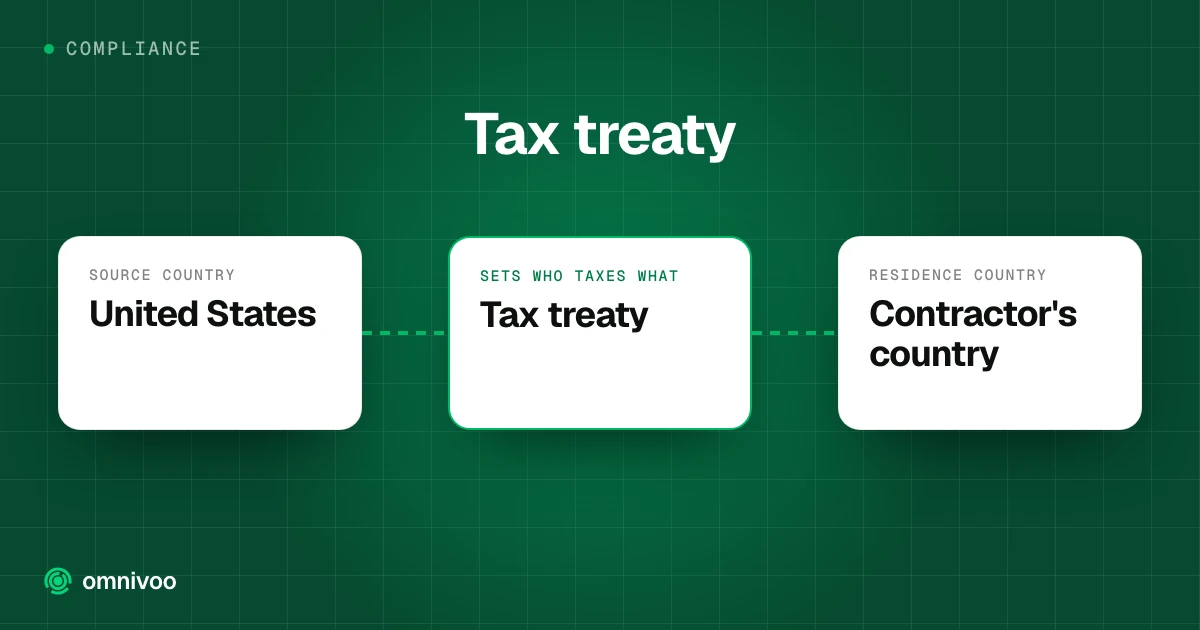
When a US company starts paying contractors abroad, “tax treaty” tends to get thrown around as if it were a discount code that makes US tax disappear. It is not that. A US income tax treaty is a bilateral agreement between the United States and another country that can lower the US tax on certain income flowing to a resident of that country, and the IRS notes its provisions are reciprocal, so relief can run in the other direction too.
The IRS puts it directly on its Tax Treaties overview: “Under these treaties, residents (not necessarily citizens) of foreign countries may be eligible to be taxed at a reduced rate or exempt from U.S. income taxes on certain items of income they receive from sources within the United States.”
Read the qualifiers in that sentence, because they do all the work. Residents of foreign countries. Certain items of income. From sources within the United States. A treaty is narrow on purpose. This guide walks what it actually does, how a contractor claims it, and the one situation where, for many cross-border contractor payments, it never comes up at all.
A quick note before we start. This is general information, not tax or legal advice. Treaty positions and withholding outcomes turn on the specific facts and the specific treaty text, so confirm the details with a qualified tax professional before you pay.
What a treaty actually does
Two functions sit at the center of every US income tax treaty.
It can reduce or eliminate US withholding on certain US-source income. The statutory default on most US-source income paid to a foreign person is a flat rate, and a treaty can drop that rate, sometimes to zero, for residents of the treaty country on the categories of income the treaty covers. The IRS describes the effect as residents of foreign countries being “eligible to be taxed at a reduced rate or exempt from U.S. income taxes on certain items of income” from US sources, on the same Tax Treaties overview.
Its provisions are reciprocal, so relief can run both ways. A treaty does not only reduce US tax for foreign residents. The IRS notes the provisions are generally reciprocal, so a US person earning income from a treaty country may likewise “be entitled to certain credits, deductions, exemptions, and reductions in the rate of taxes of those foreign countries,” per the Tax Treaties overview.
What a treaty does not do is rewrite who is a US taxpayer. The IRS is explicit: “With certain exceptions, they do not reduce the U.S. taxes of U.S. citizens or U.S. treaty residents. U.S. citizens and U.S. treaty residents are subject to U.S. income tax on their worldwide income,” from the Tax Treaties overview. That carve-out is the saving clause, and it is why a US citizen contractor cannot usually use a treaty to lower their US tax even while a foreign resident can.
First question: does a treaty even exist?
A treaty position is only available if there is a treaty. The US does not have one with every country. The IRS keeps the authoritative list, the United States Income Tax Treaties A to Z, which opens with the same baseline: “The United States has tax treaties with a number of foreign countries.”
So step one with any contractor is to check their country of residence against that A to Z list. A few entries carry caution notices for suspension or termination, so read the specific entry rather than assuming a treaty is live just because it once existed. No treaty with the contractor’s country means there is no treaty rate to claim, and the statutory rules apply on their own terms.
How a contractor claims the benefit: Form W-8BEN Part II
A treaty benefit is not automatic. The contractor has to claim it, and the claim is made on the same form that establishes their foreign status, Form W-8BEN.
The form’s core job is to certify that the person is not a US person and is the beneficial owner of the income, per the W-8BEN instructions. The treaty claim lives in Part II of that form. The IRS instructions say Part II is used for “claiming treaty benefits as a resident of a foreign country with which the United States has an income tax treaty for payments subject to withholding under chapter 3 or under section 1446(a) or (f),” from the W-8BEN instructions.
To make the claim, the contractor names the country where they are a treaty resident. The instructions define this in treaty terms: “For treaty purposes, a person is a resident of a treaty country if the person is a resident of that country under the terms of the treaty,” again from the W-8BEN instructions. In short, the contractor is asserting that they are a resident of a country that has a treaty with the US, and that the treaty covers the income you are paying.
Your side of this is documentation. You collect a complete, valid W-8BEN, including a correctly filled Part II if a treaty rate is being claimed, and you keep it on file as the basis for any reduced withholding you apply. If you want the steps with the IRS citations attached, work through our W-8BEN collection checklist before your next payment.
The catch most companies miss: source comes first
Here is the part that reframes the whole conversation. A treaty reduces US tax on US-source income. If there is no US-source income, there is no US tax for the treaty to touch.
For personal services, the IRS sources income by where the work is physically performed. Its source-of-income rule states: “The place, where the personal services are performed, generally determines the source of the personal service income, regardless of where the contract was made, or the place of payment, or the residence of the payer.”
Apply that to the common case. A contractor who lives in another country and does all the work from there is earning foreign-source income, no matter that your company is in the US, you signed the contract in the US, and you paid from a US bank account. The IRS rules every one of those factors out. Foreign-source income paid to a foreign person is generally outside US tax and US withholding to begin with, which we cover in detail in US-source vs foreign-source contractor income.
So for a contractor working entirely abroad, the sequence is: the income is foreign-source, there is no US withholding to reduce, and the treaty never enters the math. That is why so many US payers go looking for a treaty rate and find the question was moot. The treaty matters when the contractor performs some or all of the work inside the US, making part of the pay US-source, or when the income otherwise falls into the US-source withholding regime.
When the treaty does matter
Put the two pieces together and the picture is clean.
| Situation | Is the income US-source? | Does the treaty come into play? |
|---|---|---|
| Foreign contractor, all work performed abroad | No, it is foreign-source | Generally no. There is no US withholding for a treaty to reduce |
| Foreign contractor performs some work inside the US | The in-US portion is US-source | Yes, on the US-source portion, if a treaty exists and is claimed |
| Foreign contractor with US-source income subject to chapter 3 withholding | Yes | Yes, a valid W-8BEN Part II claim can reduce the rate |
| US citizen contractor | Worldwide income is taxable to the US | Generally no, the saving clause preserves US tax on US persons |
Two columns drive the answer: is the income US-source, and is the contractor a treaty-country resident who claims the benefit. Only when both are true does a treaty change what you withhold.
What a treaty does not let you assume
A few guardrails, because treaties invite shortcuts.
Do not assume a rate. Every treaty is its own text. Rates and covered categories differ by country and by income type, and they can change. Read the applicable treaty, or get advice on it, rather than applying a number you remember from somewhere else.
Do not apply a treaty without a valid claim. A treaty rate is something the contractor claims on W-8BEN Part II. No valid form, no treaty rate. The form is your documentation if the position is ever questioned.
Do not assume a treaty exists. Check the A to Z list for the contractor’s country, and read the entry for caution notices.
Do not expect it to help a US person. The saving clause means US citizens and US treaty residents are taxed on worldwide income with limited exceptions, per the Tax Treaties overview.
The short version
A US income tax treaty is a bilateral agreement that can reduce or eliminate US withholding on certain US-source income for a resident of the treaty country, and whose provisions the IRS notes are reciprocal. A foreign contractor claims the benefit on Form W-8BEN Part II by certifying residency in a treaty country. But for a contractor doing all the work abroad, the income is foreign-source and outside US tax in the first place, so for many cross-border contractor payments the treaty question never arises. Source-of-income comes first, then the treaty, in that order. If you want the underlying concept on one page, see the income tax treaty glossary entry.
When a platform tracks it for you
One US founder paying one foreign contractor can run this analysis by hand. A US team paying contractors across several countries is tracking source-of-income calls, which countries have treaties, who claimed a treaty rate on Part II, and whether the W-8BEN on file is still valid. That is where the manual approach starts to leak.
Omnivoo Contract Management handles it for $29 per contractor per month. We collect the right tax form, run the KYC, draft and manage the contract, and pay your contractors in 220+ countries and territories, end to end. Transaction fees are passed through at cost, with competitive FX and no fee for contractors, cancel anytime.
Want the answer for your specific setup? See how Omnivoo Contract Management handles foreign contractors end to end, or talk to our team.