
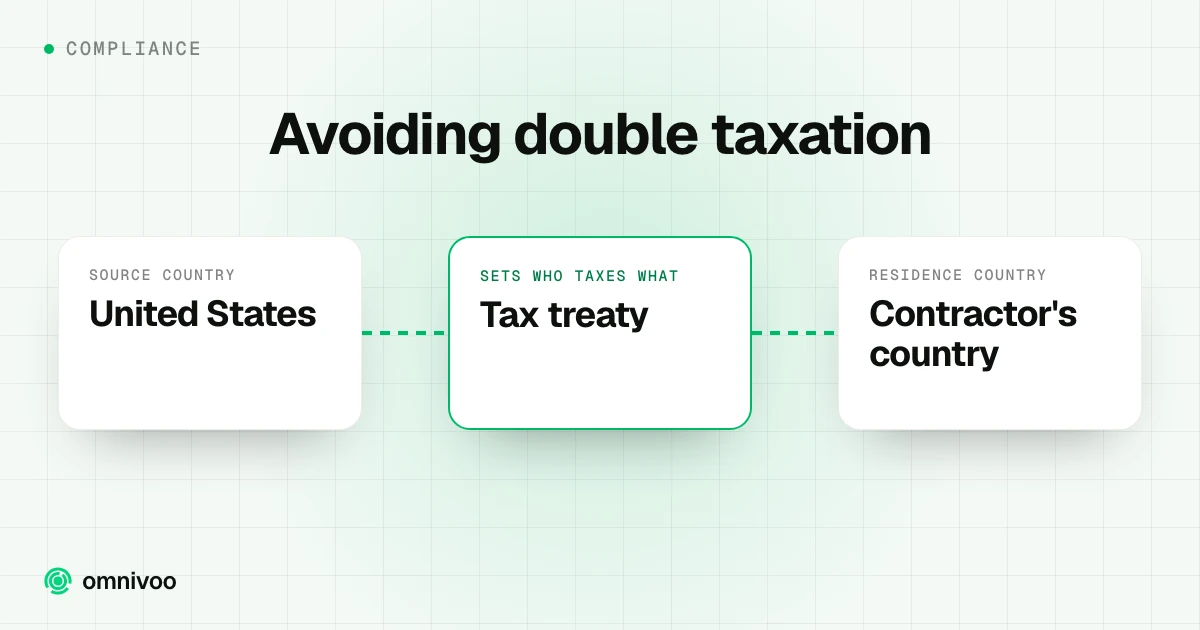
The question behind the question
A US company about to pay a developer in Manila, a designer in Lisbon, or a writer in Nairobi almost always asks the same worried question. If I pay them, and their country taxes them, and the US taxes them too, is this money getting taxed twice?
For the most common setup, the answer is reassuring. It is not taxed twice, and the reason is simpler than the worry. The income is foreign-source, so the US has no claim on it in the first place. There is no second layer to create double taxation.
This guide gives the verified mechanism with the IRS citations attached. It walks the clean common case first, then shows where double taxation can genuinely arise and the two tools that solve it: income tax treaties and the foreign tax credit. A quick note before we start. This is general information, not tax or legal advice. The outcomes turn on the facts of your situation, so confirm the specifics with a qualified tax professional before you pay.
The clean case: work performed entirely outside the US
Start with what decides everything for a service payment, the source-of-income rule. For personal services, the IRS source-of-income rule for personal services states:
“The place, where the personal services are performed, generally determines the source of the personal service income, regardless of where the contract was made, or the place of payment, or the residence of the payer.”
So a contractor who does all their work from their home country is earning foreign-source income, full stop. Where your company sits, where the contract was signed, and which bank account you paid from do not move the source.
Foreign-source income paid to a foreign person sits outside the US tax net. The IRS page “Foreign Source Income - Form 1042-S Reporting Not Required” states:
“Foreign source income (non-U.S. source income) paid to a nonresident alien is normally not subject to U.S. tax under either chapter 3 or 4. Income from sources outside of the United States is exempt from NRA withholding under Internal Revenue Code Section 1441(a). It is normally not required to be reported on an information return.”
Read those two sources together and the double taxation worry dissolves for the common case. The US does not tax foreign-source income paid to a nonresident alien, so the income is generally taxed only once, in the contractor’s home country. There is no US layer stacked on top.
What the US payer’s job actually is
This is the part that surprises people. For a normal cross-border service payment, your job as the US payer is not to collect US tax. It is to get two things right.
Get the source right. Confirm where the contractor physically performed the work. All outside the US means foreign-source, and the analysis above applies. This is the single fact that decides the outcome, which we cover in depth in US-source vs foreign-source contractor income.
Get the documentation right. Collect and keep a valid Form W-8BEN. The W-8BEN records the contractor’s foreign status and is your evidence that the payment is foreign-source and outside US withholding. Without it on file, you are exposed if a question ever comes up.
And one quiet rule that matters as much as the first two: do not over-withhold. Holding back 30 percent on income that is genuinely foreign-source does not protect you. It creates a problem, because the contractor then has to chase the IRS to recover money that was never US-taxable. Correct sourcing and a clean W-8BEN are what keep a foreign-source payment simple. Over-withholding undoes that.
Where double taxation actually becomes a live question
Double taxation stops being theoretical the moment US-source income enters the picture. That happens when some of the work was physically performed inside the US, for example a contractor who flies in for a two-week sprint.
Per the source-of-income rule, pay for services done partly inside and partly outside the US is split on a time basis. The US-source portion is the total pay multiplied by the fraction of days the services were performed in the US over the total days worked. That US-source slice is FDAP income and can carry 30 percent NRA withholding by default.
Here is where double taxation can genuinely arise. That US-source slice may be taxed by the US through withholding, and the contractor’s home country may tax the same income too, because most countries tax their residents on worldwide income. Same dollars, two tax authorities. The two mechanisms below exist precisely to stop that.
| Situation | Is double taxation a risk | What prevents or relieves it |
|---|---|---|
| Work performed entirely outside the US | Generally no. Income is foreign-source, US does not tax it | Correct sourcing plus a valid W-8BEN. No US layer exists |
| US-source income, contractor in a treaty country | Yes, without relief | Treaty reduces or removes the US withholding |
| US-source income, US tax was paid | Yes, without relief | Contractor claims the foreign tax credit on their own return |
Mechanism one: income tax treaties
The first tool works on the US side, before the money is even withheld. An income tax treaty between the US and the contractor’s country of residence can lower the US tax on US-source income, sometimes to zero. The IRS tax treaties overview states:
“Under these treaties, residents (not necessarily citizens) of foreign countries may be eligible to be taxed at a reduced rate or exempt from U.S. income taxes on certain items of income they receive from sources within the United States.”
The IRS also notes that “these reduced rates and exemptions vary among countries and specific items of income.” So the relief is country-specific and income-type-specific, not a blanket rate. A contractor claims the reduced rate by giving you a valid W-8BEN that states the treaty position. By cutting the US withholding on the US-source portion, the treaty shrinks the US layer of tax, so the same income is not heavily taxed by both countries at once. Treaties are the front-end fix, applied at the moment of payment.
Mechanism two: the foreign tax credit
The second tool works on the contractor’s side, after tax has been paid. The IRS Foreign Tax Credit page describes it for a US taxpayer who has paid foreign tax on income the US also taxes:
“If you paid or accrued foreign taxes to a foreign country or U.S. possession and are subject to U.S. tax on the same income, you may be able to take either a credit or an itemized deduction.”
Taken as a credit, the IRS explains, “foreign income taxes reduce your U.S. tax liability.” In plain terms, the taxed person offsets one country’s tax by the tax already paid to the other, so the same income is not fully taxed twice.
Here is the part US payers most need to hear. The foreign tax credit is mostly the contractor’s tool, claimed on their own tax return, not something the US payer files on a contractor’s behalf. The IRS describes a taxpayer who paid foreign taxes and is also subject to US tax on that income. That is the person sitting on both tax bills, which is the contractor, not you as the payer. Your role does not include claiming credits for them. Your role stays on the front end: correct sourcing and clean documentation, so the right amount, often nothing, is withheld in the first place.
Putting it together: a short decision path
Three questions, in order, for any foreign contractor you pay.
- Where did the contractor physically perform the work? All outside the US means foreign-source. Generally no US tax, no double taxation, no second layer. Collect a valid W-8BEN and do not over-withhold.
- For any work performed inside the US, does a treaty apply? The 30 percent default on the US-source portion may drop, sometimes to zero, under the treaty with the contractor’s country of residence. The contractor claims it on the W-8BEN.
- Was US tax actually paid on income the home country also taxes? The foreign tax credit relieves that overlap, and the contractor claims it on their own return.
Run those three and you have handled the double taxation question for almost every contractor relationship. To get the documentation that sits under all of this right, work through our W-8BEN collection checklist before your next payment. It is free, instant, and walks the steps with the IRS citations attached.
How this connects to reporting
Source-of-income is also the rule that decides whether a foreign contractor gets any IRS form at all, which we cover in do you send a 1099 to foreign contractors. The short version: a foreign person doing all the work abroad generally gets neither a 1099-NEC nor a 1042-S, because the income is foreign-source. The same rule that keeps the payment out of US tax also keeps it off the reporting forms.
When a platform handles it for you
A US founder paying one foreign contractor can run this analysis by hand. A US team paying contractors across several countries is tracking source-of-income calls, treaty positions, W-8BEN forms, and reporting deadlines, and that is where the manual approach starts to leak.
Omnivoo Contract Management handles it for $29 per contractor per month. We collect the right tax form, run the KYC, draft and manage the contract, and pay your contractors in 220+ countries and territories, end to end. Transaction fees are passed through at cost, with competitive FX and no fee for contractors, cancel anytime.
Want the answer for your specific setup? See how Omnivoo Contract Management handles foreign contractors end to end, or talk to our team.