
COMPLIANCE
How a US Company Avoids Double Taxation When Paying Foreign Contractors
Work done entirely abroad is foreign-source income, so it is generally taxed only where the contractor lives. Here is the rule, with IRS citations.
Reviewed by Rohan Sasne on Mar 8, 2026
Double taxation is when the same income is taxed by two jurisdictions. For cross-border income, it is relieved mainly by income tax treaties, which allocate taxing rights and reduce withholding, and by the foreign tax credit, which lets a person offset US tax with foreign income tax already paid on the same income.
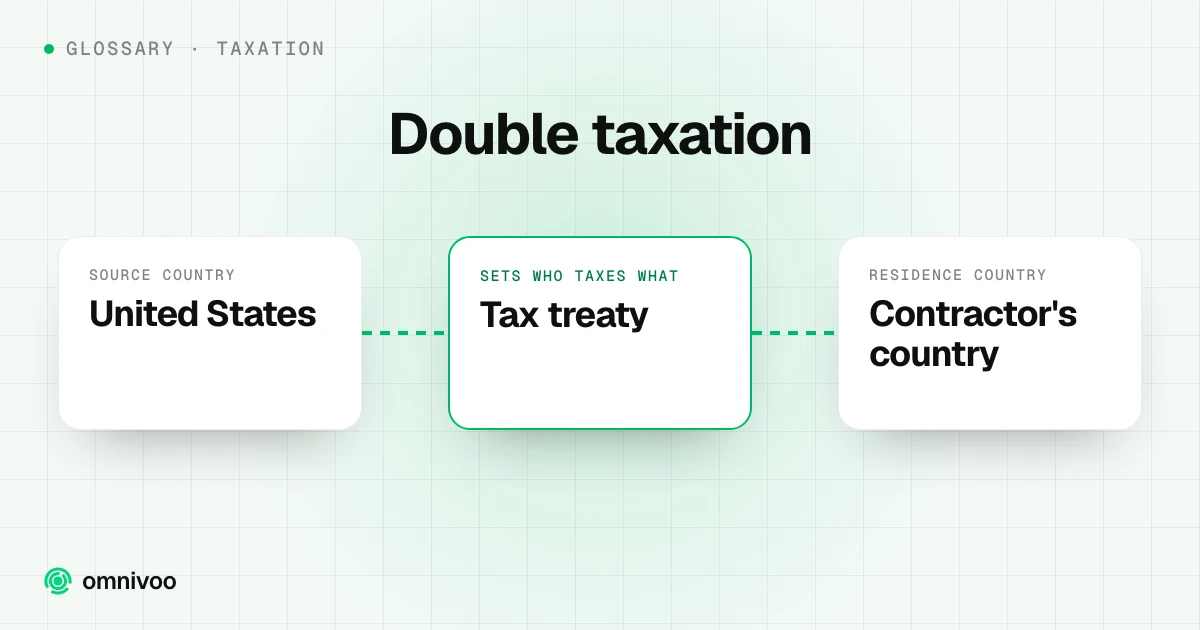
Double taxation is when the same income is taxed by two jurisdictions. In a cross-border setting it is most often discussed as juridical double taxation: two countries each tax the same person on the same income. The relief is built into the international tax system, primarily through income tax treaties that allocate taxing rights between two countries and through the foreign tax credit that offsets one country’s tax with foreign tax already paid on the same income.
People use “double taxation” in two different ways, and keeping them apart avoids confusion.
This entry focuses on the juridical sense.
There are two main mechanisms, and they often work together.
Income tax treaties. The United States has income tax treaties with a number of foreign countries. Under these treaties, residents of foreign countries may be eligible to be taxed at a reduced rate or exempt from US income tax on certain items of income they receive from sources within the United States, and the IRS notes that these reduced rates and exemptions vary among countries and specific items of income (IRS Tax Treaties). A treaty allocates taxing rights so the two countries are not both taxing the same income at full rates. See Income Tax Treaty.
Foreign tax credit. Where income is still subject to tax in both places, the foreign tax credit prevents the burden from stacking. The IRS states that if you paid or accrued foreign taxes to a foreign country or US possession and are subject to US tax on the same income, you may be able to take either a credit or an itemized deduction for those taxes, and that in most cases it is to your advantage to take foreign income taxes as a tax credit (IRS Foreign Tax Credit).
For a US company paying a foreign contractor, the cleaner answer is that double taxation often never starts. Compensation for services is sourced to where the work is physically performed under the source of income rules. When the contractor does the work entirely in their home country, the income is foreign-source income.
Foreign-source service income paid to a nonresident is outside the US income tax net. The contractor’s home country taxes the income, and the US does not. Because only one country taxes the income, there is no second layer to relieve. The relief mechanisms above matter most when both countries do have a claim, such as work physically performed in the US or income a treaty assigns to both sides.
One nuance for US persons: a US citizen abroad usually cannot use a treaty to cut US tax, because of the treaty saving clause, and instead relies on the foreign tax credit to avoid being taxed twice.
Omnivoo Contract Management sorts each foreign contractor payment by source and documentation, so income earned and performed abroad is treated as foreign-source and is not pulled into US tax in the first place.
TDS, professional tax, and Form 16 filings handled inside one payroll workflow.
A US income tax treaty is a bilateral agreement between the United States and a foreign country that reduces or eliminates US withholding on certain income, allocates taxing rights between the two countries, and lets a treaty-country resident claim a reduced rate or exemption on US-source income through a W-8BEN or Form 8233.
A saving clause is a provision in a US income tax treaty that lets the United States tax its own citizens and residents as if the treaty had not come into effect, subject to a short list of stated exceptions in the treaty. It is the reason a US citizen abroad usually cannot use a treaty to reduce US tax, while a foreign resident still can.
Stop worrying about Indian payroll and compliance terms. Omnivoo manages everything (PF, ESI, TDS, professional tax, and more).
Get startedFull details in our Terms of Service →