
COMPLIANCE
Form 1042 Annual Return Walkthrough for US Companies Paying Foreign Persons
Form 1042 line by line: the March 15 deadline, deposit schedule rules, the e-file mandate, and how it reconciles to your 1042-S filings.
Reviewed by Rohan Sasne on May 26, 2026
An information return is a form a payer files with the IRS, and furnishes to the recipient, to report certain payments made during the calendar year. Examples include Form 1099-NEC, 1099-MISC, 1099-K, W-2, and 1042-S. Most paper information returns are submitted to the IRS under a Form 1096 transmittal.
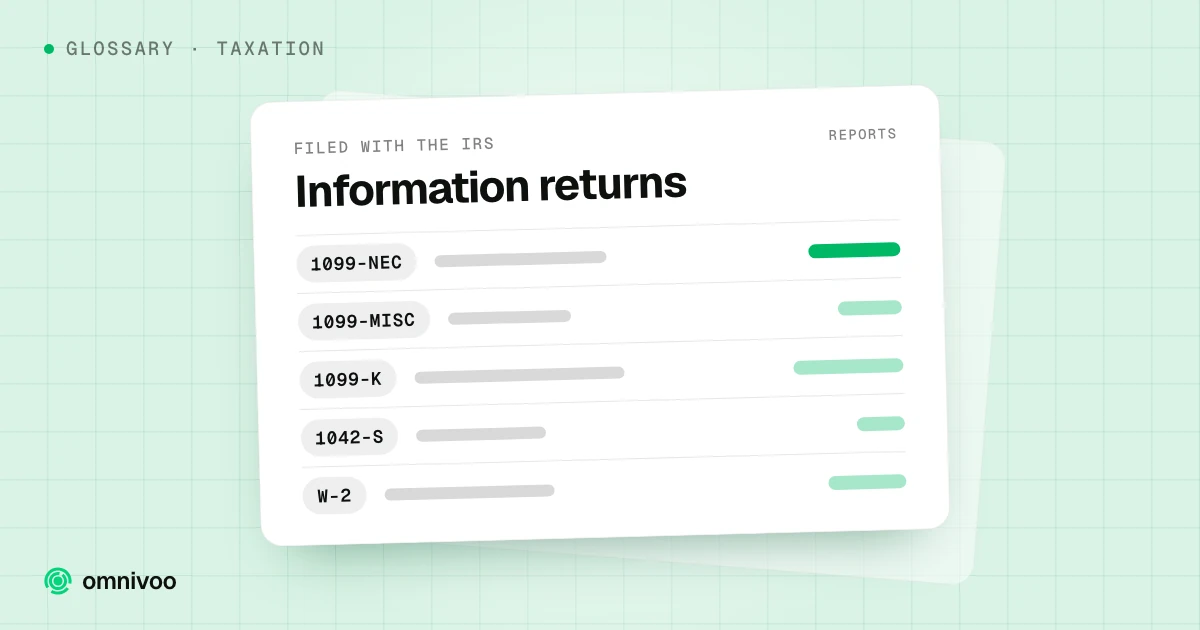
An information return is a form a payer files with the IRS to report certain payments it made during the calendar year, while furnishing a matching copy to the person who received the payment. It is not a tax return that computes the payer’s own tax. It is a report that tells the IRS, and the recipient, that a payment happened. The IRS describes the obligation plainly on its information returns page: when an entity pays recipients, it “must provide statements to them and report the transactions to the IRS.” The IRS General Instructions for Certain Information Returns cover the main families.
The information return you file depends on what you paid and to whom.
A US person who is paid as a contractor receives a 1099-NEC. A foreign person paid US-source income receives a 1042-S instead, never a 1099.
A payer carries two distinct duties for each information return: file the copy with the IRS, and furnish a statement to the recipient. The IRS enforces these separately. Per the General Instructions, a payer that fails to meet either duty “may be subject to a penalty,” with section 6721 covering failure to file correct information returns by the due date and section 6722 covering failure to furnish correct payee statements. Getting the recipient’s name and taxpayer identification number right matters, because a mismatch can trigger backup withholding and penalty exposure.
When a payer files information returns on paper, it does not mail loose forms. It attaches a Form 1096 transmittal. The IRS states on its About Form 1096 page that the form is used to “transmit paper Forms 1097, 1098, 1099, 3921, 3922, 5498, and W-2G to the Internal Revenue Service.” Form 1096 is paper only. The form itself instructs filers, “Do not use this form to transmit electronically.” Note that Form 1042-S is not in the 1096 list. It is transmitted with Form 1042 to a different address.
Most filers no longer touch Form 1096, because the e-file threshold is low. The IRS e-file information returns page states that “as of tax year 2023, if you have 10 or more information returns, you must file them electronically,” and that this includes Forms W-2. According to IRS Topic no. 801, this “10-return threshold is comprised of an aggregate of almost all information return types covered by the regulation,” so the count combines form types rather than counting each form on its own. A payer with a handful of 1099s and a few W-2s can cross the threshold and must e-file. Electronic filing uses the IRS systems, not a paper Form 1096.
Omnivoo Contract Management classifies each payee, collects the right taxpayer documentation, and produces the correct information return records, so a payer files the right form with the IRS and furnishes the right statement to each recipient at year-end.
Collect W-8BEN and W-9, sign country-aware contracts, and pay contractors in 220+ countries and territories.
Form 1042-S is the IRS information return a US withholding agent files to report US-source income paid to a foreign person and the tax withheld under chapters 3 and 4 of the Internal Revenue Code.
Form 1096 is the Annual Summary and Transmittal of U.S. Information Returns, the paper cover sheet a filer submits to the IRS with paper copies of information returns such as the 1099 series. It is not used when those returns are filed electronically.
Form 1099-NEC is the IRS information return a US business files to report nonemployee compensation paid to a US independent contractor during a calendar year. The threshold is $2,000 for payments made in 2026, up from $600 for earlier years.
TIN Matching is an IRS e-Services program that lets an authorized payer of income subject to backup withholding check whether a payee's name and taxpayer identification number combination matches IRS records before an information return is filed, which helps the payer avoid backup withholding, CP2100 notices, and B-notices.
Collect the right tax form before you pay, sign a country-aware contract, and pay contractors in 220+ countries and territories. $29 per contractor per month.
Get startedFull details in our Terms of Service →