
COMPLIANCE
CP2100 or CP2100A Notice: What a US Payer Does About a Name/TIN Mismatch on a 1099
Got a CP2100 notice for a 1099 TIN mismatch? The IRS-cited fix: check records, send a First B-notice with Form W-9, then withhold 24% if required.
Reviewed by Rohan Sasne on Apr 20, 2026
TIN Matching is an IRS e-Services program that lets an authorized payer of income subject to backup withholding check whether a payee's name and taxpayer identification number combination matches IRS records before an information return is filed, which helps the payer avoid backup withholding, CP2100 notices, and B-notices.
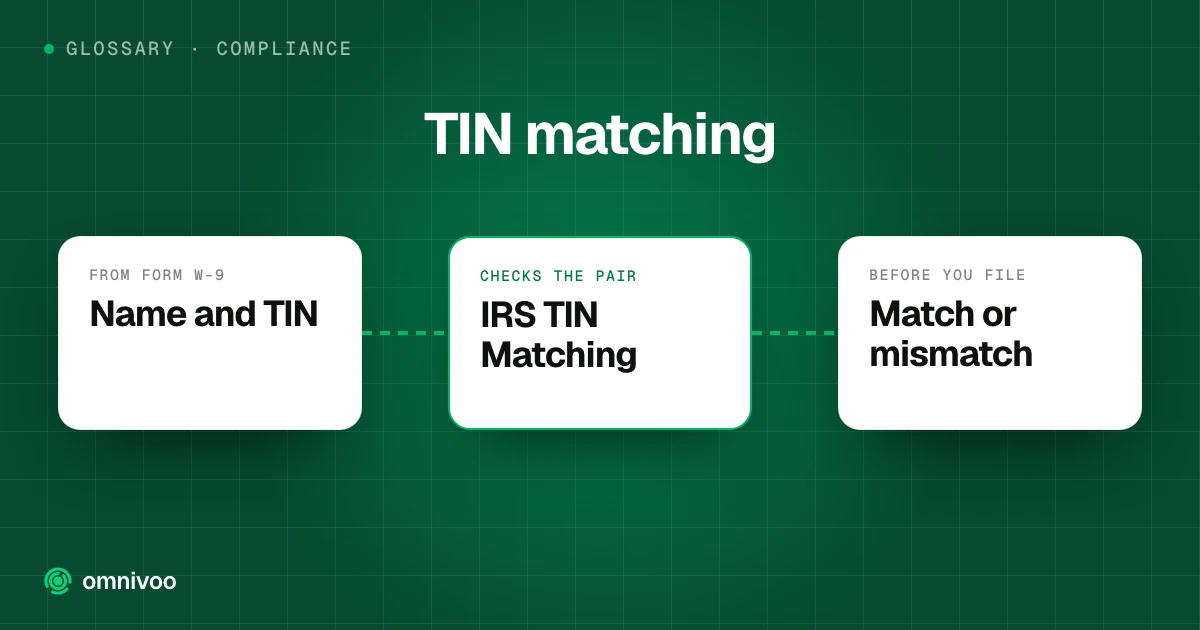
TIN Matching is a pre-filing service in IRS e-Services that lets an authorized payer confirm a payee’s name and taxpayer identification number combination matches IRS records before the payer files an information return. The IRS describes it as “a pre-filing service only offered to payers and/or their authorized agents who submit information returns.” Getting the name and TIN right before filing is what keeps a 1099 clean and keeps the payer out of the backup withholding correction cycle.
A payer who is enrolled in IRS e-Services and listed on the IRS Payer Account File submits a payee’s name and TIN and receives a match indicator showing whether the pair matches IRS records. The IRS offers two methods:
The check covers payees on the information returns subject to backup withholding, including Forms 1099-INT, 1099-DIV, 1099-MISC, 1099-NEC, 1099-B, 1099-K, and 1099-PATR.
TIN Matching exists to head off backup withholding. The IRS states a payer “is required to withhold at the current rate of 24 percent” when a payee “failed to provide a correct taxpayer identification number (TIN) to the payer for reporting on the required information return,” per the IRS backup withholding page.
When a filed return carries a missing or mismatched name and TIN, the IRS sends the payer a CP2100 or CP2100A notice. Per the IRS, “We issue a CP2100 when the payer has filed 50 or more incorrect information returns with errors. We issue a CP2100A when the payer has filed less than 50 information returns with errors,” on the IRS CP2100 page. The notice means “the payee’s name and taxpayer identification number (TIN) on your information return is missing or doesn’t match our records.”
A CP2100 or CP2100A can require the payer to send a B-notice. The First B-notice and a Form W-9 go to a payee the first time the payee appears on such a notice, and the Second B-notice follows if the same payee appears again within a three-year period, per IRS Publication 1281. Confirming the name and TIN with TIN Matching before filing is how a payer avoids landing in this loop.
Omnivoo Contract Management collects each US contractor’s W-9 at onboarding and keeps the certified name and TIN on file, so the data on every information return matches what the payer reports to the IRS.
Backup withholding is a 24 percent federal income tax that a US payer must withhold from certain reportable payments when the payee fails to provide a correct TIN or when the IRS notifies the payer that the payee is delinquent on prior reporting.
An information return is a form a payer files with the IRS, and furnishes to the recipient, to report certain payments made during the calendar year. Examples include Form 1099-NEC, 1099-MISC, 1099-K, W-2, and 1042-S. Most paper information returns are submitted to the IRS under a Form 1096 transmittal.
A Taxpayer Identification Number (TIN) is an identification number used by the Internal Revenue Service in the administration of US tax law. The five types are the SSN, ITIN, EIN, ATIN, and PTIN. An SSN is issued by the Social Security Administration, and all other TINs are issued by the IRS.
A B-notice is the backup withholding notice a payer sends a payee after the IRS issues a CP2100 or CP2100A, which flags that a name and TIN combination on a filed information return does not match IRS records. A First B-notice asks the payee for a correct TIN on a Form W-9, and a Second B-notice within a three-calendar-year period requires the payee to validate the TIN with the SSA or IRS.
Collect the right tax form before you pay, sign a country-aware contract, and pay contractors in 220+ countries and territories. $29 per contractor per month.
Get startedFull details in our Terms of Service →