
The short answer
If you are a US company that just paid a designer in Manila or an engineer in Buenos Aires, the question on your mind is simple. Do I send this person a 1099 at year-end?
In the common case, no. Form 1099-NEC is for payments to US persons. A foreign contractor who has given you a valid Form W-8BEN (for an individual) or Form W-8BEN-E (for an entity) sits outside 1099-NEC reporting. The reporting path for foreign payees is different, and depending on where the work is done, there may be no IRS form to file at all.
This guide gives the full, verified answer, with the IRS citations attached. A quick note before we start. This is general information, not tax or legal advice. Withholding and reporting outcomes turn on the facts of your situation, so confirm the specifics with a qualified tax professional before you pay.
Why a foreign contractor does not get a 1099-NEC
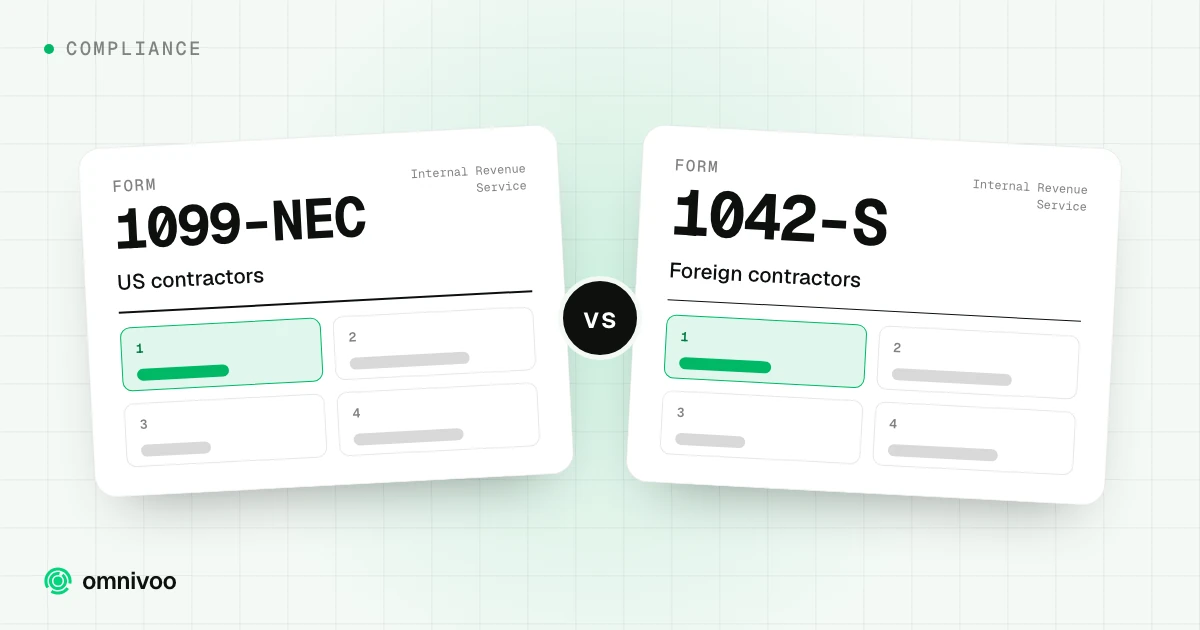
Form 1099-NEC reports nonemployee compensation paid to US contractors. The IRS Instructions for Forms 1099-MISC and 1099-NEC (rev. December 2026) set the reporting trigger at “$2,000 or more” in nonemployee compensation paid during the year, raised from $600 by the One Big Beautiful Bill Act for payments made after 31 December 2025. Either way, the instructions point payers in a different direction for foreign payees. The instructions state plainly: “Use Form 1042-S, Foreign Person’s U.S. Source Income Subject to Withholding, for payments to nonresident aliens.”
That single line is the heart of the answer. A foreign contractor is not a US person, so the 1099-NEC machinery does not apply to them. The form you might owe instead is Form 1042-S, and only when the income is US-source. We will get to that distinction in a moment.
The piece that makes this clean is documentation. You collect a W-8BEN from a foreign individual, or a W-8BEN-E from a foreign company, to establish that the payee is foreign. With a valid form on file, you are treating the payment as one made to a foreign person, which is exactly what keeps it out of the 1099-NEC bucket. If you have not collected the form yet, work through our W-8BEN collection checklist before your next payment. It is free, instant, and walks the six steps with the IRS citations attached.
So what does a foreign contractor get instead, Form 1042-S?
Maybe. Form 1042-S is the information return for US-source income paid to a foreign person, and the payer files Form 1042 to report the tax. The IRS About Form 1042-S page describes it as the return for a “Foreign Person’s U.S. Source Income Subject to Withholding.”
Read that title carefully. The form is for US-source income. That word “US-source” is doing all the work, and it is the difference between filing a 1042-S and filing nothing.
The key distinction: where is the work performed?
This is the rule that decides the whole question. The source of personal service income follows where the work physically happens. The IRS source-of-income rule for personal services states: “The place, where the personal services are performed, generally determines the source of the personal service income, regardless of where the contract was made, or the place of payment, or the residence of the payer.”
So it does not matter that your company is in Delaware, that the contract was signed in the US, or that you paid from a US bank account. What matters is where the contractor sat while doing the work.
That gives two outcomes.
Work done entirely outside the US is foreign-source. And foreign-source income paid to a foreign person is not reported on a 1042-S either. The IRS page “Foreign Source Income - Form 1042-S Reporting Not Required” states: “Foreign source income (non-U.S. source income) paid to a nonresident alien is normally not subject to U.S. tax under either chapter 3 or 4… It is normally not required to be reported on an information return.”
Work done inside the US is US-source. That portion may be subject to 30% NRA withholding, possibly reduced by a tax treaty, and it is reported on Form 1042-S, with the payer filing Form 1042. Get tax advice on any in-US portion before you pay it.
Putting it together: the common case
Here is the situation most US payers are actually in. You hire a foreign individual. They do all their work from their home country. You have a valid W-8BEN on file before the first payment.
In that case:
- No 1099-NEC. The 1099-NEC is for US persons, and your contractor is foreign.
- No 1042-S. The income is foreign-source, because the work was performed outside the US, and foreign-source income paid to a foreign person is normally not reported on an information return.
- Generally no US withholding. Foreign-source income is normally not subject to US tax under chapter 3 or chapter 4.
You still collect the W-8BEN. Not because you file it anywhere, but because it documents the contractor’s foreign status and supports the no-1099, no-1042-S treatment if you are ever asked to back it up. The form stays in your records.
The exception is the in-US work portion. If your contractor flies to the US for a sprint, or otherwise performs services on US soil, that slice of the pay is US-source. It may require Form 1042-S and 30% withholding, which a tax treaty may reduce. The moment any work moves inside US borders, the analysis changes for that portion, so flag it early.
When you DO send a 1099-NEC
To keep the contrast clear: a US person gives you Form W-9, and you report payments to them on a 1099-NEC once you cross the threshold.
A US person is a US citizen, a green-card holder, or a resident alien who meets the substantial presence test. Notice that this is about status, not location. A US citizen freelancing from Lisbon is still a US person and still gives you a W-9, not a W-8BEN. They get a 1099-NEC over the reporting threshold like any domestic contractor, per the IRS Instructions for Forms 1099-MISC and 1099-NEC.
So the very first thing to settle for any contractor, before you decide on any form, is whether they are a US person or a foreign person. That one answer routes everything else.
A quick decision path
Three questions, in order, for any contractor you pay:
- Is the contractor a US person? If yes, collect a W-9 and plan to issue a 1099-NEC over the reporting threshold. Stop here.
- If foreign, is there a valid W-8BEN or W-8BEN-E on file? Collect it before the first payment. This documents foreign status and keeps the payment out of 1099-NEC reporting.
- Where is the work performed? All outside the US means foreign-source, generally no 1042-S and generally no withholding. Any inside the US means that portion is US-source and may need a 1042-S with 30% withholding, possibly treaty-reduced.
Run those three and you have the right answer for almost every contractor relationship.
How this fits the wider payment workflow
Deciding the 1099 question is one part of paying a foreign contractor cleanly. The companion piece is the collection itself, which we cover step by step in how to collect a W-8BEN from a foreign contractor. The tax treatment above is consistent across markets, but each country layers on its own registration, invoicing, and payment-rail detail. Two of the most common corridors for US companies:
- Paying Indian contractors from a US company: W-8BEN, the US-India treaty position, and the local rail choice.
- Paying Philippine contractors from a US company: how W-8BEN collection works alongside Philippine registration.
Each guide opens with the same foreign-status step covered here, then layers on the country-specific pieces.
Common mistakes US payers make
A few patterns cause most of the confusion.
Sending a 1099-NEC to a foreign contractor anyway. Some teams treat every contractor the same and mail a 1099-NEC to their freelancer in Brazil. The 1099-NEC is for US persons. A foreign payee with a valid W-8BEN sits outside that reporting, and the right analysis is the 1042-S source-of-income test instead.
Assuming a 1042-S is always required for foreign payees. It is not. The 1042-S is only for US-source income. If the work is done entirely abroad, the income is foreign-source and is normally not reported at all.
Confusing location with status. A US citizen abroad is still a US person and gets a W-9 and a 1099-NEC. A foreign national is still foreign even if they hold a US bank account. Citizenship and residency decide the path, not where the person happens to live.
No W-8BEN on file. Without the form, you cannot cleanly document foreign status, which can push the payment toward default withholding and backup-withholding treatment. Collect it before the first payment.
When a platform handles it for you
A US founder paying one foreign contractor can run this analysis by hand. A US team paying contractors across several countries is tracking forms, expiry dates, source-of-income calls, and treaty positions, and that is where the manual approach starts to leak.
Omnivoo Contract Management handles it for $29 per contractor per month. We collect the right tax form, W-8BEN for individuals and W-8BEN-E for entities, run the KYC, draft and manage the contract, and pay your contractors in 220+ countries and territories, end to end. Transaction fees are passed through at cost, with competitive FX and no fee for contractors, cancel anytime.
Want the answer for your specific setup? See how Omnivoo Contract Management handles foreign contractors end to end, or talk to our team.