
Why this guide exists
Indian software talent is the single largest external workforce that US companies tap into. Most US founders we talk to pay their first Indian contractor within 90 days of starting to hire. They almost always get the tax forms half right, the GST piece confused, and the FX rail wrong.
This guide walks through the full stack: what the US side requires, what the Indian side requires, and how to wire the payment without losing 4 percent to intermediary banks.
US side: what you need to do as the payer
Step 1. Collect a W-8BEN before the first payment
The first action is non-negotiable. Before the first invoice is paid, the contractor must complete Form W-8BEN and return it to you. The form certifies the contractor is the beneficial owner of the income and is a tax resident of India, not the US.
“Give Form W-8 BEN to the withholding agent or payer if you are a foreign person and you are the beneficial owner of an amount subject to withholding. Submit Form W-8 BEN when requested by the withholding agent or payer whether or not you are claiming a reduced rate of, or exemption from, withholding.”
The W-8BEN is valid for three calendar years after signature, after which it must be refreshed. Before you pay, run through our W-8BEN collection checklist to make sure the form is complete.
If your contractor operates through a registered Indian company or LLP, the form is W-8BEN-E (the entity equivalent) instead.
Step 2. Confirm the work is performed outside the US
This is the question that determines almost everything else. Under IRS source of income rules for personal services, services are sourced to the place where they are physically performed. If your contractor does all the work from her home in Pune, the income is Indian source income from the US perspective.
This is the part that surprises most founders. If your Indian contractor never sets foot in the US, you do not withhold US tax, you do not file Form 1042-S for the payment, and you do not file a 1099-NEC either (1099-NEC is only for US person payees).
If the contractor visits the US for a sprint or onsite work, the days spent in the US must be allocated as US source income and treated under the rules for foreign contractor payments performed in the US.
Step 3. Know the treaty for the edge cases
The US-India income tax treaty governs the cases where your payment generates US source income. The IRS technical explanation of the treaty walks through how each article applies.
Article 15 covers independent personal services. Article 12 covers royalties and fees for included services. The Article 12 cap is generally 15 percent withholding for royalties and fees for included services paid to an Indian resident. If you are paying for software development services that include a transfer of intellectual property, this is the article that may bite if you misallocate.
For services payments where US withholding does apply, the contractor files Form 8233 to claim treaty benefits on the services portion. For royalty type payments, the contractor relies on Form W-8BEN with the relevant treaty article number entered in Part II of the form.
India side: what your contractor handles
This is where US founders get confused. You as the US payer are not in scope for most Indian taxes. The Indian contractor is. But it helps to understand the landscape so you can have an informed conversation when the contractor asks for specific invoice fields or documents.
TDS does not apply to a US payer with no Indian PE
Sections 194J and 194C of the Indian Income Tax Act require Indian payers to withhold TDS on payments to Indian contractors for professional and contractual work. 194J applies at 10 percent on professional fees. 194C applies at 1 percent to individuals and HUFs and 2 percent to other entities for work contracts. The 194C thresholds are Rs 30,000 per single payment and Rs 1,00,000 per financial year for aggregate payments.
These sections apply to a person resident in India or to a foreign company with an Indian PE. A US company with no Indian operations is generally not required to deduct Indian TDS at source. The contractor accounts for their own income tax through their personal Indian tax return.
If you do happen to have an Indian entity, an Indian PE, or you use an Indian Contractor of Record (CoR) arrangement, TDS becomes an issue. Our explainer on Contract Management vs Contractor of Record covers when CoR is the right approach.
GST and export of services
If your contractor is GST registered (mandatory above the Rs 20 lakh services threshold in most states), the next question is whether the services qualify as exports. Under the Indian GST framework, a service is an export when the supplier is in India, the recipient is outside India, the place of supply is outside India, the payment is received in convertible foreign exchange, and the supplier and recipient are not establishments of the same person.
Exports of services are zero rated under the IGST Act. The contractor can either pay IGST and claim a refund, or file a Letter of Undertaking on the GST portal and invoice without IGST. Most freelancers file the LUT annually because it avoids the cash flow tied up in IGST refunds.
For you as the US payer, none of this is your problem. But the contractor will ask you to ensure the invoice clearly shows the service is performed in India for an export recipient (your US company).
FEMA, FIRC, and RBI purpose codes
When your USD payment lands in the contractor’s Indian bank account, the bank converts it to INR and credits the account. Under the Foreign Exchange Management Act framework, every foreign inward remittance must be tagged with an RBI purpose code that describes why the funds were received.
For software consultancy and implementation work, the relevant code is P0802. For business and management consultancy, the code is P1006. The bank assigns the code based on the documents the contractor provides (invoice, contract, SWIFT message details).
The bank then issues an electronic FIRC, also called FIRA in newer formats. This is the proof the contractor needs to: claim GST zero rating, defend the foreign source nature of the income for Indian tax, and demonstrate FEMA compliance during an audit.
Service export proceeds must be realized in India within nine months of the invoice date under RBI rules. If your contractor is consistently slow to invoice and you delay payment, the contractor faces an FEMA exposure, not you.
The payment rail decision
There are four real options for paying an Indian contractor from a US bank account.
SWIFT through your US bank. The universal rail. Cost: typically $25 to $50 sender fee plus intermediary bank deductions (often another $15 to $25) plus an FX margin of 2 to 4 percent applied by the contractor’s bank. Net cost on a $5,000 invoice: $150 to $250 of leakage.
Wise (formerly TransferWise). Routes through local INR banking partners. Quotes the mid-market rate plus a transparent margin (typically 0.4 to 0.7 percent for USD to INR). Settlement: same day to one business day. Generates an FIRC.
Payoneer. Similar model to Wise, with marketplace-style integration. Fees are competitive on larger volumes but higher on small individual transfers. Generates an FIRC.
Stripe Connect. Works if your US company is on Stripe and the contractor is set up as a connected account. Stripe handles the FX conversion and INR settlement. Useful when contractor payments are part of a broader Stripe flow.
For most small US companies paying one to ten Indian contractors, Wise or a comparable specialist is the cleanest option. SWIFT is fine for one-off larger payments where the percentage cost matters less.
Misclassification risk in India
The legal frame in India is different from the US. The Indian Industrial Disputes Act, 1947 and case law from the Supreme Court establish a control-and-integration test. A worker engaged on paper as a contractor can be reclassified as a workman or employee if the substance of the relationship looks like employment: fixed hours, exclusive engagement, integration into the company’s operational hierarchy, no other clients, and so on.
The consequences fall on the principal (your company), even if you have no Indian entity, when the contractor sues for employee benefits. Backdated Provident Fund and ESIC liability are the most common heads of claim.
The mitigations are straightforward: a properly drafted SOW that establishes the contractor relationship in substance, a legitimate scope of work tied to deliverables not time, evidence that the contractor has other clients, and a documented review of misclassification risk at 6, 12, and 24 month checkpoints.
Omnivoo Contract Management bakes these into the SOW template and runs the engagement so misclassification flags are surfaced before they become claims.
End-to-end workflow
Here is the clean version for a US company onboarding its first Indian contractor.
- Send the contractor an SOW that defines deliverables, payment, IP assignment, and termination.
- Collect a signed W-8BEN before any payment moves.
- Confirm the contractor is GST registered and has filed a Letter of Undertaking for the financial year.
- Pick a payment rail (Wise or Payoneer for most cases) and onboard the contractor’s payout details.
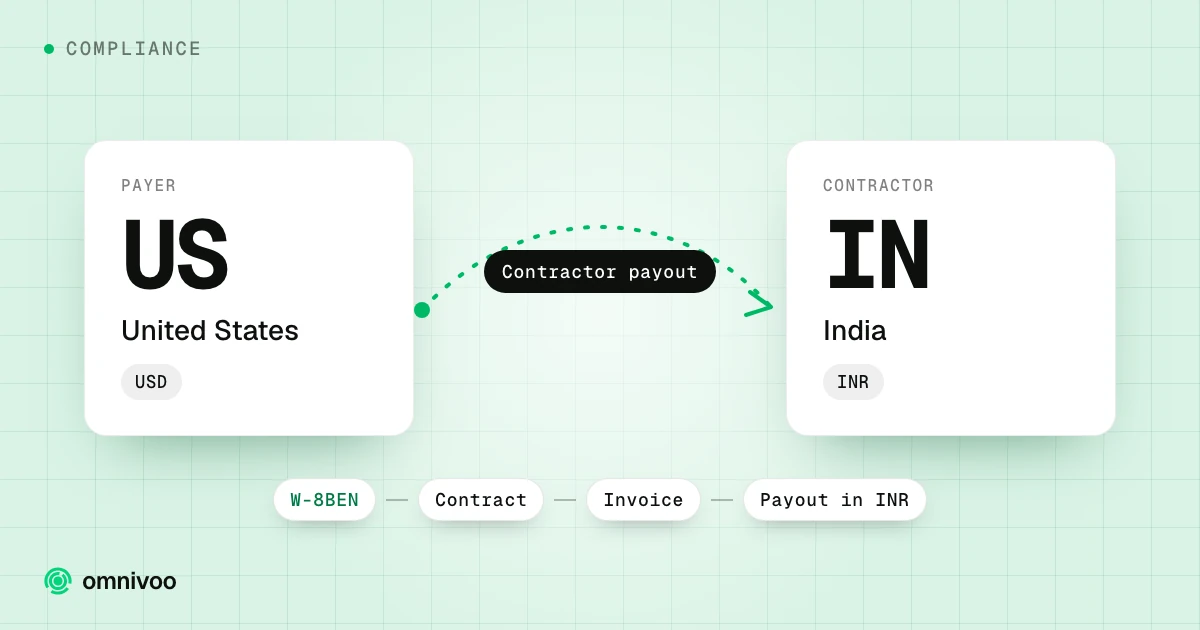
- Pay the invoice on schedule. Keep the W-8BEN, SOW, invoice, and payment receipt together as a packet.
- Review the engagement quarterly for misclassification risk and refresh the W-8BEN every three years.
For ongoing relationships with Indian contractors, also see our guide on contractor vs employee in India for the substantive labour law tests. For the broader framework, see our guide on how to pay international contractors from the US. If you pay contractors elsewhere in the region, see our guides on paying Pakistan, Bangladesh, and Philippines contractors.
When a platform pays for itself
A US founder paying one Indian contractor can do this manually. A US team paying five or more Indian contractors faces enough W-8BEN refreshes, FIRC chases, and FX margin questions that a platform pays for itself.
Omnivoo Contract Management costs $29 per contractor per month. We draft the SOW with India-specific IP and misclassification clauses, collect the W-8BEN, run the FX payment through a local INR rail, ensure the FIRC lands in the contractor’s records, and store the full packet for audit. Transaction fees are passed through at cost.
If the contractor is really doing employee-shaped work, Omnivoo Employer of Record for India starts at $99 per employee per month and converts the relationship into a compliant full-time hire with PF, ESI, TDS, and Form 16 handled end to end.
If you would rather just see pricing in one place, our pricing page lays out both products against each other.
A simple sanity check
Three questions for every Indian contractor relationship.
- Is there a signed W-8BEN on file?
- Will all the work be performed in India for the foreseeable future?
- Are we paying through a rail that generates FIRC and avoids SWIFT correspondent leakage?
If yes to all three, you are 95 percent of the way to a clean US-India contractor payment stack. The remaining 5 percent is misclassification hygiene over time.
Want to skip the assembly entirely? See how Omnivoo Contract Management handles Indian contractors end to end, or talk to our team about your specific setup.