
Why this guide exists
Pakistani software talent has scaled rapidly. The country produces a large pool of competent backend, frontend, and DevOps engineers, with rates that are often 30 to 40 percent lower than India for comparable seniority. English proficiency in tech is high. The pain points sit elsewhere: SBP’s evolving FX regime, the FBR’s treatment of freelance and IT export income, and a payment landscape where PayPal Personal does not exist for receiving funds.
This guide walks through the full stack for US companies paying their first Pakistani contractor.
US side: what you do as the payer
Step 1. Collect a W-8BEN before the first payment
The contractor completes Form W-8BEN certifying Pakistani tax residency and beneficial ownership of the income. The form is valid from signature through December 31 of the third following calendar year. Before you pay, run through our W-8BEN collection checklist to make sure the form is complete.
If the contractor operates through a Pakistani Private Limited or Single Member Company, the form is W-8BEN-E.
Step 2. Confirm services are performed in Pakistan
The decisive question. Under IRS rules on source of income for personal services, services are sourced to the country where the work is physically performed. A developer in Lahore, Karachi, or Islamabad working entirely from Pakistan generates Pakistani source income from the US perspective.
Services performed outside the US by a nonresident alien are foreign source income and are not subject to US withholding or Form 1042-S reporting. You also do not file a 1099-NEC because 1099-NEC applies only to US person payees.
If the contractor visits the US for onsite work, days inside the US must be allocated to US source income.
Step 3. Know the US-Pakistan tax treaty for the edge cases
The US-Pakistan Income Tax Convention was signed at Washington on July 1, 1957, with instruments of ratification exchanged in Karachi on May 21, 1959. The treaty is still in force and Pakistan is on the IRS A-to-Z list of US income tax treaties.
“The United States has tax treaties with a number of foreign countries. Under these treaties, residents (not necessarily citizens) of foreign countries are taxed at a reduced rate, or are exempt from U.S. taxes on certain items of income they receive from sources within the United States.”
Article 11 of the 1957 treaty addresses personal (including professional) services. Under the treaty framework, a Pakistani resident is generally taxable only in Pakistan on personal service income unless they have a fixed base regularly available in the US. The treaty is older than most current treaties and lacks some of the modern provisions (no fixed limitation on benefits article, no exchange of information modernization), but it is still operative for treaty claims.
For services payments where US withholding applies, the contractor files Form 8233 to claim treaty benefits on the services portion. For royalty or other FDAP, the contractor uses W-8BEN with the relevant article number in Part II.
Pakistan side: what the contractor handles
The Pakistani piece is the contractor’s responsibility, not yours. Understanding it helps you talk through invoice fields and documentation requests.
NTN and FBR registration
The Federal Board of Revenue (FBR) administers federal taxes. Each taxpayer is issued an NTN (National Tax Number), now in the form of the CNIC (Computerized National Identity Card) number for individuals. Annual income tax returns are filed on the IRIS portal.
Individual income tax slabs FY 2025-26
For tax year 2025-26 (July 1, 2025 to June 30, 2026), the salaried individual tax slabs are:
- Up to PKR 600,000: 0 percent
- PKR 600,001 to PKR 1,200,000: 1 percent of amount over PKR 600,000
- PKR 1,200,001 to PKR 2,200,000: PKR 6,000 plus 11 percent of amount over PKR 1,200,000
- PKR 2,200,001 to PKR 3,200,000: PKR 116,000 plus 23 percent of amount over PKR 2,200,000
- PKR 3,200,001 to PKR 4,100,000: PKR 346,000 plus 30 percent of amount over PKR 3,200,000
- Above PKR 4,100,000: PKR 616,000 plus 35 percent of amount over PKR 4,100,000
A 9 percent surcharge on tax applies for taxable salary above PKR 10,000,000. Non-salaried individuals (business income, professional services) face a separate, generally higher slab structure under the same FBR framework.
Concessional 0.25 percent tax on IT exports
This is the part most relevant to US companies hiring Pakistani contractors. Under Section 154A of the Income Tax Ordinance 2001, IT and IT-enabled services exports receive concessional treatment. A freelancer registered with the Pakistan Software Export Board (PSEB) pays a final tax of 0.25 percent of gross export receipts, subject to conditions. A non-PSEB registered freelancer typically pays 1 percent of gross export receipts as a final tax.
The conditions include receipt of payment in foreign currency through approved banking channels, registration with FBR, and filing the annual return. At least 80 percent of export proceeds must be received through approved banking channels in Pakistan. This regime is among the most generous in the region for freelance IT income.
Provincial sales tax on services
Sales tax on services is provincial in Pakistan. Each province has its own revenue authority:
- Punjab Revenue Authority (PRA): 16 percent general rate
- Sindh Revenue Board (SRB): 15 percent general rate
- Khyber Pakhtunkhwa Revenue Authority (KPRA)
- Balochistan Revenue Authority (BRA)
- Islamabad Capital Territory under FBR: 15-16 percent
For exports of services to foreign recipients, each provincial law provides for zero rating or exemption when the recipient is outside Pakistan, the payment is received in foreign currency, and other documentation requirements are met. Your contractor invoices in USD with no provincial sales tax charged, subject to the export documentation.
SBP foreign exchange rules
The State Bank of Pakistan maintains the Foreign Exchange Manual. Inward remittances have no general restriction. Under Chapter 10 of the FE Manual and SBP facilitation circulars for IT exporters and freelancers:
- Form R, the prescribed declaration for inward remittances, is required only above USD 25,000 per transaction after SBP’s facilitation measures.
- A one-time declaration of the nature of services is required at account opening.
- Purpose codes are applied by the receiving bank to each inward transaction.
For freelancers, SBP introduced the Exporters Special Foreign Currency Account (ESFCA), allowing IT and IT-enabled services exporters to retain up to 50 percent of foreign exchange earnings in foreign currency. Some banks (Bank Islami, Faysal Bank, Meezan Bank) offer dedicated IT Exporter / Freelancer accounts with the ESFCA feature.
Roshan Digital Account: not for residents
The Roshan Digital Account (RDA) is an SBP-launched product for non-resident Pakistanis. It is not available to resident freelancers. The RDA is sometimes mentioned in articles about Pakistani contractor payments by mistake. A US founder hiring a freelancer who lives and works in Pakistan should expect the freelancer to use a regular PKR account or an ESFCA, not an RDA.
The RDA matters only when the Pakistani contractor is non-resident, such as a Pakistani national living abroad and providing services from there. In that less common case, the contractor’s USD receipts can flow into the RDA freely.
The payment rail decision
Four real options for paying a Pakistani contractor from a US bank account.
SWIFT through your US bank. The universal rail. Cost: USD 25 to USD 50 sender fee plus intermediary deductions (USD 15 to USD 25) plus an FX margin of 2 to 3 percent at the contractor’s bank. Net leakage on a USD 5,000 invoice: USD 150 to USD 220.
Wise. Routes through local PKR banking partners. Mid-market rate plus a transparent margin (typically 0.6 to 1.0 percent for USD to PKR). Same day to one business day.
Payoneer. Widely used by Pakistani freelancers on Upwork and Fiverr. Withdraw-to-local-bank model with competitive fees.
PayPal Business. PayPal Personal is not available in Pakistan for receiving payments. PayPal Business operates via local partners but is not the dominant rail.
For most US companies, Wise or Payoneer is the cleanest option. SWIFT works for one-off larger payments.
Misclassification risk in Pakistan
Pakistan’s labour and employment framework includes the Industrial and Commercial Employment (Standing Orders) Ordinance 1968, the Pakistan Industrial Relations Act 2012, and provincial labour laws. The substance-over-form principle applies: a worker engaged on paper as a contractor can be reclassified as an employee if the engagement looks like employment in practice (fixed hours, exclusivity, integration into the principal’s hierarchy, no other clients).
Reclassification consequences include backdated EOBI (Employees’ Old-Age Benefits Institution) contributions, Social Security contributions under the provincial Social Security Institution, and severance under provincial labour laws. The US principal can be drawn into a claim even with no Pakistani entity when the contractor sues for benefits.
The mitigations: a properly drafted service agreement, scope tied to deliverables rather than time, evidence the contractor has other clients, and a periodic review of misclassification risk. Omnivoo Contract Management handles these patterns by default.
End-to-end workflow
The clean version for a US company onboarding its first Pakistani contractor.
- Send the contractor an SOW that defines deliverables, payment, IP assignment, and termination.
- Collect a signed W-8BEN before any payment moves.
- Confirm the contractor is registered with FBR (NTN) and ideally with PSEB for the 0.25 percent IT export rate.
- Pick a payment rail (Wise or Payoneer for most cases).
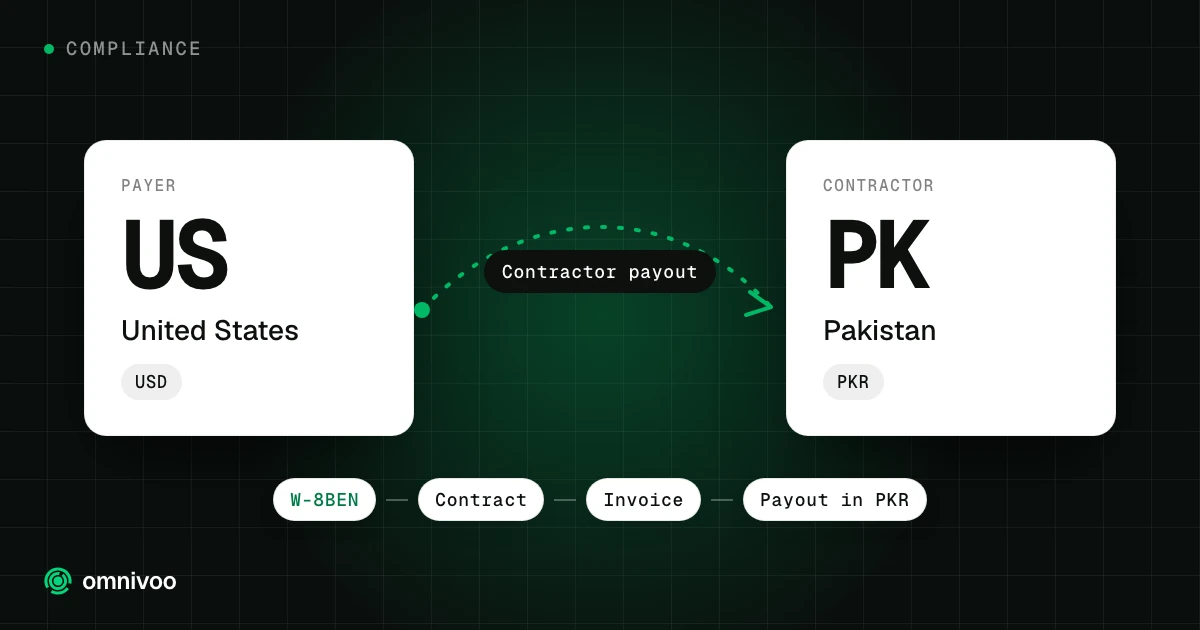
- Pay invoices on schedule. Keep the W-8BEN, SOW, invoice, and payment receipt together.
- Review the engagement quarterly for misclassification risk and refresh the W-8BEN every three years.
For broader context, see our guide on FX margin in international contractor payments and our guide on how to pay international contractors from the US. If you pay contractors elsewhere in the region, see our guides on paying India, Bangladesh, and Indonesia contractors.
When a platform pays for itself
A US founder paying one Pakistani contractor can do this manually. A US team paying five or more Pakistani contractors faces enough W-8BEN refreshes, FX margin questions, and misclassification reviews that a platform pays for itself.
Omnivoo Contract Management handles the SOW with Pakistan-specific IP and misclassification clauses, collects the W-8BEN, runs the FX payment through a local PKR rail, and stores the full packet for audit. Transaction fees are passed through at cost.
For pricing across both Contract Management and Contractor of Record options, our pricing page lays out the products side by side.
A simple sanity check
Three questions for every Pakistani contractor relationship.
- Is there a signed W-8BEN on file?
- Will all the work be performed in Pakistan for the foreseeable future?
- Are we paying through a rail that avoids SWIFT correspondent leakage and produces a clean record?
If yes to all three, you are 95 percent of the way to a clean US-Pakistan contractor payment stack. The remaining 5 percent is misclassification hygiene over time.
Want to skip the assembly entirely? See how Omnivoo Contract Management handles Pakistani contractors end to end, or talk to our team about your specific setup.