
Why W-8BEN collection trips up US companies
You found a great designer in Manila or a great engineer in Buenos Aires. The work is done, the invoice is in, and you are about to pay. The one piece most US founders skip is the tax form, and skipping it is the single most common compliance gap in a global contractor program.
The fix is one form and one short process. For a foreign individual that form is Form W-8BEN, the Certificate of Foreign Status of Beneficial Owner for United States Tax Withholding and Reporting (Individuals), per the IRS About Form W-8BEN page. For a foreign company it is Form W-8BEN-E, the entity version, per the IRS About Form W-8BEN-E page. The form is what proves to the IRS that the contractor is foreign and that you handled the payment correctly.
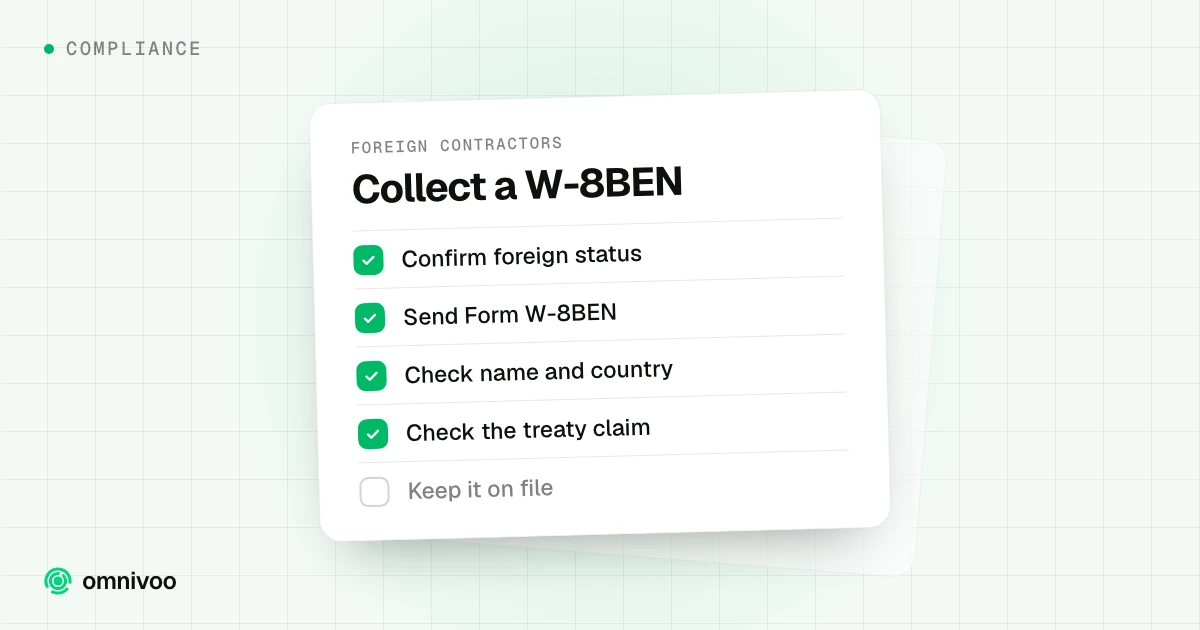
This guide walks the full collection process for a US company in 2026. It is the companion to our interactive checklist. If you want to work through your own contractor right now, use our free W-8BEN collection checklist to go step by step while you read.
A quick note before the steps. This is general information, not tax or legal advice. Withholding and reporting outcomes turn on the facts of your situation, so confirm the specifics with a qualified tax professional before you pay.
The six steps to collect a W-8BEN
Collection is six steps. Get them in this order and you have a clean packet for every foreign contractor.
Step 1. Confirm the contractor is a foreign person
The W-8 family is only for foreign people and foreign entities. A US person, that is a US citizen, green-card holder, or US resident, gives you Form W-9 instead, no matter where they live. Sort this first so you request the right paperwork from the start. If you ask a US citizen abroad for a W-8BEN, you have collected the wrong form and you still owe the W-9.
The cleanest way to settle this is to ask the contractor directly about their tax residency and citizenship before you send any form.
Step 2. Pick the right form
Once you know the contractor is foreign, the choice is about individual versus entity. A foreign individual completes Form W-8BEN. A foreign company or other entity, a corporation, partnership, or foreign LLC, completes Form W-8BEN-E.
Most solo freelancers are individuals and give you a W-8BEN. A contractor who invoices through their own incorporated company is an entity and gives you a W-8BEN-E. When in doubt, ask how they bill you and whether they are incorporated. Our checklist asks these same two questions and lands you on the right form.
Step 3. Request the form before the first payment
Collect the form up front and keep it on file. It does not go to the IRS. The IRS instructions are direct: “Do not send Form W-8BEN to the IRS. Instead, give it to the person who is requesting it from you.” As the payer you are the person requesting it, and you hold it.
Asking after you have already paid is the wrong order. The form should be on file at the time of payment so it documents the foreign status of that payment. Build the request into onboarding, right alongside the contract and the bank details.
Step 4. Verify the form is complete and consistent
A signed form with blanks or mismatches is not much better than no form. Check the basics on a W-8BEN:
- Legal name that matches the contract and the invoice.
- Country of citizenship.
- Foreign permanent residence address. A US address on a W-8BEN is a red flag that needs explaining before you accept the form.
- Date of birth.
- Signature and date.
If the contractor wants to claim a tax treaty benefit, they must also complete Part II. Per the IRS instructions: “To claim certain treaty benefits, you must complete line 5 by submitting an SSN or ITIN, or line 6 by providing a foreign tax identification number (foreign TIN),” along with the treaty country, article, and rate in Part II. A blank Part II simply means no treaty claim is being made.
Step 5. Determine where the work is performed
This is the step that decides whether any US tax is in play. Source of personal service income follows where the work happens. The IRS source-of-income rule states: “The place, where the personal services are performed, generally determines the source of the personal service income, regardless of where the contract was made, or the place of payment, or the residence of the payer.”
So when your contractor does the work entirely outside the US, that income is generally foreign-source. Under the IRS instructions, it is generally not subject to US withholding and generally not reported on Form 1042-S, and a valid W-8BEN documents the foreign status so the payment is generally exempt from Form 1099 and backup withholding.
If some or all of the work is performed inside the US, that portion is US-source income and may be subject to 30% NRA withholding, possibly reduced by a tax treaty, with Form 1042 and Form 1042-S reporting. Get tax advice on the in-US portion before you pay.
Step 6. File it and set a renewal reminder
A W-8BEN does not last forever. Per the IRS instructions, it is valid from the date signed through the last day of the third succeeding calendar year, unless a change in circumstances makes any information on the form incorrect. A form signed in 2026 is generally valid through December 31, 2029.
Two timing rules to diarize. First, the expiry date, so you re-collect before the form lapses. Second, the 30-day rule: if the contractor’s circumstances change, for example they move to the US and become a US resident, they must notify you within 30 days and give you a new form. Store the signed form with the contract, the invoices, and the payment receipts as one packet per contractor.
Worked through it? Use the interactive checklist
Reading the six steps is one thing. Working them for a real contractor is faster with a checklist you can tick off. Our W-8BEN collection checklist asks the two questions that pick the right form, then walks the same six steps with the IRS citations attached. It is free, instant, and stores nothing.
How collection fits the bigger payment workflow
Collecting the W-8BEN is one part of paying a foreign contractor cleanly. The full picture is covered in our two pillar guides: how to pay international contractors from a US company walks the classification, tax, and payment-rail decisions end to end, and how to pay contractors in 220+ countries and territories lays out a process that scales from your first hire to a worldwide team. For the wider country-by-country picture, start at our how to pay contractors.
The tax treatment is consistent across markets, but each country adds its own contractor registration, invoicing, and payment-rail detail. A few of the most common corridors for US companies:
- Paying Indian contractors from a US company: W-8BEN, the US-India treaty position, and the local rail choice.
- Paying Philippine contractors from a US company: how W-8BEN collection works alongside Philippine registration.
- Paying Argentine contractors from a US company: W-8BEN with the monotributo regime and FX controls.
Each guide opens with the same W-8BEN step covered here, then layers on the country-specific pieces.
Common W-8BEN collection mistakes
A handful of patterns cause most of the trouble.
No form on file. The company paid a foreign contractor for months without ever collecting a W-8BEN. Without it you cannot prove foreign status, which can flip the contractor into default withholding treatment.
Wrong form for the payee. An individual was sent the entity W-8BEN-E, or an incorporated contractor signed the individual W-8BEN. The two are not interchangeable. Settle the individual-versus-entity question in step two.
Blank Part II but a treaty claim expected. The contractor assumed a treaty rate applied but left Part II empty, with no TIN and no treaty article. With nothing in Part II, no treaty claim is made.
Letting the form expire. A W-8BEN signed years ago is treated as stale once it passes the third calendar year after signing. Set the reminder in step six so you re-collect on time.
Accepting a US address without question. A US permanent or mailing address on a W-8BEN undercuts the foreign-status claim and needs to be resolved before you rely on the form.
When a platform does the collection for you
A US founder paying one foreign contractor can run these six steps by hand. A US team paying five or more contractors across several countries is tracking multiple forms, multiple expiry dates, and multiple treaty positions, and that is where the manual approach starts to leak.
Omnivoo Contract Management handles it for $29 per contractor per month. We collect the right form, W-8BEN for individuals and W-8BEN-E for entities, run the KYC, draft and manage the contract, track the renewal dates, and pay your contractors in 220+ countries and territories, end to end. Transaction fees are passed through at cost, with competitive FX and no fee for contractors, cancel anytime.
A simple sanity check
Three questions for every foreign contractor relationship.
- Is the right form on file, a W-8BEN for an individual or a W-8BEN-E for an entity, and is it less than three years old?
- Is the form complete: legal name, country of citizenship, foreign address, signature and date, plus a TIN and treaty article in Part II if a treaty benefit is claimed?
- Will all the work be performed outside the US for the foreseeable future, keeping the payment generally foreign-source?
If yes to all three, your W-8BEN collection is in good shape. The remaining work is the renewal reminder and watching for any change in circumstances.
Want to skip the assembly entirely? See how Omnivoo Contract Management handles foreign contractors end to end, or talk to our team about your specific setup.