
Why this guide exists
Argentina has been a strange place to pay contractors for the past six years. The combination of high inflation, a peso that lost roughly 80 percent of its USD value in 2023 alone, and a multi-tier exchange rate system (official rate, MEP, CCL, blue) made the question of “how do I actually get USD to my Argentine developer” surprisingly hard.
A lot has changed. In April 2025 the Milei government lifted most of the cepo cambiario currency controls for individuals, the parallel rates converged with the official rate, and the situation normalised materially. USD payments to Argentine contractors are now much more straightforward in 2026 than they were in 2024.
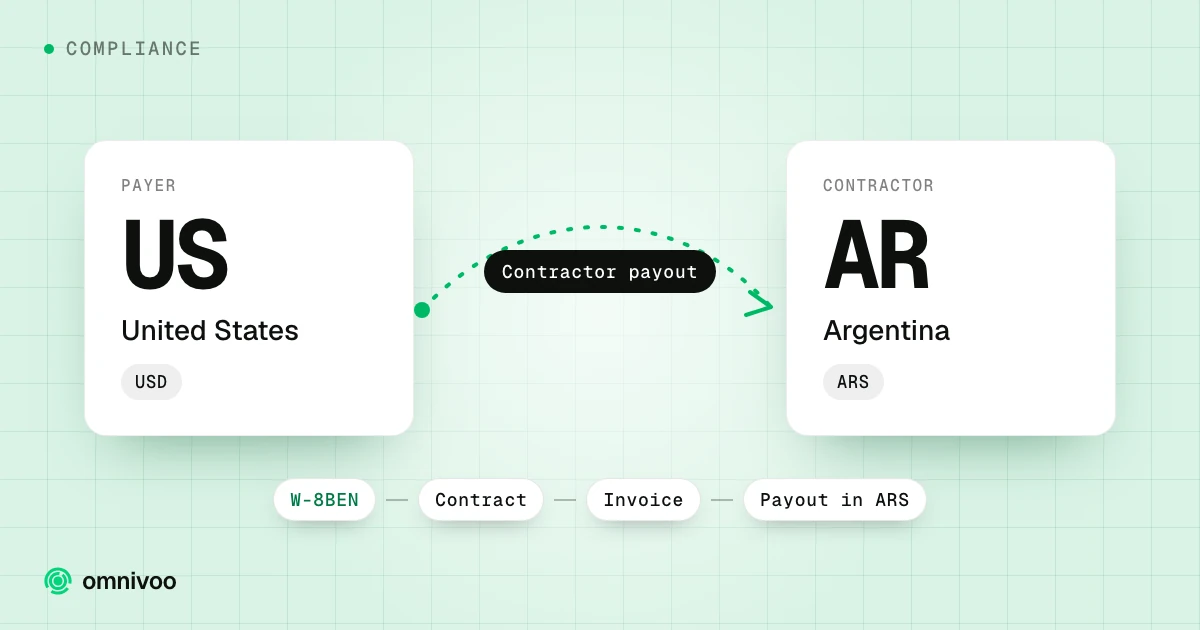
This guide covers what a US company needs to know to pay Argentine contractors cleanly in this new environment. We cover the US side (W-8BEN, source rules), the Argentina side (Monotributo, IVA, Ingresos Brutos), the FX context, and the payment rail decision. If you want to skip the assembly and let a platform handle it, Omnivoo Contract Management handles SOW drafting, W-8BEN collection, invoice capture, and USD or ARS settlement for $29 per contractor per month.
US side: what you need to do as the payer
Step 1. Collect a W-8BEN before the first payment
Before any invoice is paid, the Argentine contractor must complete Form W-8BEN and return it to you. The form certifies the contractor is the beneficial owner of the income, is a tax resident of Argentina, and is not a US person. Run through our W-8BEN collection checklist before you pay to make sure the form is complete.
The W-8BEN is valid for three calendar years after signature and must be refreshed when it expires or when a relevant fact changes. If your contractor operates through a registered Argentine company (SRL or SA), the form is W-8BEN-E, the entity equivalent.
Part II of the W-8BEN (treaty benefits) is left blank for Argentine contractors because there is no US-Argentina tax treaty.
Step 2. Confirm the work is performed in Argentina
Under IRS source of income rules for personal services, services income is sourced to the place where the services are physically performed. If your Argentine contractor does the work entirely from Buenos Aires, Cordoba, or Rosario, the income is Argentine source income from the US perspective.
This is the part that surprises most founders given the lack of a treaty. Treaty or no treaty, foreign source income is not subject to US tax in the first place. The treaty matters only when the income is US source. For an Argentine contractor doing all work in Argentina, the result is identical to a treaty-country contractor: no withholding, no 1042-S, no 1099-NEC.
If the contractor visits the US for an onsite sprint, the days physically worked inside the US are US source days. Without a treaty, the Argentine contractor cannot claim a treaty exemption on those US source days, so any US source income above the de minimis threshold becomes subject to default 30 percent FDAP withholding.
Step 3. Understand what the absence of a treaty actually changes
The IRS A-to-Z list of US income tax treaties does not list Argentina, confirming there is no treaty in force as of 2026.
“The United States has tax treaties with a number of foreign countries. Under these treaties, residents (not necessarily citizens) of foreign countries are taxed at a reduced rate, or are exempt from U.S. taxes on certain items of income they receive from sources within the United States.”
For a typical pure services engagement where the Argentine contractor never sets foot in the US, the absence of a treaty is a non-event. The contractor pays Argentine income tax (or Monotributo) on the income and the US side has no withholding or reporting obligation. The lack of a treaty matters only in narrow cases involving US source income (US-physical work days, US source royalties).
Argentina side: what your contractor handles
You as the US payer are not in scope for most Argentine taxes. The Argentine contractor is. But understanding the landscape helps you have an informed conversation when the contractor asks for specific invoice fields or your tax ID, especially around Monotributo limits and IVA treatment.
CUIT, CUIL, and tax registration with AFIP
Every Argentine taxpayer who provides services or sells goods needs to register with AFIP (Administracion Federal de Ingresos Publicos), now operating as ARCA and obtain a CUIT (Clave Unica de Identificacion Tributaria). The CUIT is the tax ID that appears on every invoice the contractor issues.
A Monotributista freelancer registered as a natural person uses their CUIT for invoicing. A contractor operating through an Argentine SRL or SA uses the entity’s CUIT.
Monotributo: the simplified regime most freelancers use
Monotributo is Argentina’s simplified single-tax regime for small taxpayers. It unifies income tax, IVA, and social security contributions (jubilacion and obra social) into one monthly cuota.
The regime has categories from A through K, with each category corresponding to an annual gross revenue cap. Categories are recalibrated by AFIP at least twice a year to account for inflation. As of the most recent AFIP scales (effective February 2026), the lowest service-provider categories start at single-digit-million ARS annual revenue caps and the top service category H has a higher cap. For exact current values, see the AFIP Monotributo categorias page.
Service providers can be Monotributistas in categories A through H. Product sellers (vendors of bienes) can also be in categories I, J, and K. Above the top service category cap, the contractor must migrate to the Regimen General (the standard PIT and IVA regime).
For you as the US payer, the practical takeaway is: most Argentine freelancers earning a moderate USD income are Monotributistas. They will send you a Factura C (Monotributo invoice for services to a final consumer or non-IVA-registered party) or a Factura E (export invoice). The invoice does not break out IVA because Monotributistas do not charge IVA separately.
Regimen General, IVA, and exports of services
Higher-revenue contractors operating under the Regimen General are IVA-registered. Argentina’s standard IVA rate is 21 percent. Exports of services to a foreign recipient generally qualify for an IVA-exempt regime when the service is provided from Argentina, used exclusively outside Argentina, and the recipient has no Argentine establishment. AFIP requires the contractor to document this with a Factura E and the supporting export-of-services records.
For you as the US payer, IVA is not your liability. You pay the gross invoice amount in the currency stated on the invoice. The contractor handles their IVA filings.
Ingresos Brutos: the provincial turnover tax
Ingresos Brutos is a provincial gross revenue tax. Each Argentine province sets its own rates and rules. For service contractors, the typical rate is in the low single digits, but most provinces exempt exports of services or apply a zero rate when the contractor documents the export.
Buenos Aires Province, City of Buenos Aires, Cordoba, and Santa Fe each have their own regimes. The contractor’s accountant handles this. You do not pay or recover Ingresos Brutos.
Argentine PIT for Regimen General contractors
Argentine tax residents pay PIT on worldwide income at progressive rates. For Monotributistas, PIT is embedded in the monthly cuota and the contractor does not file a separate income tax return for the Monotributo income. For Regimen General contractors, PIT is filed annually on their gross income (less deductible expenses), with monthly anticipos paid throughout the year.
You as the US payer do not need to track which path the contractor takes. You only need to make sure they can issue you a valid Factura C or Factura E for each payment.
The FX context: what changed in 2025
For roughly six years (2019 to 2024) Argentina had a cepo cambiario system of strict currency controls. Individuals could only buy small amounts of USD per month at the official rate, and US payments received in USD were often converted to ARS at the official rate automatically by the contractor’s bank, well below the prevailing parallel rates (MEP, CCL, or blue).
In April 2025 the Milei administration lifted most of the cepo cambiario for individuals. The MEP and CCL parallel rates converged with the official rate, and unlimited USD purchases for savings became available without prior BCRA approval. The peso now floats within a wide band managed by the central bank.
For your Argentine contractor in 2026, this means:
- They can hold USD in an Argentine bank account or convert to ARS at the market rate without the multi-tier rate gap.
- They can receive USD via foreign payment providers (Wise, Payoneer) and route it into their preferred USD account.
- They can buy and sell USD through MEP or CCL operations without time-window restrictions.
The pre-2025 workaround of receiving payment via crypto or holding funds in offshore USD accounts (Mercury, Wise USD) is no longer the only viable option, though many contractors still prefer it for tax-planning and inflation-hedging reasons.
The payment rail decision
There are four real options for paying an Argentine contractor from a US bank account in 2026.
| Rail | Typical FX margin | Speed | Notes |
|---|---|---|---|
| US bank SWIFT wire to ARS account | 2 to 4 percent plus bank conversion | 2 to 4 business days | Highest leakage |
| Wise USD to ARS | ~1 to 2 percent | One business day | Lands ARS via bank transfer |
| Payoneer USD to ARS or to USD balance | Tiered | One business day | Contractor can hold USD before converting |
| USD to USD account (Wise USD, Mercury, contractor’s Argentine USD account) | None on the rail | Same day | Contractor controls conversion timing |
For most US companies paying Argentine contractors in 2026, USD-to-USD into a Wise USD, Payoneer USD, or Mercury balance is the cleanest option because it gives the contractor full control over conversion timing in an environment where ARS still loses ground over time. Wise USD-to-ARS or Payoneer USD-to-ARS works well for contractors who want immediate local-currency liquidity.
SWIFT is a fallback for one-off larger payments where the percentage cost matters less.
Misclassification risk in Argentina
Argentina’s Ley de Contrato de Trabajo (LCT) presumes an employment relationship when there is subordination, fixed hours, exclusive engagement, and integration into the company’s hierarchy. A worker engaged on paper as a Monotributista contractor can be reclassified as an employee through a labour court action, with retroactive entitlement to severance (preaviso plus indemnizacion), vacation pay, aguinaldo (13th-month salary), and social security contributions to ANSeS.
The consequences fall on the principal (your US company) when the contractor sues, even with no Argentine entity. The mitigations follow the same playbook as the rest of Latin America: a properly drafted services agreement that establishes the contractor relationship in substance, a legitimate scope tied to deliverables not time, evidence the contractor has other clients, and a documented review at six and twelve months.
For more depth, see our guide on drafting an SOW for global contractors. The Omnivoo Contract Management SOW templates bake these protections in by default.
End-to-end workflow
Here is the clean version for a US company onboarding its first Argentine contractor.
- Send the contractor a services agreement that defines deliverables, payment, IP assignment, and termination.
- Collect a signed W-8BEN before any payment moves. Part II is left blank.
- Confirm the contractor has an active CUIT and operates under Monotributo or Regimen General with the capacity to issue a Factura C or Factura E.
- Pick a payment rail. USD-to-USD into a foreign-currency balance the contractor controls is usually the cleanest. USD-to-ARS via Wise or Payoneer works for contractors who want immediate ARS.
- Pay the invoice on schedule. Keep the W-8BEN, services agreement, Factura, and payment receipt together as a packet.
- Review the engagement quarterly for misclassification risk and refresh the W-8BEN every three years.
If you also handle contractors in treaty countries, our Form 8233 treaty exemption guide covers that side for the cases where US source income is involved. For the broader framework, see our guide on how to pay international contractors from the US. If you pay contractors elsewhere in the region, see our guides on paying Brazil, Mexico, and Colombia contractors.
When a platform pays for itself
A US founder paying one Argentine contractor can do this manually. A US team paying five or more Argentine contractors faces enough W-8BEN refreshes, Monotributo category changes, and FX timing decisions that a platform pays for itself within a few months.
Omnivoo Contract Management costs $29 per contractor per month. We draft the services agreement with Argentina-specific IP and misclassification clauses, collect the W-8BEN, capture the Factura on every payment, run the FX payment via USD-to-USD or USD-to-ARS depending on the contractor’s preference, and store the full packet for audit. Transaction fees are passed through at cost.
A simple sanity check
Three questions for every Argentine contractor relationship.
- Is there a signed W-8BEN on file and is it less than three years old?
- Will all the work be performed in Argentina for the foreseeable future?
- Are we paying through a rail that captures the Factura for every invoice and lets the contractor choose USD or ARS settlement?
If yes to all three, you are in great shape on the US-Argentina stack. The remaining work is misclassification hygiene over time and tracking the contractor’s Monotributo category as their revenue grows.
Want to skip the assembly entirely? See how Omnivoo Contract Management handles Argentine contractors end to end, or talk to our team about your specific setup.