
Why this guide exists
Mexico is the closest, largest, and fastest-growing nearshore market for US companies. A typical US startup hiring nearshore engineering, design, or operations talent will pay its first Mexican contractor within 60 days of opening that hiring lane. The tax and invoicing rules are stricter than India or the Philippines, and the CFDI 4.0 electronic invoice requirement is a constant source of confusion for US founders who have never seen a Mexican XML invoice before.
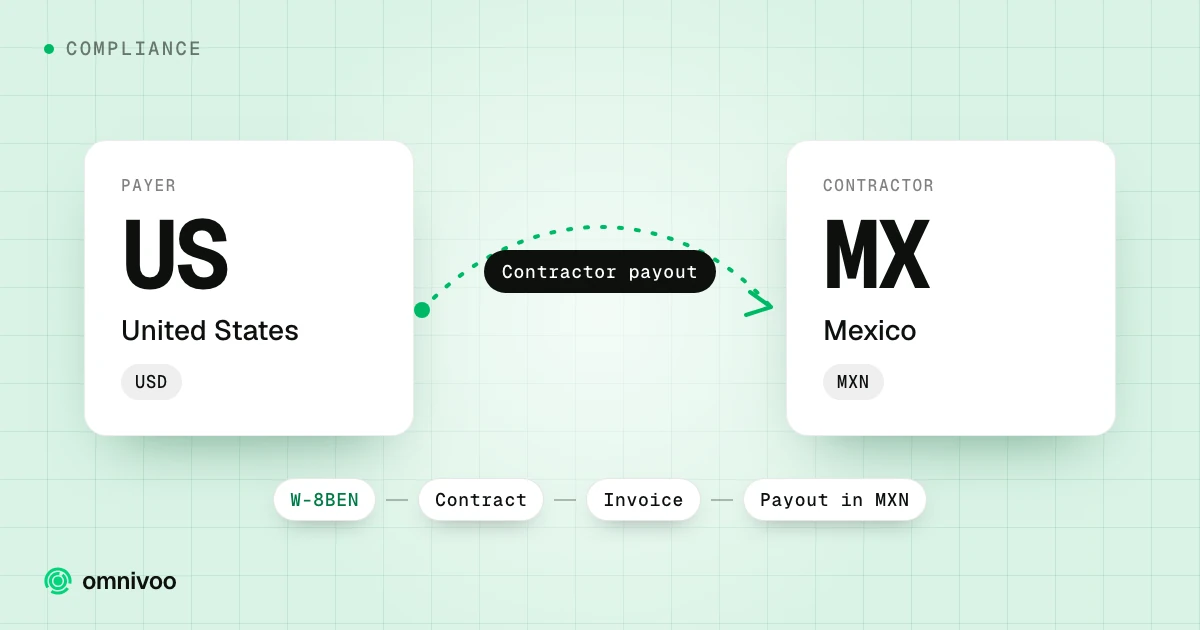
This guide covers the full stack for a US company paying contractors in Mexico. We look at the US side (W-8BEN, treaty application, 1042-S), the Mexico side (RFC, CFDI 4.0, IVA, the tax regime the contractor picks), and the payment rail. By the end you should know exactly what to ask your contractor for and what each document is doing in the chain.
If you want to skip the assembly and let a platform run the whole stack, Omnivoo Contract Management handles SOW drafting, W-8BEN collection, CFDI capture, and SPEI or USD payouts for $29 per contractor per month.
US side: what you need to do as the payer
Step 1. Collect a W-8BEN before the first payment
The first action is non-negotiable. Before any invoice is paid, the contractor must complete Form W-8BEN and return it to you. The form certifies the contractor is the beneficial owner of the income, is a tax resident of Mexico, and is not a US person.
The W-8BEN is valid for three calendar years after signature and must be refreshed when it expires or when a relevant fact changes (address, treaty country, beneficial ownership). If your contractor operates through a registered Mexican company, the form is W-8BEN-E, the entity equivalent. Before you pay, run through our W-8BEN collection checklist to make sure the form is complete.
Step 2. Confirm the work is performed in Mexico
Under IRS source of income rules for personal services, services income is sourced to the place where the services are physically performed. If your Mexican contractor does the work entirely from Guadalajara, Mexico City, or Monterrey, the income is Mexican source income from the US perspective.
The practical takeaway: no withholding, no 1042-S, no 1099-NEC (which is for US persons only). You keep the W-8BEN, the SOW, the CFDI, and the payment receipt as the documentation packet.
If the contractor visits the US for an onsite sprint or quarterly planning, the days physically worked inside the US are US source days. Those days have to be allocated and may trigger withholding plus a 1042-S. Most US companies that hire heavily in Mexico build a simple onsite-days log to keep this clean.
Step 3. Know the treaty for the edge cases
The US-Mexico income tax treaty, signed in 1992 with protocols in 1994 and 2002, governs the cases where your payment generates US source income. The Treasury technical explanation walks through how each article applies.
“Under these treaties, residents (not necessarily citizens) of foreign countries are taxed at a reduced rate, or are exempt from U.S. taxes on certain items of income they receive from sources within the United States.”
Article 14 covers independent personal services. It generally allows Mexico to tax personal services income unless the Mexican contractor has a fixed base regularly available in the US, or is present in the US for more than 183 days in a twelve month period. If neither test is met, the income is taxable in Mexico, not the US.
Article 12 caps withholding on royalties at 10 percent. If your SOW transfers software, source code, trademarks, or other intellectual property to your US company and the contract characterises any portion as a royalty rather than a services fee, the 10 percent cap is what the contractor relies on when filing Form 8233 or W-8BEN to claim the treaty rate.
For most pure services engagements (design, development, marketing, customer success), Article 14 is the relevant article and you should not need to withhold. The cleanest practice is to draft the SOW as a pure services agreement with full IP assignment for value already included in the fee, which avoids splitting the fee into a royalty component.
Mexico side: what your contractor handles
This is where US founders typically get lost. You as the US payer are not in scope for most Mexican taxes. The Mexican contractor is. But it helps to understand the landscape so you can have an informed conversation when the contractor asks for specific invoice fields or your tax ID.
RFC and tax regime selection
Every Mexican contractor must register with the Servicio de Administracion Tributaria (SAT) and obtain an RFC. For a freelancer, the typical setup is Persona Fisica con Actividad Empresarial y Profesional, the equivalent of a US sole proprietor running a services business.
Within that umbrella, the contractor picks a tax regime. The most common for small freelancers is RESICO (Regimen Simplificado de Confianza), a simplified flat-rate regime for taxpayers earning up to MXN 3.5 million per year. Higher earners file under the standard Regimen General with normal progressive rates.
You do not need to know which regime your contractor uses. You only need to know they are registered with an RFC and can issue a valid CFDI.
CFDI 4.0: the invoice format Mexico actually accepts
Under SAT rules, every Mexican business invoice must be a Comprobante Fiscal Digital por Internet (CFDI) issued through a SAT-authorised PAC (certification provider). CFDI version 4.0 has been mandatory since July 1, 2023.
A CFDI consists of two artefacts: an XML file digitally signed and certified by SAT (the legal invoice), and a PDF representation for human reading. Your contractor will send both. The XML is what Mexico audits if there is ever a question, and your contractor keeps it on file for at least five years under Mexican tax rules.
For your US accounting team, the PDF is enough for bookkeeping. The fields on the CFDI that matter for you are: the contractor’s RFC, the receptor (you, normally tagged as a foreign recipient using the generic foreign-receptor RFC code XEXX010101000), the service description, the amount, the currency, and the IVA treatment.
IVA on exported services
Mexico’s standard IVA rate is 16 percent. Services exported to a foreign recipient generally qualify for a zero IVA rate under Mexican VAT export rules, provided the contractor documents the export status correctly.
For you as the US payer, this is the contractor’s problem to file correctly. You do not pay or recover IVA on a Mexican invoice. The cleanest signal that the contractor has handled this is that the CFDI shows the IVA as zero rated (tasa 0%) rather than exempt or taxable.
SPEI and Mexican banking
Once your USD payment lands in the contractor’s Mexican bank account, it is converted to MXN at the bank’s spot rate. Mexico’s domestic interbank rail is SPEI (Sistema de Pagos Electronicos Interbancarios), operated by Banxico, the central bank.
SPEI is the rail that lets Mexican contractors receive instant MXN payments from any Mexican payer. Payment platforms like Skydo, Wise, and Payoneer that support Mexico typically settle a USD-to-MXN payment by depositing MXN into the contractor’s account via SPEI. This is faster and cheaper than a SWIFT wire that goes through a US correspondent and a Mexican correspondent before landing in the contractor’s bank.
The payment rail decision
There are four real options for paying a Mexican contractor from a US bank account.
| Rail | Typical FX margin | Speed | Generates SAT-friendly trail |
|---|---|---|---|
| US bank SWIFT wire | 2 to 4 percent | 2 to 4 business days | Yes (bank receipt only) |
| Wise USD to MXN | ~0.4 to 0.7 percent | Same day to one day | Yes (transfer receipt + SPEI) |
| Payoneer USD to MXN | Tiered, lower at volume | One business day | Yes |
| ACH to a US-based Mexican freelancer | Free or minimal | Same day | If contractor has US banking |
For most US companies paying one to ten Mexican contractors, Wise or Payoneer is the cleanest option. SWIFT is fine for one-off larger payments where the percentage cost matters less.
Misclassification risk in Mexico
The legal frame in Mexico is stricter than the US. The Federal Labour Law (Ley Federal del Trabajo) presumes an employment relationship when there is subordination, fixed hours, exclusive engagement, and integration into the employer’s operations. A worker engaged on paper as a contractor can be reclassified as an employee, with retroactive entitlement to severance, profit sharing (PTU), and social security (IMSS) contributions.
The consequences fall on the principal (your company) even with no Mexican entity, if a contractor sues for employee benefits. The mitigations are well established: a properly drafted services agreement that establishes the contractor relationship in substance, a legitimate scope of work tied to deliverables not time, evidence the contractor has other clients, and a documented review of misclassification risk at the six and twelve month checkpoints.
For more depth on how to structure these contracts, see our guide on drafting an SOW for global contractors. The Omnivoo Contract Management SOW templates bake these protections in by default.
End-to-end workflow
Here is the clean version for a US company onboarding its first Mexican contractor.
- Send the contractor a services agreement that defines deliverables, payment, IP assignment, and termination.
- Collect a signed W-8BEN before any payment moves.
- Confirm the contractor has an active RFC and can issue a CFDI 4.0 with your company name as the foreign receptor.
- Pick a payment rail (Wise, Payoneer, or comparable) and onboard the contractor’s payout details (CLABE for SPEI, or USD account if they have one).
- Pay the invoice on schedule. Keep the W-8BEN, SOW, CFDI XML, CFDI PDF, and payment receipt together as a packet.
- Review the engagement quarterly for misclassification risk and refresh the W-8BEN every three years.
If you also handle non-Mexican contractors, the contractor management vs contractor of record framing helps you pick the right product. For the broader framework, see our guide on how to pay international contractors from the US. If you pay contractors elsewhere in the region, see our guides on paying Brazil, Colombia, and Costa Rica contractors.
When a platform pays for itself
A US founder paying one Mexican contractor can do this manually. A US team paying five or more Mexican contractors faces enough W-8BEN refreshes, CFDI chases, and FX margin questions that a platform pays for itself within the first few months.
Omnivoo Contract Management costs $29 per contractor per month. We draft the services agreement with Mexico-specific IP and misclassification clauses, collect the W-8BEN, capture the CFDI 4.0 XML and PDF on every payment, run the FX payment through a SPEI rail to avoid SWIFT leakage, and store the full packet for audit. Transaction fees are passed through at cost.
A simple sanity check
Three questions for every Mexican contractor relationship.
- Is there a signed W-8BEN on file and is it less than three years old?
- Will all the work be performed in Mexico for the foreseeable future?
- Are we paying through a rail that lands MXN via SPEI and captures the CFDI 4.0 for every invoice?
If yes to all three, you are 95 percent of the way to a clean US-Mexico contractor payment stack. The remaining 5 percent is misclassification hygiene over time.
Want to skip the assembly entirely? See how Omnivoo Contract Management handles Mexican contractors end to end, or talk to our team about your specific setup.