
Why this guide exists
Colombia is one of the fastest-growing nearshore engineering and operations markets for US companies. The cost of an experienced developer in Medellin or Bogota is materially lower than in Mexico, the time zone overlap with US East Coast is perfect, and the talent pool has been investing in English fluency for a decade.
But the tax and compliance picture is unique. There is no US-Colombia income tax treaty, so the usual treaty-based comfort that founders rely on (Form 8233, reduced withholding rates) is not available. The Colombian side has a strict electronic invoicing regime through DIAN, an IVA system with an export-services carve-out, and a domestic withholding system called retencion en la fuente that does not apply to US payers.
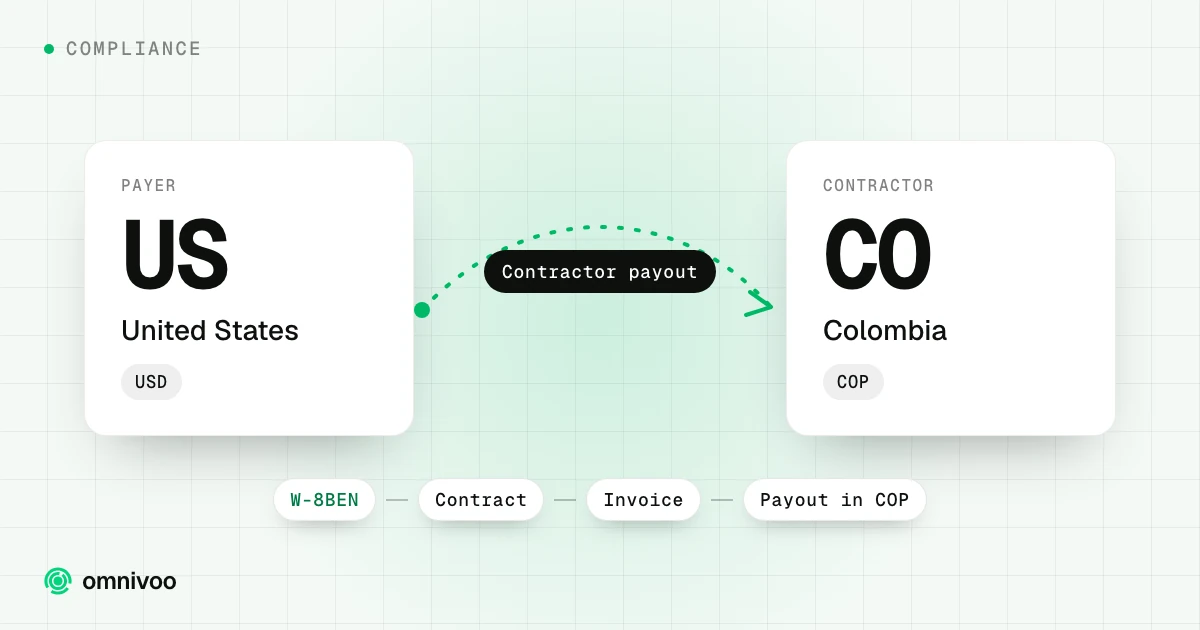
This guide walks through what a US company needs to know to pay Colombian contractors cleanly. We start with the US side, cover the Colombia side, then look at the payment rail decision. If you want to skip the assembly and let a platform handle it, Omnivoo Contract Management drafts the SOW, collects the W-8BEN, captures the electronic invoice, and runs the FX payment for $29 per contractor per month.
US side: what you need to do as the payer
Step 1. Collect a W-8BEN before the first payment
Before any invoice is paid, the Colombian contractor must complete Form W-8BEN and return it to you. The form certifies the contractor is the beneficial owner of the income, is a tax resident of Colombia, and is not a US person.
The W-8BEN is valid for three calendar years after signature and must be refreshed when it expires or when a relevant fact changes. If your contractor operates through a registered Colombian company, the form is W-8BEN-E, the entity equivalent. Our W-8BEN collection checklist walks through what to verify before you release the first payment.
Part II of the W-8BEN is where a contractor would normally claim treaty benefits. For Colombian contractors, Part II is left blank or marked not applicable, because no US-Colombia treaty exists.
Step 2. Confirm the work is performed in Colombia
Under IRS source of income rules for personal services, services income is sourced to the place where the services are physically performed. If your Colombian contractor does the work entirely from Medellin, Bogota, or Cali, the income is Colombian source income from the US perspective.
This is the part that surprises most founders given the lack of a treaty. Treaty or no treaty, foreign source income is not subject to US tax in the first place. The treaty matters only when the income is US source. For a Colombian contractor doing all work in Colombia, the result is the same as for a treaty-country contractor: no withholding, no 1042-S, no 1099-NEC.
If the contractor visits the US for an onsite sprint, the days physically worked inside the US are US source days. Those days have to be allocated. Without a treaty, the Colombian contractor cannot claim a treaty exemption on the US source days, so any US source income above the de minimis threshold becomes fully taxable in the US.
Step 3. Understand what the absence of a treaty actually changes
This is the part to get right because it is often overstated. The IRS A-to-Z list of US income tax treaties does not list Colombia, confirming there is no treaty in force as of 2026.
“The United States has tax treaties with a number of foreign countries. Under these treaties, residents (not necessarily citizens) of foreign countries are taxed at a reduced rate, or are exempt from U.S. taxes on certain items of income they receive from sources within the United States.”
What this means in practice:
- For Colombian source services income (work done in Colombia), nothing changes. The income is not US source, so it is not subject to US withholding or reporting. No treaty is needed.
- For US source income (days the contractor works inside the US), the default 30 percent withholding on FDAP under IRC Section 1441 applies. The Colombian contractor cannot reduce this rate by claiming a treaty exemption on Form 8233 (which requires a treaty).
- For royalty-type income paid to a Colombian resident from US sources, the default 30 percent withholding applies for the same reason.
For a typical pure services engagement where the contractor never sets foot in the US, the absence of a treaty is a non-event.
Colombia side: what your contractor handles
You as the US payer are not in scope for most Colombian taxes. The Colombian contractor is. But understanding the landscape helps you have an informed conversation when the contractor asks for specific invoice fields or your tax ID.
RUT and DIAN registration
Every Colombian contractor must register with the Direccion de Impuestos y Aduanas Nacionales (DIAN) and obtain a RUT (Registro Unico Tributario). The RUT is the single registry that identifies the contractor as a taxpayer and lists the tax obligations they are subject to (income tax, IVA, electronic invoicing, etc.).
For freelancers, the typical setup is registration as a Persona Natural with the economic activity code matching their services (software development, marketing, design, consulting). Higher-volume contractors may register a sole-proprietor Persona Natural Comerciante or a small SAS (Sociedad por Acciones Simplificada).
Electronic invoicing through DIAN
Colombia operates a mandatory electronic invoicing system administered by DIAN. Every invoice issued by a Colombian taxpayer obligated to invoice must be a Factura Electronica de Venta in XML format, signed by the contractor’s electronic certificate and validated by DIAN before delivery to the customer.
For your US accounting team, the contractor will send both an XML and a PDF representation. The PDF is enough for bookkeeping. The XML is what DIAN audits and what the contractor stores for at least five years under Colombian tax rules.
The fields that matter for cross-border invoices are: the contractor’s NIT (the RUT-derived tax number), your company name and address, the service description, the amount and currency, and the IVA treatment (typically excluido for exports of services).
IVA and the export of services regime
Colombia’s standard IVA rate is 19 percent. Exports of services to a foreign recipient generally qualify for the IVA-exclusion regime if the service is provided from Colombia, the recipient has no business presence in Colombia, the service is used exclusively outside Colombia, and the contractor documents these conditions. This is the practical equivalent of zero-rating used in other VAT systems.
For you as the US payer, none of this is your concern. You do not pay or recover Colombian IVA. The cleanest signal that the contractor has handled this is that the electronic invoice shows IVA as excluded (excluido) on the export-of-services line rather than taxed at 19 percent.
Retencion en la fuente does not apply to US payers
Retencion en la fuente is Colombia’s domestic withholding tax system. It requires Colombian companies and other designated withholding agents to withhold a portion of payments to Colombian service providers as a prepayment of their income tax. The rates vary by service type and are set annually in UVT (Unidad de Valor Tributario) increments.
This system applies to a Colombian payer with Colombian operations. A US company paying directly from a US bank account to a Colombian contractor is not a Colombian withholding agent under DIAN rules. The Colombian contractor accounts for their own income tax through their annual Colombian tax return without retention having happened at the source.
If you do have a Colombian entity or use a Colombian Contractor of Record, retencion en la fuente becomes an issue and the Colombian payer handles it.
The payment rail decision
There are four real options for paying a Colombian contractor from a US bank account.
| Rail | Typical FX margin | Speed | Notes |
|---|---|---|---|
| US bank SWIFT wire | 2 to 4 percent | 2 to 4 business days | Highest leakage |
| Wise USD to COP | ~0.5 to 0.8 percent | One business day | Settles to Colombian bank account |
| Payoneer USD to COP | Tiered, lower at volume | One to two days | Widely accepted |
| USD to USD (Colombian USD account) | FX margin on contractor side when they convert | Same day | Available at select Colombian banks |
For most US companies paying one to ten Colombian contractors, Wise or Payoneer is the cleanest option. SWIFT is fine for one-off larger payments where the percentage cost matters less. The Colombian contractor may also prefer to receive USD into a US-based account (Mercury, Wise USD, Payoneer USD balance) and convert on their own timing, which can reduce FX margin further.
Misclassification risk in Colombia
Colombia’s Codigo Sustantivo del Trabajo presumes an employment relationship when there is subordination, fixed hours, exclusive engagement, and integration into the company’s operational hierarchy. A worker engaged on paper as a contractor can be reclassified as a dependent worker (trabajador dependiente), with retroactive entitlement to severance (cesantias), service bonus (prima de servicios), vacation, and social security contributions to the Colombian system.
The consequences fall on the principal (your US company) when the contractor sues, even if you have no Colombian entity. The mitigations are the same as in any nearshore market: a properly drafted services agreement that establishes the contractor relationship in substance, a legitimate scope of work tied to deliverables not time, evidence the contractor has other clients, and a documented review of misclassification risk at the six and twelve month checkpoints.
For more depth on how to structure these contracts, see our guide on drafting an SOW for global contractors. The Omnivoo Contract Management SOW templates bake these protections in by default.
End-to-end workflow
Here is the clean version for a US company onboarding its first Colombian contractor.
- Send the contractor a services agreement that defines deliverables, payment, IP assignment, and termination.
- Collect a signed W-8BEN before any payment moves. Part II (treaty claim) is left blank.
- Confirm the contractor has an active RUT and can issue a Factura Electronica de Venta with your company name as a foreign customer.
- Pick a payment rail (Wise, Payoneer, or comparable) and onboard the contractor’s payout details.
- Pay the invoice on schedule. Keep the W-8BEN, SOW, electronic invoice (XML and PDF), and payment receipt together as a packet.
- Review the engagement quarterly for misclassification risk and refresh the W-8BEN every three years.
If you also handle contractors in treaty countries, our Form 8233 treaty exemption guide explains how that side works. For the broader framework, see our guide on how to pay international contractors from the US. If you pay contractors elsewhere in the region, see our guides on paying Mexico, Brazil, and Costa Rica contractors.
When a platform pays for itself
A US founder paying one Colombian contractor can do this manually. A US team paying five or more Colombian contractors faces enough W-8BEN refreshes, electronic invoice chases, and FX margin questions that a platform pays for itself within a few months.
Omnivoo Contract Management costs $29 per contractor per month. We draft the services agreement with Colombia-specific IP and misclassification clauses, collect the W-8BEN, capture the Factura Electronica on every payment, run the FX payment through a Colombian banking partner to avoid SWIFT leakage, and store the full packet for audit. Transaction fees are passed through at cost.
A simple sanity check
Three questions for every Colombian contractor relationship.
- Is there a signed W-8BEN on file and is it less than three years old?
- Will all the work be performed in Colombia for the foreseeable future?
- Are we paying through a rail that captures the Factura Electronica for every invoice and lands COP or USD without 3 percent SWIFT leakage?
If yes to all three, you are in great shape on the US-Colombia stack. The remaining work is misclassification hygiene over time.
Want to skip the assembly entirely? See how Omnivoo Contract Management handles Colombian contractors end to end, or talk to our team about your specific setup.