
Why this guide exists
Brazil is the largest Portuguese-speaking talent market in the world and the second-largest contractor pool in Latin America after Mexico. Brazilian engineering and design talent has been a fixture in US startup hiring for a decade. But the tax and invoicing picture is more complex than Mexico or Colombia. There is no US-Brazil income tax treaty, Brazil’s municipal-tax system means every contractor has a slightly different ISS rate, and the country is mid-way through a multi-year tax reform that replaces ISS with new federal-level VAT-style taxes.
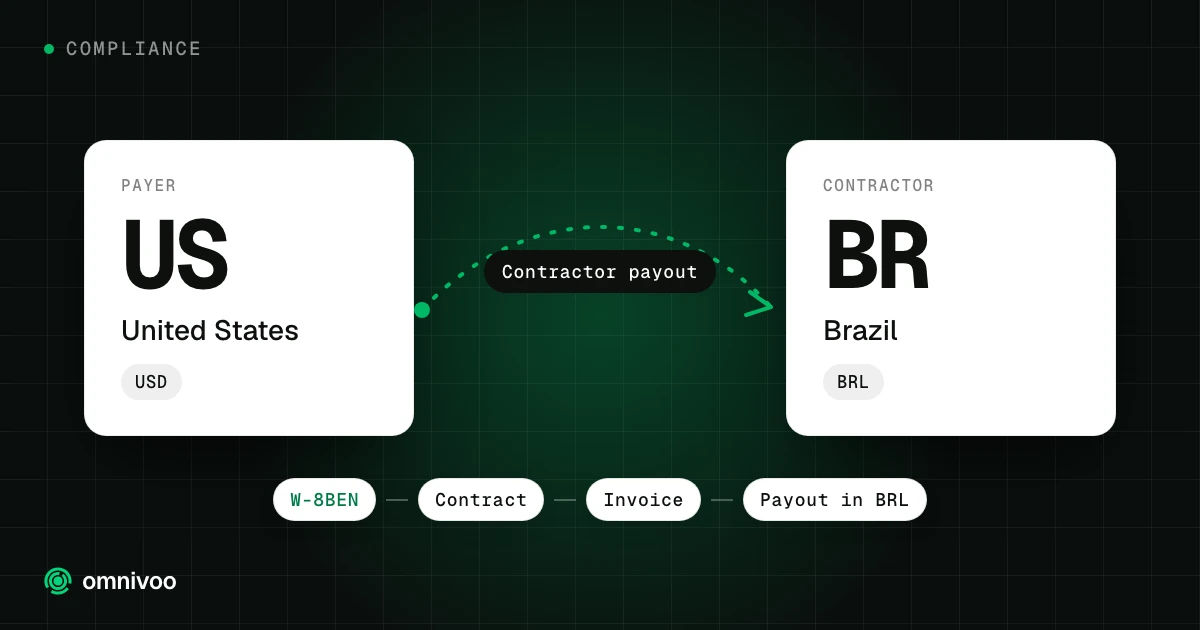
This guide walks through the full stack for a US company paying contractors in Brazil. We cover the US side (W-8BEN, source rules, why the lack of a treaty does not matter for most engagements), the Brazil side (CPF vs CNPJ, NFS-e, ISS, the 2026 reform), and the payment rail with PIX as the modern endpoint. If you want to skip the assembly and let a platform handle it, Omnivoo Contract Management handles SOW drafting, W-8BEN collection, NFS-e capture, and BRL settlement for $29 per contractor per month.
US side: what you need to do as the payer
Step 1. Collect a W-8BEN before the first payment
Before any invoice is paid, the Brazilian contractor must complete Form W-8BEN and return it to you. The form certifies the contractor is the beneficial owner of the income, is a tax resident of Brazil, and is not a US person.
The W-8BEN is valid for three calendar years after signature and must be refreshed when it expires or when a relevant fact changes. If your contractor operates through a Brazilian CNPJ (entity), the form is W-8BEN-E, the entity equivalent. Use the free W-8BEN collection checklist to confirm you have the right form and fields before the first payment.
Part II of the W-8BEN (treaty benefits) is left blank for Brazilian contractors because there is no US-Brazil tax treaty.
Step 2. Confirm the work is performed in Brazil
Under IRS source of income rules for personal services, services income is sourced to the place where the services are physically performed. If your Brazilian contractor does the work entirely from Sao Paulo, Florianopolis, or Recife, the income is Brazilian source income from the US perspective.
This is the part that surprises most founders given the lack of a US-Brazil treaty. Treaty or no treaty, foreign source income is not subject to US tax in the first place. The treaty only matters when the income is US source. For a Brazilian contractor doing all work in Brazil, the result is identical to a treaty-country contractor: no withholding, no 1042-S, no 1099-NEC.
If the contractor visits the US for an onsite sprint, the days physically worked inside the US are US source days. Without a treaty, the Brazilian contractor cannot claim a treaty exemption on those US source days, so any US source income above the de minimis threshold becomes subject to the default 30 percent FDAP withholding under IRC Section 1441.
Step 3. Understand what the absence of a treaty actually changes
The IRS A-to-Z list of US income tax treaties does not list Brazil, confirming there is no treaty in force as of 2026.
“Under these treaties, residents (not necessarily citizens) of foreign countries are taxed at a reduced rate, or are exempt from U.S. taxes on certain items of income they receive from sources within the United States.”
The lack of a treaty matters in three narrow cases:
- US source services days (contractor working physically in the US). Default 30 percent withholding applies and cannot be reduced by treaty.
- US source royalty income. Default 30 percent withholding applies.
- Dual residency or PE issues. There is no treaty tiebreaker rule available.
For a typical pure services engagement where the Brazilian contractor never sets foot in the US, the absence of a treaty is a non-event. Your contractor pays Brazilian income tax on the income and your US side has no withholding or reporting obligation.
Brazil side: what your contractor handles
You as the US payer are not in scope for most Brazilian taxes. The Brazilian contractor is. But understanding the landscape helps you have an informed conversation when the contractor asks for specific invoice fields or your tax ID.
CPF, CNPJ, and the contractor’s tax setup
Every Brazilian individual has a CPF (Cadastro de Pessoas Fisicas) issued by Receita Federal. Every Brazilian entity has a CNPJ (Cadastro Nacional da Pessoa Juridica).
A Brazilian freelancer can operate three ways:
- Autonomo (individual under CPF only). Simplest setup. Tax is paid via Carne-Leao (monthly self-assessment) at the progressive PIT rates up to 27.5 percent. Limited ability to deduct expenses. Cannot issue NFS-e for B2B services in most municipalities.
- MEI (Microempreendedor Individual). A simplified CNPJ regime for freelancers with annual revenue up to roughly BRL 81,000. Flat monthly DAS payment covers most taxes. Can issue NFS-e.
- ME or LTDA under Simples Nacional or Lucro Presumido. A small-business CNPJ regime. Most professional service contractors above the MEI ceiling operate as a Sociedade Limitada Unipessoal (single-member LTDA) under Simples Nacional, with combined federal-state-municipal tax rates that depend on the revenue band and service classification.
Most professional Brazilian contractors who work with US clients operate as a CNPJ under Simples Nacional because the effective tax rate is materially lower than the personal CPF route. You will see this referred to as PJ (Pessoa Juridica) in conversations.
NFS-e and Brazil’s municipal invoicing system
When your Brazilian contractor invoices you, they must issue a Nota Fiscal de Servicos Eletronica (NFS-e) for service transactions. Until recently, NFS-e was regulated municipality by municipality with each city having its own format and submission portal. As of 2026, Brazil is rolling out a national NFS-e system administered by Receita Federal in coordination with municipalities.
For a US company receiving the invoice, the practical impact is small. The contractor sends a PDF representation of the NFS-e (and an XML file in the national format if their municipality has migrated). Your accounting team uses the PDF for bookkeeping. The XML is what the Brazilian audit chain uses.
ISS, CBS, and the 2026 tax reform
ISS (Imposto sobre Servicos de Qualquer Natureza) is the municipal service tax in Brazil. Rates range from 2 to 5 percent depending on the municipality and the service code under municipal classifications. ISS is paid by the contractor (the service provider), calculated on the gross invoice amount.
Brazil’s tax reform, approved in 2023 and rolling out from 2026 through the early 2030s, replaces ISS, ICMS, PIS, and Cofins with two new VAT-style taxes:
- CBS (Contribuicao sobre Bens e Servicos) at the federal level
- IBS (Imposto sobre Bens e Servicos) at the state and municipal level
The transition runs in phases. During the transition years (starting 2026), contractors will see both old and new taxes on invoices. For you as the US payer, the practical impact is again minimal. You pay the gross invoice amount in BRL or USD and the contractor handles ISS, CBS, and IBS as applicable.
Carne-Leao and Brazilian income tax on foreign income
A Brazilian tax resident pays Brazilian PIT on worldwide income. For contractors invoicing under CPF (autonomo), the standard mechanism is Carne-Leao, monthly self-assessment of income received from sources that did not withhold Brazilian PIT at the source. Foreign income from a US payer falls into this category. The Brazilian contractor pays PIT monthly at progressive rates up to 27.5 percent on the BRL value of the payment.
For contractors invoicing under a CNPJ (PJ), the income is corporate income to the Brazilian entity, taxed under whichever regime the entity has elected (Simples Nacional, Lucro Presumido, or Lucro Real). The contractor then takes the post-tax cash as a profit distribution (which is generally tax-free at the individual level in Brazil).
You do not need to know which path the contractor takes. You only need to make sure they can issue you a valid NFS-e for each payment.
The payment rail decision
There are four real options for paying a Brazilian contractor from a US bank account.
| Rail | Typical FX margin | Speed | Notes |
|---|---|---|---|
| US bank SWIFT wire | 2 to 4 percent | 2 to 4 business days | Highest leakage. Brazilian intermediary banks add additional fees |
| Wise USD to BRL via PIX | ~0.5 to 0.8 percent | Same day to one day | Lands instant BRL via PIX |
| Payoneer USD to BRL | Tiered, competitive at volume | One business day | Widely accepted |
| USD to USD (contractor’s USD account abroad) | Contractor handles conversion | Same day | Useful for Wise USD or Payoneer USD balances |
PIX is the dominant rail in Brazil and is operated by the Banco Central do Brasil (BCB). PIX settles instantly in BRL and is free or near-free for the recipient. Cross-border providers convert USD to BRL on the US side and use PIX to land BRL into the contractor’s account in seconds.
For most US companies paying one to ten Brazilian contractors, Wise or Payoneer with PIX-aware settlement is the cleanest option. SWIFT is a fallback for one-off larger payments or when the contractor’s bank does not support PIX (rare in 2026).
Misclassification risk in Brazil
Brazil’s CLT (Consolidacao das Leis do Trabalho) is one of the most protective labour codes in the world. A worker engaged on paper as a PJ (contractor under CNPJ) can be reclassified as an employee through a process called “pejotizacao”, with retroactive entitlement to vacation, 13th-month salary, FGTS deposits, INSS contributions, and severance.
The reclassification test looks at subordination, fixed hours, exclusive engagement, integration into the company’s hierarchy, and onerosity (regular salary-like payments). The consequences fall on the principal (your US company) when the contractor sues, even with no Brazilian entity.
The mitigations are well established: a properly drafted services agreement that establishes the contractor relationship in substance, a legitimate scope tied to deliverables not time, evidence the contractor has other clients, and a documented review at six and twelve months. For more depth, see our guide on drafting an SOW for global contractors. The Omnivoo Contract Management SOW templates bake these protections in by default.
End-to-end workflow
Here is the clean version for a US company onboarding its first Brazilian contractor.
- Send the contractor a services agreement that defines deliverables, payment, IP assignment, and termination.
- Collect a signed W-8BEN (individuals) or W-8BEN-E (CNPJ) before any payment moves. Part II is left blank.
- Confirm the contractor operates as a CNPJ (PJ) or, if autonomo, that they can issue an NFS-e or equivalent service receipt your accounting team can record.
- Pick a payment rail (Wise, Payoneer, or comparable with PIX-aware settlement) and onboard the contractor’s payout details.
- Pay the invoice on schedule. Keep the W-8BEN, services agreement, NFS-e (XML and PDF), and payment receipt together as a packet.
- Review the engagement quarterly for misclassification risk and refresh the W-8BEN every three years.
If you also handle contractors in treaty countries, our Form 8233 treaty exemption guide explains how that side works for the cases where US source income is involved. For the broader framework, see our guide on how to pay international contractors from the US. If you pay contractors elsewhere in the region, see our guides on paying Mexico, Argentina, and Colombia contractors.
When a platform pays for itself
A US founder paying one Brazilian contractor can do this manually. A US team paying five or more Brazilian contractors faces enough W-8BEN refreshes, NFS-e chases, and FX margin questions that a platform pays for itself within a few months.
Omnivoo Contract Management costs $29 per contractor per month. We draft the services agreement with Brazil-specific IP and misclassification clauses, collect the W-8BEN, capture the NFS-e on every payment, run the FX payment with PIX-aware settlement to avoid SWIFT leakage, and store the full packet for audit. Transaction fees are passed through at cost.
A simple sanity check
Three questions for every Brazilian contractor relationship.
- Is there a signed W-8BEN on file and is it less than three years old?
- Will all the work be performed in Brazil for the foreseeable future?
- Are we paying through a rail that lands BRL via PIX and captures the NFS-e for every invoice?
If yes to all three, you are in great shape on the US-Brazil stack. The remaining work is misclassification hygiene over time and tracking the CBS/IBS rollout as it phases in through the late 2020s.
Want to skip the assembly entirely? See how Omnivoo Contract Management handles Brazilian contractors end to end, or talk to our team about your specific setup.