
Why this guide exists
Indonesian talent has quietly become one of the largest growing offshore engineering markets for US companies. Salaries are competitive with the Philippines, English proficiency in tech is high, and the timezone (UTC+7) is workable for both US coasts. But the tax and banking side has rules that catch US payers off guard. The DJP runs Indonesia’s tax administration with a different structure than most Western systems. Bank Indonesia maintains specific FX reporting thresholds. PPN treatment depends on whether the contractor is a Taxable Entrepreneur.
This guide walks through the full stack so you can onboard your first Indonesian contractor without surprises.
US side: what you do as the payer
Step 1. Collect a W-8BEN before the first payment
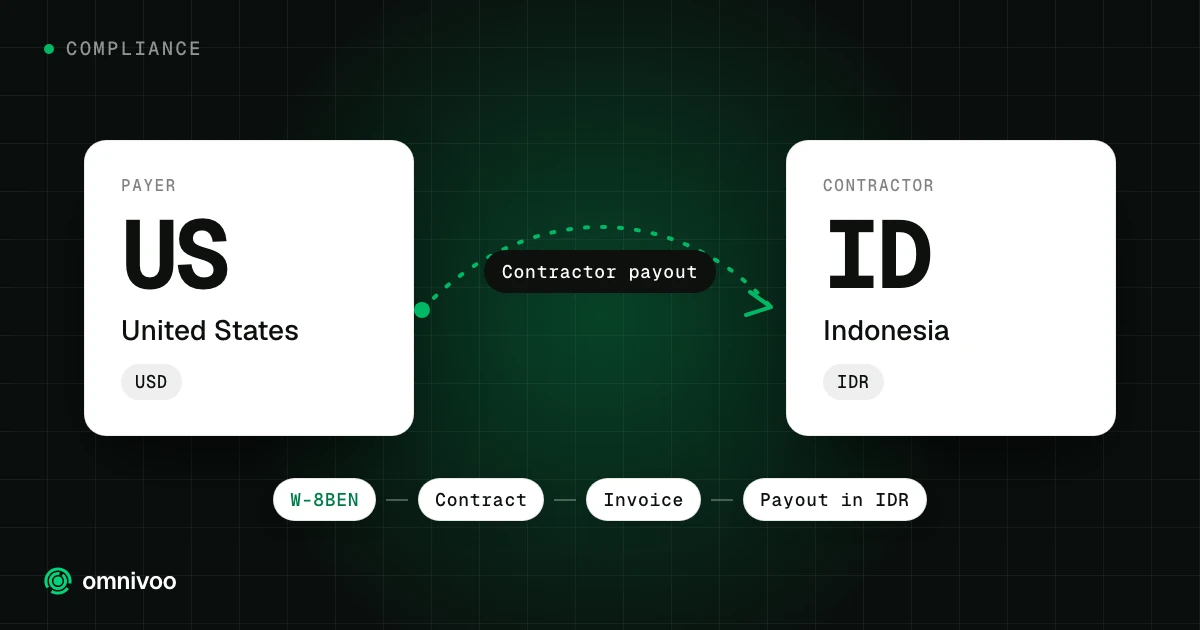
The contractor completes Form W-8BEN certifying Indonesian tax residency and beneficial ownership of the income. A signed W-8BEN is valid from the signature date through December 31 of the third following calendar year. Our W-8BEN checklist walks through what to verify before the first payment.
If the contractor operates through an Indonesian PT or CV (corporate entity), the form is W-8BEN-E.
Step 2. Confirm services are performed in Indonesia
The decisive question. Under IRS rules on source of income for personal services, services are sourced to the country where the work is physically performed. A developer in Jakarta or Bandung working entirely from Indonesia generates Indonesian source income.
Services performed outside the US by a nonresident alien are foreign source income and are not subject to US withholding or Form 1042-S reporting. You also do not file a 1099-NEC because 1099-NEC applies only to US person payees.
If the contractor visits the US for a sprint or onsite, days spent inside the US must be allocated to US source income and treated under nonresident alien withholding rules.
Step 3. Know the treaty for the edge cases
The US-Indonesia income tax treaty, signed 1988 and amended by the 1996 Protocol, governs cases where US source income arises. Article 15 covers independent personal services. An Indonesian resident performing services in the US is exempt from US tax provided they are present no more than 119 days in any consecutive 12-month period and have no fixed base regularly available to them in the US.
For services payments where US withholding applies, the contractor files Form 8233 to claim treaty benefits on the services portion. For royalty type payments, the contractor uses W-8BEN with the relevant article number in Part II.
Indonesia side: what the contractor handles
The Indonesian piece is the contractor’s responsibility, not yours. But understanding it helps you talk through invoice fields and documentation requests.
NPWP and DJP self-filing
The Directorate General of Taxes (Direktorat Jenderal Pajak, DJP) administers Indonesian tax. The DJP issues each taxpayer an NPWP (Nomor Pokok Wajib Pajak), the 15-digit tax identification number used for all income tax filings.
Indonesia operates self-assessment for income tax. Resident individuals earning more than the PTKP (Penghasilan Tidak Kena Pajak, the personal allowance) of IDR 54,000,000 annually for a single filer are required to register for an NPWP and file an annual return (SPT Tahunan).
PPh 21 progressive rates
For self-employed income paid by a foreign payer, the contractor pays PPh under the personal income tax brackets in Article 17 of the Indonesian Income Tax Law. The current progressive bracket structure under PMK and DJP guidance for 2025-2026 is:
- 5 percent on the first IDR 60,000,000 of taxable income
- 15 percent on income from IDR 60,000,001 to IDR 250,000,000
- 25 percent on income from IDR 250,000,001 to IDR 500,000,000
- 30 percent on income from IDR 500,000,001 to IDR 5,000,000,000
- 35 percent on income above IDR 5,000,000,000
These rates apply after PTKP and any deductible expenses. The contractor remits via the DJP Online portal.
PPN (VAT) and the exports rule
Indonesia’s Value Added Tax (PPN, Pajak Pertambahan Nilai) has a statutory rate of 12 percent effective January 1, 2025, with an effective rate of 11 percent for most non-luxury goods and services under Ministry of Finance Regulation 131/2024 (which applies the 12 percent rate to 11/12ths of the transaction base, producing an effective 11 percent).
The PKP (Pengusaha Kena Pajak, Taxable Entrepreneur) registration threshold is annual turnover of IDR 4.8 billion. Below that, registration is optional. Most Indonesian freelancers operate below the threshold and do not charge PPN.
Service exports to foreign recipients qualify for zero rated PPN, subject to documentation requirements in the Ministry of Finance regulations. Your contractor will not charge you PPN as long as they document the foreign recipient status, foreign currency receipt, and service performed for use outside Indonesia.
Bank Indonesia FX rules
Bank Indonesia (the central bank) administers FX regulations under the BI website. For inward remittances:
- No prior approval is required for receipt of foreign currency from a non-resident.
- The receiving bank requires a purpose code on the transaction.
- Resident and non-resident account holders fill in a purpose code for BI monitoring on any foreign currency transfer at or above USD 10,000.
- Under PBI No. 21/15/PBI/2019, monthly foreign currency purchases against rupiah exceeding USD 25,000 per month require underlying transaction documents.
The contractor can hold USD in a domestic foreign currency account or convert to IDR at the bank counter rate. For freelancers, holding USD in a bank like BCA, Mandiri, or BNI is common, with conversion to IDR done when rupiah is needed for spending.
The payment rail decision
Four real options for paying an Indonesian contractor from a US bank account.
SWIFT through your US bank. The universal rail. Cost: USD 25 to USD 50 sender fee plus intermediary deductions (USD 15 to USD 25) plus a 2 to 3 percent FX margin at the contractor’s bank. On a USD 5,000 invoice, total leakage is USD 150 to USD 220.
Wise. Routes through local IDR banking partners. Quotes the mid-market rate plus a transparent margin (typically 0.5 to 0.8 percent for USD to IDR). Settlement: same day to one business day.
Payoneer. Similar profile to Wise. Marketplace integrations are useful when Upwork or Fiverr is in the mix. Fees are competitive on larger volumes, higher on small transfers.
Local Indonesian provider (Flip, Xendit). Some Indonesian providers offer USD receipt accounts that settle to local IDR. Useful when the contractor prefers an Indonesian provider and you can route via ACH or local USD wire.
For most US companies paying one to ten Indonesian contractors, Wise is the cleanest option. SWIFT is acceptable for one-off larger payments where percentage cost is a smaller concern.
Misclassification risk in Indonesia
The Indonesian Labour Law No. 13 of 2003 (Undang-Undang Ketenagakerjaan) and Ministry of Manpower regulations distinguish between an employee under a definite or indefinite term contract and a contractor under a service agreement (perjanjian kerja sama). A worker engaged on paper as a contractor can be reclassified as an employee if the substance shows control, integration, and exclusivity that look like employment.
Reclassification consequences are similar to other markets: backdated mandatory social security (BPJS Kesehatan and BPJS Ketenagakerjaan) contributions, severance under the Job Creation Law, and potential disputes before the Industrial Relations Court. The US principal can be pulled into the claim even with no Indonesian entity when the contractor sues for benefits.
The mitigations: a properly drafted service agreement that establishes the contractor relationship in substance, scope tied to deliverables rather than time, evidence the contractor has other clients, and a periodic review of misclassification risk.
Omnivoo Contract Management bakes these into the template and flags misclassification risk before it becomes a claim.
End-to-end workflow
The clean version for a US company onboarding its first Indonesian contractor.
- Send the contractor an SOW that defines deliverables, payment, IP assignment, and termination.
- Collect a signed W-8BEN before any payment moves.
- Confirm the contractor has an NPWP for their own filings.
- Pick a payment rail (Wise is the default for most cases).
- Pay invoices on schedule. Keep the W-8BEN, SOW, invoice, and payment receipt together.
- Review the engagement quarterly for misclassification risk and refresh the W-8BEN every three years.
For broader context on global contractor payment options, see our guide on global contractor payment methods compared and our guide on how to pay international contractors from the US. If you pay contractors elsewhere in the region, see our guides on paying Vietnam, Philippines, and India contractors.
When a platform pays for itself
A US founder paying one Indonesian contractor can do this manually. A US team paying five or more Indonesian contractors faces enough W-8BEN refreshes, FX margin questions, and misclassification reviews that a platform pays for itself.
Omnivoo Contract Management handles the SOW with Indonesia-specific IP and misclassification clauses, collects the W-8BEN, runs the FX payment through a local IDR rail, and stores the full packet for audit. Transaction fees are passed through at cost.
For pricing comparison across both Contract Management and Contractor of Record products, our pricing page lays out the options side by side.
A simple sanity check
Three questions for every Indonesian contractor relationship.
- Is there a signed W-8BEN on file?
- Will all the work be performed in Indonesia for the foreseeable future?
- Are we paying through a rail that avoids SWIFT correspondent leakage and produces a clean record?
If yes to all three, you are 95 percent of the way to a clean US-Indonesia contractor payment stack. The remaining 5 percent is misclassification hygiene over time.
Want to skip the assembly entirely? See how Omnivoo Contract Management handles Indonesian contractors end to end, or talk to our team about your specific setup.