
Why this guide exists
Vietnam has emerged as one of the major Southeast Asian software development talent markets for US companies. Cost is roughly half of Eastern European peers, English fluency is improving rapidly in the IT sector, and the time zone is workable for follow-the-sun development with US East Coast or West Coast teams.
The tax and compliance picture is less familiar to US founders than India or the Philippines. Vietnam has its own tax authority (GDT, General Department of Taxation), its own central bank (SBV), and a Foreign Contractor Tax regime that does not apply to outbound US payers but is often misunderstood. There is no US-Vietnam income tax treaty in force, despite a 2015 signed treaty that has remained in ratification limbo for over a decade.
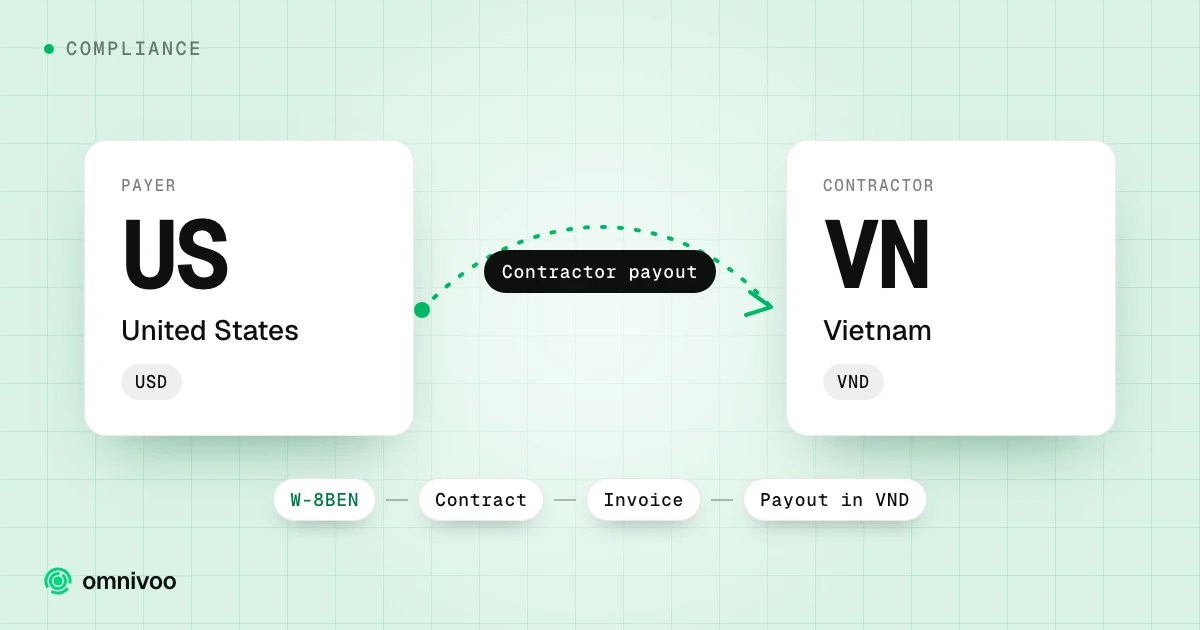
This guide walks through what a US company needs to know to pay Vietnamese contractors cleanly in 2026. We cover the US side (W-8BEN, source rules, why the lack of a treaty does not matter for most engagements), the Vietnam side (PIT, business income, FCT, SBV currency rules), and the payment rail decision. If you want to skip the assembly and let a platform handle it, Omnivoo Contract Management handles SOW drafting, W-8BEN collection, invoice capture, and USD or VND settlement for $29 per contractor per month.
US side: what you need to do as the payer
Step 1. Collect a W-8BEN before the first payment
Before any invoice is paid, the Vietnamese contractor must complete Form W-8BEN and return it to you. The form certifies the contractor is the beneficial owner of the income, is a tax resident of Vietnam, and is not a US person.
The W-8BEN is valid for three calendar years after signature. If your contractor operates through a Vietnamese company, the form is W-8BEN-E, the entity equivalent. Not sure the form is filled in correctly? Our W-8BEN checklist walks through what to verify.
Part II of the W-8BEN (treaty benefits) is left blank for Vietnamese contractors because no US-Vietnam tax treaty is in force.
Step 2. Confirm the work is performed in Vietnam
Under IRS source of income rules for personal services, services income is sourced to the place where the services are physically performed. If your Vietnamese contractor does the work entirely from Ho Chi Minh City, Hanoi, or Da Nang, the income is Vietnamese source income from the US perspective.
This is the part that surprises most founders given the lack of a treaty. Treaty or no treaty, foreign source income is not subject to US tax in the first place. The treaty matters only when the income is US source. For a Vietnamese contractor doing all work in Vietnam, the result is the same as for a treaty-country contractor: no withholding, no 1042-S, no 1099-NEC.
If the contractor visits the US for an onsite sprint, the days physically worked inside the US are US source days. Without a treaty, the Vietnamese contractor cannot claim a treaty exemption on those US source days, so any US source income above the de minimis threshold becomes subject to the default 30 percent FDAP withholding under IRC Section 1441.
Step 3. The treaty situation: what is actually in force
The IRS A-to-Z list of US income tax treaties does not list Vietnam, confirming that no treaty is in force as of 2026.
“The United States has tax treaties with a number of foreign countries. Under these treaties, residents (not necessarily citizens) of foreign countries are taxed at a reduced rate, or are exempt from U.S. taxes on certain items of income they receive from sources within the United States.”
The history: a US-Vietnam tax treaty was signed on 7 July 2015 by the two governments. Vietnam ratified the treaty domestically. The treaty has not been ratified by the US Senate and has remained in ratification limbo through multiple US administrations. After US tax law changes (notably the 2017 Tax Cuts and Jobs Act) that affected aspects of the negotiated treaty, the practical path forward has been further delayed.
The result for 2026: no treaty rate, no treaty exemption, no treaty tiebreaker rules. Vietnamese contractors deal with potential US-source-income exposure under the default IRC rules, and Vietnamese tax residents claim a foreign tax credit on their Vietnamese return for any US tax they pay on US source income.
For a typical pure services engagement where the Vietnamese contractor never sets foot in the US, the absence of a treaty is a non-event because the income is foreign source to begin with.
Vietnam side: what your contractor handles
You as the US payer are not in scope for most Vietnamese taxes. The Vietnamese contractor is. But understanding the landscape helps you have an informed conversation about how the contractor structures their work and what SBV rules apply when your USD payment lands.
PIT for Vietnamese tax residents
Vietnam’s General Department of Taxation (GDT) administers personal income tax. Vietnamese tax residents (individuals present in Vietnam 183 days or more in a calendar year, or whose permanent residence is in Vietnam) are taxable on worldwide income.
Employment-type income is taxed at progressive rates with a top marginal rate of 35 percent. Vietnam’s National Assembly passed a revised PIT law that becomes effective from 2026 with adjusted brackets and personal deductions. The headline structure of progressive rates with a top of 35 percent is maintained.
Independent business or services income from a Vietnamese individual contractor is generally taxed under a separate business-income regime. The rates and method depend on the activity classification under the Vietnam Tax Code, but they are typically applied as a deemed-rate-on-revenue scheme rather than the full progressive PIT schedule. The contractor’s accountant identifies the correct classification.
For you as the US payer, the practical takeaway is: your Vietnamese contractor will pay Vietnamese tax on the income you remit, either as PIT or under the business income regime depending on how their activity is classified. You do not handle this. You pay the gross invoice amount.
Foreign Contractor Tax (FCT): the inversion that confuses founders
Foreign Contractor Tax (FCT) is one of the more commonly misunderstood Vietnamese taxes. FCT is a Vietnamese inbound tax. It applies when a Vietnamese party (a Vietnamese company, individual, or organisation) pays a foreign supplier for services or goods used in Vietnam. The Vietnamese payer is the FCT withholding agent, and the foreign supplier bears the economic burden of the tax (or grosses up the contract to cover it).
This is the inverse of your situation. You as a US payer paying a Vietnamese contractor are:
- The foreign customer (not a Vietnamese party).
- Paying for services consumed in the US, by the US company (not in Vietnam).
- Outside the FCT framework entirely.
The Vietnamese contractor is the supplier, and you are the customer. The cross-border direction is outbound from Vietnam (Vietnam exports services to a US customer), not inbound into Vietnam. FCT simply does not apply.
This is not a treaty-driven exemption. It is the structural design of FCT, which by its terms only applies to payments from Vietnamese parties to foreign suppliers.
Invoicing and Vietnamese e-invoice rules
Vietnamese businesses (entities and individual business households above a revenue threshold) must issue e-invoices under GDT rules. The e-invoice format is XML-based and is registered with the GDT system.
Individual freelancers below the e-invoice threshold may use simpler payment receipts. The contractor’s accountant determines which regime applies. For you as the US payer, you receive a PDF or XML invoice that records the transaction.
SBV foreign currency rules
The State Bank of Vietnam (SBV) regulates all foreign-currency transactions in and out of Vietnam. The key rules for your Vietnamese contractor receiving USD from a US client:
- USD payments are received through licensed credit institutions (Vietnamese banks).
- International electronic transfers of USD 1,000 or above are reportable to the SBV by the receiving bank.
- The contractor’s bank either holds the USD in a foreign-currency account (if the contractor has one) or converts to VND at the bank’s spot rate referenced to the SBV’s daily central rate.
- For transactions inside Vietnam between two Vietnamese parties, foreign currency cannot generally be used as a settlement currency, except in cases specifically allowed by the SBV. This does not affect cross-border USD invoicing from your Vietnamese contractor to your US company.
For most contractors, the practical effect is: your USD payment lands in the Vietnamese bank, gets converted to VND on receipt at the SBV-referenced rate, and credits the contractor’s account in VND. The contractor sees the VND equivalent and that is what they report and pay tax on.
Contractors who hold foreign-currency accounts (some Vietnamese banks offer USD accounts to qualifying individuals) can choose to retain USD rather than convert immediately. Cross-border payment providers like Wise and Payoneer also operate in Vietnam and offer USD-to-VND conversion at the provider’s rate, sometimes more favourable than the bank spot rate.
The payment rail decision
There are four real options for paying a Vietnamese contractor from a US bank account.
| Rail | Typical FX margin | Speed | Notes |
|---|---|---|---|
| US bank SWIFT wire | 2 to 4 percent plus bank conversion | 2 to 4 business days | Highest leakage. Lands VND or USD depending on contractor’s account type |
| Wise USD to VND | ~0.5 to 1 percent | One business day | Lands VND via Vietnamese bank transfer |
| Payoneer USD to VND or USD balance | Tiered | One business day | Widely used by Vietnamese freelancers |
| USD to a foreign USD account the contractor controls | None on the rail | Same day | Useful when contractor holds Wise USD or Payoneer USD outside Vietnam |
For most US companies paying one to ten Vietnamese contractors, Wise or Payoneer is the cleanest option. SWIFT remains a fallback for larger one-off payments where the percentage cost matters less.
Misclassification risk in Vietnam
Vietnam’s Labour Code treats employment as the default form of working relationship when there is subordination, fixed hours, exclusive engagement, and integration into the company’s hierarchy. An individual engaged on paper as a service contractor can be reclassified as an employee in disputes before the Vietnamese labour authorities, with retroactive entitlement to social security contributions, severance, and other employee protections.
The reclassification risk is lower when the contractor operates as a registered business household (ho kinh doanh) or company, has multiple clients, and works on deliverable-based scopes rather than fixed schedules.
The mitigations follow the same pattern as in other markets: a properly drafted services agreement that establishes the contractor relationship in substance, a legitimate scope tied to deliverables not time, evidence the contractor has other clients, and a documented review at six and twelve months. For more depth, see our guide on drafting an SOW for global contractors. The Omnivoo Contract Management SOW templates bake these protections in by default.
End-to-end workflow
Here is the clean version for a US company onboarding its first Vietnamese contractor.
- Send the contractor a services agreement that defines deliverables, payment, IP assignment, and termination.
- Collect a signed W-8BEN before any payment moves. Part II is left blank.
- Confirm the contractor can issue an e-invoice (if a registered business) or a service receipt that satisfies the receiving bank’s documentation requirements for foreign currency receipt.
- Pick a payment rail (Wise, Payoneer, or comparable) and onboard the contractor’s payout details. Confirm whether the contractor wants USD or VND settlement.
- Pay the invoice on schedule. Keep the W-8BEN, services agreement, invoice or receipt, and payment receipt together as a packet.
- Review the engagement quarterly for misclassification risk and refresh the W-8BEN every three years.
If you also handle contractors in treaty countries elsewhere in Asia, our guides on paying Indian contractors from a US company and the Form 8233 treaty exemption process cover the treaty side. For the broader framework, see our guide on how to pay international contractors from the US. If you pay contractors elsewhere in the region, see our guides on paying Indonesia and Philippines contractors.
When a platform pays for itself
A US founder paying one Vietnamese contractor can do this manually. A US team paying five or more Vietnamese contractors faces enough W-8BEN refreshes, SBV-rule questions, and FX margin decisions that a platform pays for itself within a few months.
Omnivoo Contract Management costs $29 per contractor per month. We draft the services agreement with Vietnam-specific IP and misclassification clauses, collect the W-8BEN, capture the invoice or e-invoice on every payment, run the FX payment via USD-to-USD or USD-to-VND depending on the contractor’s preference, and store the full packet for audit. Transaction fees are passed through at cost.
A simple sanity check
Three questions for every Vietnamese contractor relationship.
- Is there a signed W-8BEN on file and is it less than three years old?
- Will all the work be performed in Vietnam for the foreseeable future?
- Are we paying through a rail that captures the invoice and lets the contractor choose USD or VND settlement?
If yes to all three, you are in great shape on the US-Vietnam stack. The remaining work is misclassification hygiene over time and monitoring the long-running question of whether the 2015 treaty ever gets ratified.
Want to skip the assembly entirely? See how Omnivoo Contract Management handles Vietnamese contractors end to end, or talk to our team about your specific setup.