
Why this guide exists
Costa Rica has quietly become one of the most attractive nearshore corridors for US companies. San José hosts a deep pool of bilingual software, support, and design talent, the time zone matches US central time, and the country’s stability and education levels make it a default choice for nearshore teams. The wrinkle that catches US founders off guard is the treaty position. Costa Rica does not have an income tax treaty with the US, only an information exchange agreement, which changes how the W-8BEN analysis reads. On top of that, Costa Rica runs a strict electronic invoicing regime and a social security system that independent workers must join.
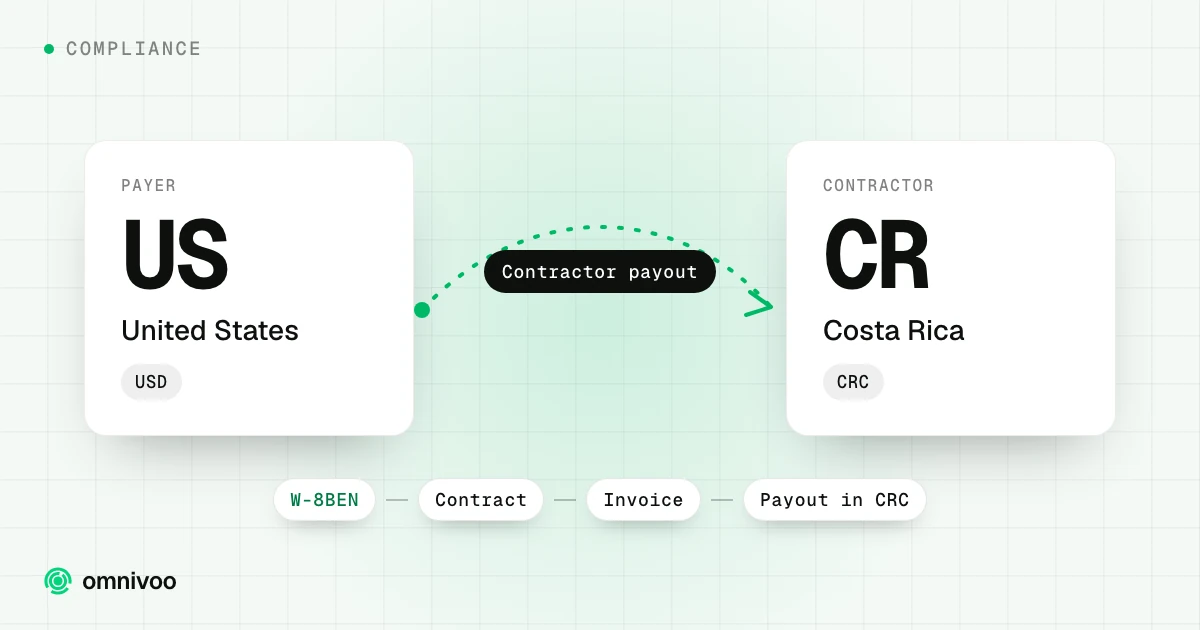
This guide covers the full stack for a US company paying contractors in Costa Rica. We look at the US side (W-8BEN, the no-treaty reality, 1042-S), the Costa Rica side (NITE tax ID, IVA on exported services, CCSS social security, factura electrónica 4.4, the territorial tax system), and the payment rail. By the end you should know exactly what to ask your contractor for and what each document is doing in the chain.
If you want to skip the assembly and let a platform run the whole stack, Omnivoo Contract Management handles SOW drafting, W-8BEN collection, invoice capture, and CRC or USD payouts for $29 per contractor per month.
US side: what you need to do as the payer
Step 1. Collect a W-8BEN before the first payment
The first action is non-negotiable. Before any invoice is paid, the contractor must complete Form W-8BEN and return it to you. The form certifies the contractor is the beneficial owner of the income, is a tax resident of Costa Rica, and is not a US person. The IRS version lives on the official Form W-8BEN page.
The W-8BEN is valid through the end of the third calendar year after signature and must be refreshed when it expires or when a relevant fact changes, such as address. If your contractor operates through a registered Costa Rican company (a sociedad), the form is Form W-8BEN-E, the entity equivalent on the IRS Form W-8BEN-E page. Because there is no treaty (covered below), the treaty-claim section of the form is left blank. The form’s value here is documenting foreign status, not claiming a reduced rate. Use the free W-8BEN collection checklist to confirm you have the right form and that every field is complete.
Step 2. Confirm the work is performed in Costa Rica
Under IRS source of income rules for personal services, services income is sourced to the place where the services are physically performed. If your contractor does the work entirely from San José, Heredia, or Cartago, the income is foreign source income from the US perspective.
The practical takeaway: no withholding, no Form 1042-S, and no 1099-NEC, which is for US persons only. You keep the W-8BEN, the SOW, the contractor’s invoice, and the payment receipt as the documentation packet.
If the contractor visits the US for an onsite stretch, the days physically worked inside the US are US source days. Those days have to be allocated and may trigger withholding plus a 1042-S. A simple onsite-days log keeps this clean, and it matters more here because there is no treaty rate to soften the US source piece.
Step 3. No US-Costa Rica income tax treaty
This is the part that distinguishes Costa Rica from many other corridors. Costa Rica is not on the IRS list of US income tax treaties. There is no comprehensive income tax treaty in force.
What does exist is a Tax Information Exchange Agreement, listed among the agreements the US Treasury maintains. A TIEA lets the two governments share tax information. It does not reduce withholding, allocate taxing rights, or prevent double taxation. So there is no treaty rate to claim, and no Form 8233 treaty exemption to file for US source income.
This matters only for US source income. If your Costa Rican contractor performs work inside the US, or earns US-source royalties, the default US withholding under the statute is 30 percent and there is no treaty rate to reduce it. For purely offshore services performed in Costa Rica, the absence of a treaty is a non-issue, because the US has no withholding right in the first place under the source rules. The clean practice is the same as everywhere: draft the SOW as a pure services agreement with full IP assignment, so the fee is not split into a royalty component that could create US source income.
Costa Rica side: what your contractor handles
You as the US payer are not in scope for most Costa Rican taxes. The contractor is. Understanding the landscape helps you talk through invoice fields and documentation requests.
NITE tax ID and Hacienda registration
Every Costa Rican contractor who invoices registers with the Ministerio de Hacienda and obtains a tax identification number. For an individual, the number is built on the national identity document (cédula) and registered in the tax registry as a NITE-type identifier for tax purposes. The contractor enrols in the relevant income tax and IVA regimes. You only need to know the contractor is registered and can issue a valid electronic invoice.
Territorial tax system
Costa Rica taxes on a territorial basis. Income from a Costa Rican source is taxable, and income from genuinely foreign sources generally falls outside the Costa Rican income tax base, under the Income Tax Law administered by Hacienda. For a contractor doing the work physically in Costa Rica for a US client, the income is Costa Rican source and is taxable in Costa Rica. The territorial point matters for the contractor’s own tax planning, not for you as the payer.
IVA on exported services
Costa Rica’s standard IVA (Impuesto al Valor Agregado) rate is 13 percent, introduced by Law 9635 effective July 1, 2019. Exports of services to a foreign recipient are zero-rated, per the Ministerio de Hacienda IVA guidance. A Costa Rican contractor invoicing your US company generally charges no IVA, with the export treatment documented on their side.
For you as the US payer, this is the contractor’s matter to handle. You do not pay or recover Costa Rican IVA on the invoice.
CCSS (Caja) social security
Independent workers in Costa Rica are required to enrol with the Caja Costarricense de Seguro Social (CCSS), commonly called la Caja, the social security fund that covers health and pension. Affiliation as a trabajador independiente is compulsory and the contributions are the contractor’s own obligation based on declared income. A US payer does not deduct or remit CCSS contributions. This matters for misclassification, because the CCSS can reassess a relationship and treat a supposed contractor as a worker who should have been on payroll.
Factura electrónica 4.4
Costa Rica requires registered taxpayers to issue electronic invoices, the comprobantes electrónicos, through the Ministerio de Hacienda system. Version 4.4 became mandatory on September 1, 2025, replacing version 4.3, under a resolution of the Dirección General de Tributación. Your contractor issues a valid electronic invoice for each payment. The document, with its digital acceptance from Hacienda, is what the authority audits.
For your US accounting team, what matters is that the invoice shows the contractor’s tax ID, the service description, the amount, the currency, and the IVA treatment (zero-rated as an export of services). The electronic format is the contractor’s responsibility.
The payment rail decision
There are four real options for paying a Costa Rican contractor from a US bank account.
| Rail | Typical FX margin | Speed | Notes |
|---|---|---|---|
| US bank SWIFT wire | 2 to 4 percent | 2 to 4 business days | Lands in CRC or a USD account, correspondent fees apply |
| Wise USD to CRC | Mid-market plus a transparent margin | Same day to one business day | Check current CRC payout support before relying on it |
| Payoneer | Tiered, lower at volume | One to two business days | Common with Costa Rican freelancers serving US clients |
| USD to a Costa Rican USD account | Bank spot on conversion | Varies by bank | Many CR banks offer USD accounts, simplifying settlement |
Costa Rica’s domestic interbank rail is SINPE, operated by the central bank (BCCR), which moves both colones and US dollars between local accounts and also powers SINPE Móvil for mobile transfers. Once a cross-border payment reaches the contractor’s Costa Rican bank, SINPE handles the domestic leg. Many Costa Rican contractors hold USD accounts, which can remove a conversion step entirely if you settle in dollars. For most US companies paying one to ten Costa Rican contractors, Payoneer or a USD-to-USD settlement is the cleanest option. For how margin is built into any rail, see our guide on FX margin in international contractor payments and the SWIFT network glossary entry.
Misclassification risk in Costa Rica
Costa Rica applies the principle of primacy of reality (primacía de la realidad): the true nature of the relationship governs, not the label on the contract. Under the Código de Trabajo, an arrangement marked as a contractor engagement can be treated as employment where there is subordination, a fixed schedule, integration into the company, and economic dependence on one payer.
Reclassification carries two layers of exposure. The labour side brings severance (cesantía), notice (preaviso), the mandatory thirteenth-month salary (aguinaldo), and vacation. The social security side is sharper: the CCSS can reassess the relationship and demand back contributions for a worker it concludes should have been insured as an employee. A US principal can be drawn into these claims even without a Costa Rican entity. The mitigations are the standard ones: a properly drafted services agreement, a scope tied to deliverables rather than hours, evidence the contractor has other clients, and a documented review of worker misclassification risk at the six and twelve month checkpoints. A clean engagement also lowers the risk of creating a permanent establishment for your US company.
For more depth, see our guide on drafting an SOW for global contractors. The Omnivoo Contract Management templates build a master service agreement and statement of work with intellectual property assignment and a clear governing law clause by default.
End-to-end workflow
Here is the clean version for a US company onboarding its first Costa Rican contractor.
- Send the contractor a services agreement that defines deliverables, payment, IP assignment, governing law, and termination.
- Collect a signed W-8BEN before any payment moves, leaving the treaty section blank since there is no income tax treaty.
- Confirm the contractor is registered with Hacienda, enrolled with the CCSS as an independent worker, and can issue a factura electrónica 4.4 showing the service as a zero-rated export.
- Pick a payment rail (Payoneer, a USD account, or comparable) and onboard the contractor’s CRC or USD bank details.
- Pay the invoice on schedule. Keep the W-8BEN, SOW, electronic invoice, and payment receipt together as a packet.
- Review the engagement quarterly for misclassification risk and refresh the W-8BEN every three years.
If you are weighing this against employment through an entity, the contractor management versus contractor of record comparison helps you pick the right product. For the broader framework, see our guide on how to pay international contractors from the US. If you pay contractors elsewhere in the region, see our guides on paying Mexico, Colombia, and Brazil contractors.
When a platform pays for itself
A US founder paying one Costa Rican contractor can do this manually. A US team paying five or more Costa Rican contractors faces enough W-8BEN refreshes, electronic invoice checks, and FX margin questions that a platform pays for itself within the first few months.
Omnivoo Contract Management costs $29 per contractor per month. We draft the services agreement with Costa Rica-specific IP and misclassification clauses, collect the W-8BEN, capture the factura electrónica on every payment, run the FX payment through a CRC or USD rail to limit leakage, and store the full packet for audit. Transaction fees are passed through at cost, with competitive FX and no fee for contractors, cancel anytime.
A simple sanity check
Three questions for every Costa Rican contractor relationship.
- Is there a signed W-8BEN on file (treaty section blank) and is it less than three years old?
- Will all the work be performed in Costa Rica for the foreseeable future?
- Are we paying through a rail that lands CRC or USD via a Costa Rican bank with a tight FX margin?
If yes to all three, you are most of the way to a clean US-Costa Rica contractor payment stack. The rest is misclassification hygiene over time.
Want to skip the assembly entirely? See how Omnivoo Contract Management handles Costa Rican contractors end to end, or talk to our team about your specific setup.