
Why this guide exists
Egypt has emerged as a significant talent corridor for US companies in the past five years. The country produces a steady flow of engineering, design, and content talent, with English proficiency in tech roles that is generally high. Rates are competitive with North Africa peers and lower than Latin America for comparable seniority. The setup challenges in Egypt are different from South Asian markets: the ETA tax system, the Central Bank of Egypt’s recent FX reforms, and a regional VAT regime that has been clarified for service exports in late 2025.
This guide walks through the full stack for US companies paying their first Egyptian contractor.
US side: what you do as the payer
Step 1. Collect a W-8BEN before the first payment
The contractor completes Form W-8BEN certifying Egyptian tax residency and beneficial ownership of the income. The form is valid from signature through December 31 of the third following calendar year. Before you pay, run through our W-8BEN collection checklist to make sure the form is complete.
If the contractor operates through an Egyptian LLC, joint stock company, or sole proprietorship registered as a business, the form is W-8BEN-E.
Step 2. Confirm services are performed in Egypt
The decisive question. Under IRS rules on source of income for personal services, services are sourced to the country where the work is physically performed. A developer in Cairo, Alexandria, or New Cairo working entirely from Egypt generates Egyptian source income from the US perspective.
Services performed outside the US by a nonresident alien are foreign source income and are not subject to US withholding or Form 1042-S reporting. You also do not file a 1099-NEC because 1099-NEC applies only to US person payees.
If the contractor visits the US for onsite work, days inside the US must be allocated to US source income.
Step 3. The US-Egypt tax treaty
The US-Egypt Income Tax Convention was signed in 1980 and is on the IRS A-to-Z list of US income tax treaties. Article 14 covers independent personal services.
Under Article 14, an Egyptian resident performing independent personal services in the United States is exempt from US tax provided they are present in the US for no more than 89 days during the tax year. The 89-day threshold is shorter than the typical 183-day threshold in modern US treaties, so onsite trips need close attention. The IRS technical explanation of the treaty walks through each article.
For services performed entirely in Egypt, the US generally does not have a withholding right in the first place, so the treaty is rarely the operative document for purely offshore work. For services payments where US withholding does apply, the contractor files Form 8233 to claim treaty benefits.
Egypt side: what the contractor handles
The Egyptian piece is the contractor’s responsibility, not yours. Understanding it helps you talk through invoice fields and documentation requests.
ETA registration and tax card
The Egyptian Tax Authority (ETA) administers personal income tax under Income Tax Law No. 91 of 2005 (as amended). Resident individuals earning self-employment income register with the ETA, obtain a tax card (Bitaqat Daribiya), and file an annual personal income tax return.
Filing is done through the ETA’s electronic services portal. The Egyptian tax year is the calendar year. Annual returns are due by March 31 of the year following the tax year.
Personal income tax slabs
Egypt operates a progressive personal income tax structure. For 2026, the brackets under ETA guidance and PwC’s summary generally run from 0 to 27.5 percent with a personal exemption of EGP 20,000 per year:
- 0 percent up to a tax-free band
- 10 percent on the next band
- 15 percent on the next band
- 20 percent on the next band
- 22.5 percent on the next band
- 25 percent on the next band
- 27.5 percent on income above the top band
The exact bracket cutoffs are revised periodically through Finance Law amendments. The contractor’s local accountant or the ETA portal will have the current year’s exact thresholds.
VAT and the service exports zero rating
Egypt’s Value Added Tax has a standard rate of 14 percent under VAT Law No. 67 of 2016 (as amended). For service exports, the ETA Executive Instructions No. 45 of 2025 established clear rules for applying zero-rated VAT to services provided by Egyptian-based suppliers to clients abroad.
A key condition: payment must flow through CBE-supervised banks. If the payment does not arrive through the formal banking system (for example, cash or informal transfers), the supply does not qualify for zero rating and 14 percent VAT applies. This is why the payment rail matters as much as the invoice text. Your USD wire or Wise transfer to an Egyptian bank meets the requirement.
In late 2025, Egypt also clarified VAT-free treatment for remote tech talent exports under the same framework, which helped settle ambiguity for IT freelancers serving foreign clients.
CBE foreign currency rules
The Central Bank of Egypt (CBE) administers FX policy. Under Law No. 88/2003, individuals and businesses in Egypt can hold foreign currency, maintain bank accounts denominated in foreign currency, buy foreign currency, and transfer it abroad subject to the law’s framework. Foreign exchange transactions are conducted through banks and licensed foreign exchange bureaus that submit transaction statements to the CBE.
Following the March 2024 reforms (when the EGP was floated and CBE took significant policy actions), FX liquidity has improved and the bank conversion rate is now generally close to the market rate. The contractor can hold USD in a foreign currency account or convert to EGP at the bank counter rate.
The payment rail decision
Four real options for paying an Egyptian contractor from a US bank account.
SWIFT through your US bank. The universal rail. Cost: USD 25 to USD 50 sender fee plus intermediary deductions (USD 15 to USD 25) plus an FX margin of 2 to 3 percent applied at the contractor’s bank. Net leakage on a USD 5,000 invoice: USD 150 to USD 220.
Wise. Wise supports payouts to Egyptian bank accounts. Quotes the mid-market rate plus a transparent margin (typically 0.7 to 1.0 percent for USD to EGP). Settlement: same day to one business day.
Payoneer. Widely used by Egyptian freelancers on Upwork, Fiverr, and direct client work. Operates a withdraw-to-local-bank model. Particularly common among Egyptian designers and developers serving European and US clients.
PayPal. Available in Egypt but with restrictions and conversion friction. Most contractors prefer Payoneer or Wise for direct client payments.
For most US companies paying one to ten Egyptian contractors, Payoneer or Wise is the cleanest option. SWIFT is acceptable for one-off larger payments.
Misclassification risk in Egypt
Egypt’s Labour Law No. 12 of 2003 (and the new Labour Law No. 14 of 2025 which is being phased in) governs the employment relationship. The substance-over-form principle applies in Egyptian courts: a worker engaged on paper as a contractor can be reclassified as an employee if the engagement looks like employment in practice (control, fixed hours, exclusivity, integration into the company’s operational hierarchy).
Reclassification consequences include backdated social insurance contributions to the National Organization for Social Insurance, severance under the Labour Law, and potential disputes before the Labour Courts. The US principal can be drawn into a claim even with no Egyptian entity when the contractor sues for benefits.
The mitigations: a properly drafted service agreement, scope tied to deliverables rather than time, evidence the contractor has other clients, and a periodic review of misclassification risk. Omnivoo Contract Management builds these into the template.
End-to-end workflow
The clean version for a US company onboarding its first Egyptian contractor.
- Send the contractor an SOW that defines deliverables, payment, IP assignment, and termination.
- Collect a signed W-8BEN before any payment moves.
- Confirm the contractor is registered with ETA and has a tax card.
- Pick a payment rail (Payoneer or Wise for most cases) and confirm the contractor has a bank account that can receive USD.
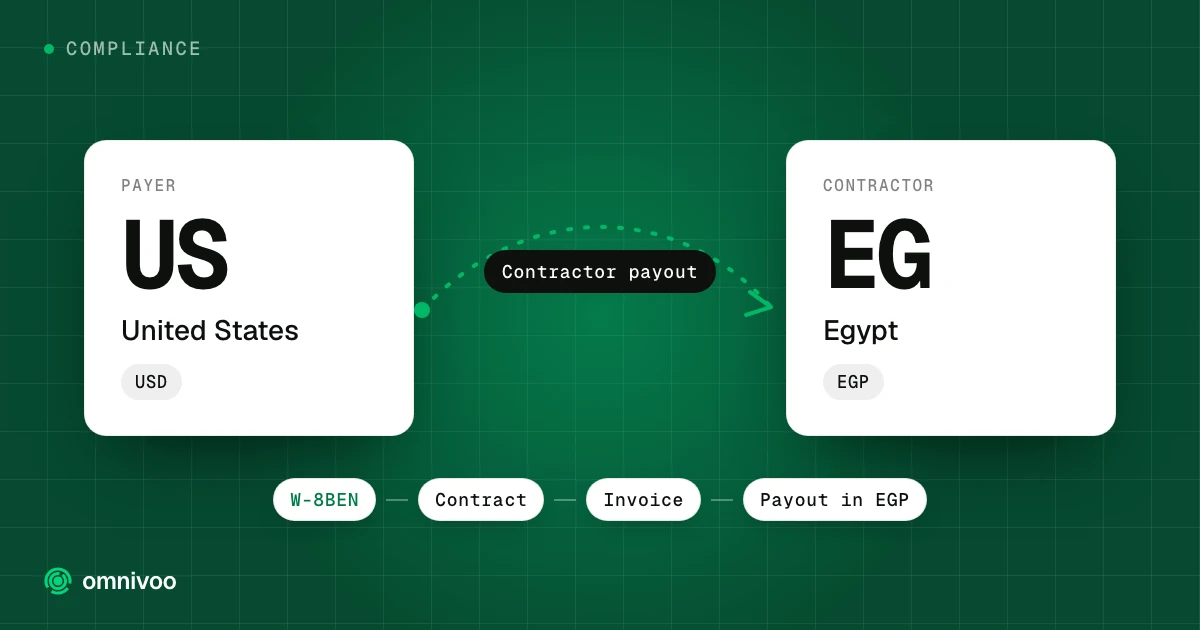
- Pay invoices on schedule. Keep the W-8BEN, SOW, invoice, and payment receipt together.
- Review the engagement quarterly for misclassification risk and refresh the W-8BEN every three years.
For broader context on payment options across markets, see our guide on global contractor payment methods compared and our guide on how to pay international contractors from the US. If you pay contractors elsewhere in the region, see our guides on paying Turkey, Nigeria, and Kenya contractors.
When a platform pays for itself
A US founder paying one Egyptian contractor can do this manually. A US team paying five or more Egyptian contractors faces enough W-8BEN refreshes, FX margin questions, and misclassification reviews that a platform pays for itself.
Omnivoo Contract Management handles the SOW with Egypt-specific IP and misclassification clauses, collects the W-8BEN, runs the FX payment through a local EGP or USD rail, and stores the full packet for audit. Transaction fees are passed through at cost.
For pricing across both Contract Management and Contractor of Record options, our pricing page lays out the products side by side.
A simple sanity check
Three questions for every Egyptian contractor relationship.
- Is there a signed W-8BEN on file?
- Will all the work be performed in Egypt for the foreseeable future?
- Are we paying through a rail that lands in a CBE-supervised bank and avoids SWIFT correspondent leakage?
If yes to all three, you are 95 percent of the way to a clean US-Egypt contractor payment stack. The remaining 5 percent is misclassification hygiene over time.
Want to skip the assembly entirely? See how Omnivoo Contract Management handles Egyptian contractors end to end, or talk to our team about your specific setup.