
The question behind the question
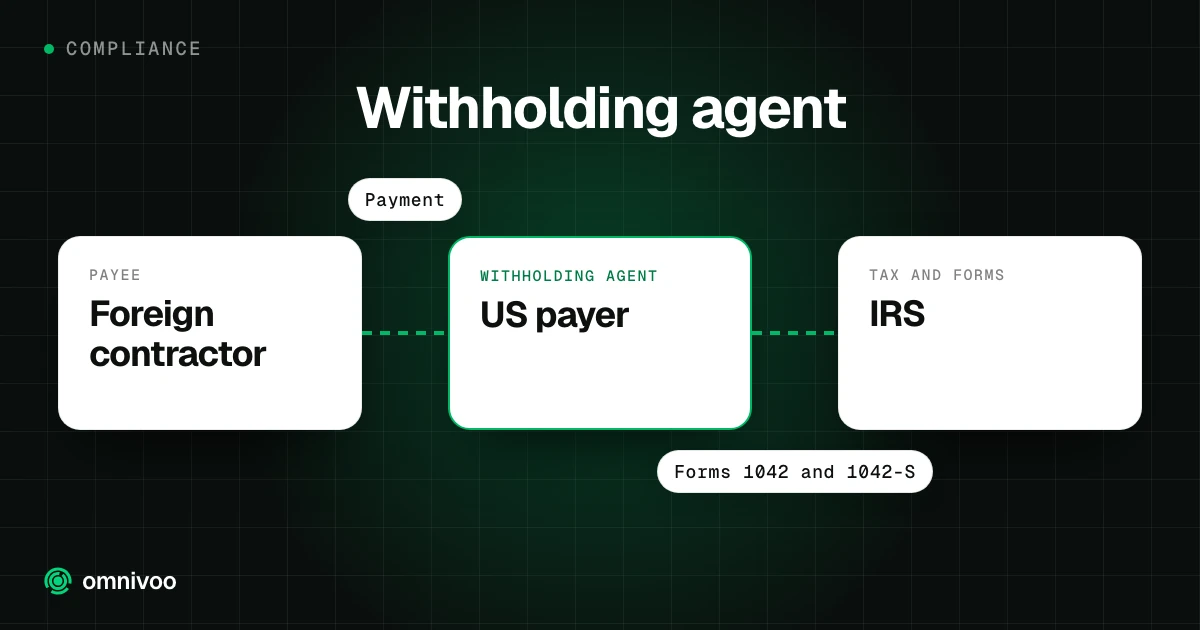
A US company is about to pay a contractor in another country. Someone on the finance team asks the right question: are we a withholding agent here? Because if the answer is yes, there is a tax to withhold, a return to file, and personal liability if it is done wrong.
The good news is that the IRS defines the term precisely, and the definition tells you exactly when the duties attach. The status is not about your nationality. It is about the payment. This guide gives the verified definition with the IRS citations attached, explains the personal-liability rule that makes the question matter, and shows the one fact that decides whether the duties bite for a given contractor.
A quick note before we start. This is general information, not tax or legal advice. Withholding outcomes turn on the facts of your situation, so confirm the specifics with a qualified tax professional before you pay.
What the IRS says a withholding agent is
The definition comes straight from IRS Publication 515, which states:
“You are a withholding agent if you are a U.S. or foreign person, in whatever capacity acting, that has control, receipt, custody, disposal, or payment of an amount subject to chapter 3 withholding.”
The IRS withholding agent page frames the same rule in terms of the income itself:
“You are a withholding agent if you are a U.S. or foreign person that has control, receipt, custody, disposal, or payment of any item of income of a foreign person that is subject to withholding.”
Read the two phrases that do the work. First, “a U.S. or foreign person.” A withholding agent can be either. Being a US company does not make you one, and being a foreign company does not exempt you. The nationality of the payer is not the test. Second, “an amount subject to chapter 3 withholding.” That is the actual trigger. You are a withholding agent only with respect to a payment that is an amount subject to withholding. No such amount, no agent duties for that payment.
The same Publication 515 also lists the forms a withholding agent can take. It can be “an individual, corporation, partnership, trust, association, or any other entity, including any foreign intermediary, foreign partnership, or U.S. branch of certain foreign banks and insurance companies.” A small US startup paying a single developer abroad is just as much a potential withholding agent as a large corporation. Size does not change the analysis.
Why this is not a label you want to ignore
The reason the question matters, rather than being a paperwork curiosity, is the liability rule. Publication 515 states it in one line:
“As a withholding agent, you are personally liable for any tax required to be withheld.”
The withholding agent page adds the part that stings:
“This liability is independent of the tax liability of the foreign person to whom the payment is made.”
Sit with that for a moment. If a payment was subject to withholding and you did not withhold, the IRS does not have to chase the contractor in another country. It can come to you for the amount that should have been withheld, plus interest and possible penalties, and the contractor’s own tax position does not let you off the hook. That is what turns “are we a withholding agent” into a question worth answering before the money moves, not after.
The one fact that decides it
So the whole thing reduces to a single question: is the payment an amount subject to withholding? For US-source income paid to a foreign person, the answer is generally yes. For foreign-source income, the answer is no.
For personal services, source of income is decided by where the work is physically performed, not where your company is, where the contract was signed, or where you paid from. That is the rule covered in detail in US-source vs foreign-source contractor income. Apply it here and the two outcomes fall out cleanly.
Work performed inside the US. When a foreign person performs services on US soil, that pay is US-source income, and US-source income paid to a foreign person is the trigger for the withholding regime. The IRS NRA withholding page states that “Most types of U.S. source income received by a foreign person are subject to U.S. tax of 30%,” under the chapter 3 rules. See the IRS NRA withholding page. For that payment, you are a withholding agent with real duties: withhold the tax, deposit it, and report it.
Work performed entirely abroad. When the foreign contractor does all of the work in their home country, the pay is foreign-source. The IRS page “Foreign Source Income - Form 1042-S Reporting Not Required” states:
“Foreign source income (non-U.S. source income) paid to a nonresident alien is normally not subject to U.S. tax under either chapter 3 or 4. Income from sources outside of the United States is exempt from NRA withholding under Internal Revenue Code Section 1441(a). It is normally not required to be reported on an information return.”
This is the heart of the answer. Foreign-source income is not an amount subject to withholding. So even though you are a US person making a payment to a foreign person, the agent duties do not bite for that payment, because there is no amount subject to withholding in the first place. You did not stop being a potential withholding agent. There just is nothing to withhold from.
Decision table
| The payment | Amount subject to withholding? | Are you a withholding agent for it? | What you do |
|---|---|---|---|
| US-source income, foreign person (work performed in the US) | Yes | Yes | Withhold 30 percent default, reducible by treaty, then report on Form 1042-S and file Form 1042 |
| Foreign-source income, foreign person (work performed entirely abroad) | No | No duties bite for this payment | Collect and keep a valid W-8BEN, no withholding, generally no information return |
| Payment to a US person | No (this regime targets foreign persons) | Not under chapter 3 NRA withholding | Different rules apply, such as 1099 reporting |
Notice what is absent. Your company’s US incorporation does not appear anywhere as a trigger. The table turns on the source of the income and the status of the recipient, exactly as the IRS definition says it should.
The trap: assuming “US payer” means “must withhold”
The instinct that gets US teams into trouble runs like this. We are a US company, we are paying a foreign person, so we are a withholding agent and we had better withhold 30 percent to be safe. Two of those steps are wrong.
You are a US person, true, and that is one half of the definition. But the definition also requires “an amount subject to chapter 3 withholding.” If the contractor did all the work abroad, there is no such amount, because the income is foreign-source and exempt under IRC section 1441(a). Withholding 30 percent from a payment that is not subject to withholding is not caution. It is taking money from a contractor that the rules never asked you to take, and you then have to unwind it.
The correct order is: check the source first, then decide whether you are a withholding agent for that payment. Source decides whether there is an amount subject to withholding. The amount decides whether the agent duties attach. Get the order backwards and you either over-withhold on foreign-source pay or, worse, under-withhold on US-source pay and inherit personal liability.
What documentation actually protects you
Knowing the source is one thing. Being able to show the IRS why you treated a payment as foreign-source is another. That is what the contractor’s tax form is for.
A foreign contractor documents foreign status to you on Form W-8BEN. A valid W-8BEN on file is your evidence that the recipient is a foreign person and that your foreign-source treatment was reasonable. Without it, you have a payment to someone whose status you cannot prove, and that is a weak place to stand if the question comes up later. Collect the form before the first payment, not after.
To get that step right every time, work through our W-8BEN collection checklist before your next payment. It is free, instant, and walks the steps with the IRS citations attached.
A quick decision path
Three questions, in order, for any foreign contractor you pay:
- Is the recipient a foreign person? If they are a US person, this NRA withholding regime is not the right frame. Different reporting applies.
- Where did the contractor physically perform the work? All abroad means foreign-source, which is not an amount subject to withholding, so no agent duties bite for that payment. Any work inside the US means at least part is US-source.
- For any US-source portion, what is the rate? The 30 percent default may drop, sometimes to zero, under a tax treaty with the contractor’s country of residence, claimed on a valid W-8BEN. Withhold, deposit, and report the US-source portion.
Run those three and you know whether you are a withholding agent for the payment, what to withhold, and what to keep on file.
When a platform handles it for you
A US founder paying one foreign contractor working abroad can run this analysis by hand and keep a W-8BEN in a folder. A US team paying contractors across several countries is tracking source-of-income calls, treaty positions, W-8BEN forms, and the line between which payments carry agent duties and which do not, and that is where the manual approach starts to leak.
Omnivoo Contract Management handles it for $29 per contractor per month. We collect the right tax form, run the KYC, draft and manage the contract, and pay your contractors in 220+ countries and territories, end to end. Transaction fees are passed through at cost, with competitive FX and no fee for contractors, cancel anytime.
Want the answer for your specific setup? See how Omnivoo Contract Management handles foreign contractors end to end, or talk to our team.