
The risk hiding behind a foreign hire
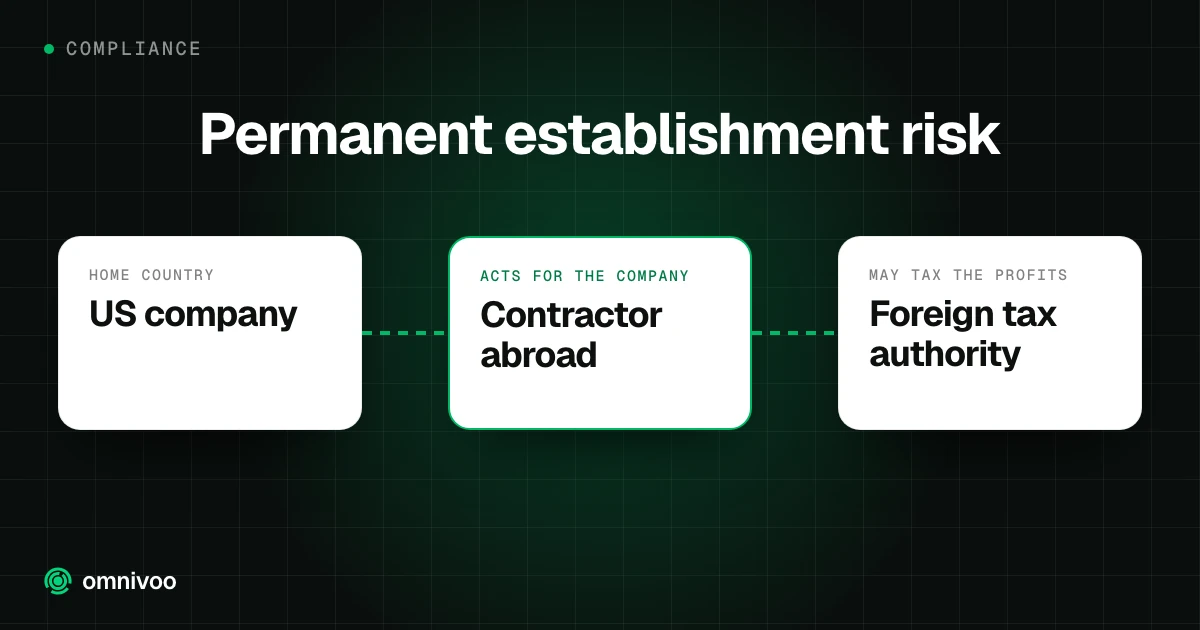
A US company hires a contractor in another country, pays them by invoice, and treats the relationship as a clean cross-border arrangement. In most cases it is. But there is a second question sitting underneath that hire, and it is not about the contractor’s tax. It is about yours. In some situations, the way a foreign contractor works for you can create a permanent establishment, a PE, for your US company in the contractor’s country. A PE can expose the company to local corporate income tax on the profits attributable to that presence.
This guide explains the concept with the OECD citations attached, draws the line between a genuinely independent contractor and the kind of arrangement that raises PE risk, and ties it back to the misclassification question most teams already know to watch. A note before we go further. This is general information, not tax or legal advice. PE is decided under the specific treaty between the US and the contractor’s country, or under local law where no treaty applies, and it turns on the facts of your arrangement. Confirm the specifics for each country with a qualified international tax advisor before you rely on any of this.
What a permanent establishment actually is
PE is an international tax concept, not a US one. It lives in tax treaties, and the reference text most treaties draw from is Article 5 of the OECD Model Tax Convention on Income and on Capital. The 2017 condensed version of the Model defines it in Article 5(1):
“For the purposes of this Convention, the term ‘permanent establishment’ means a fixed place of business through which the business of an enterprise is wholly or partly carried on.”
Article 5(2) gives examples of what that fixed place can look like: a place of management, a branch, an office, a factory, a workshop, and a mine or other place of extraction of natural resources. That is the first flavour of PE, the fixed place of business.
The second flavour is the one that matters more for contractor relationships, because it does not need an office. Article 5(5) of the Model describes the dependent agent PE:
“where a person is acting in a Contracting State on behalf of an enterprise and, in doing so, habitually concludes contracts, or habitually plays the principal role leading to the conclusion of contracts that are routinely concluded without material modification by the enterprise”
If that person is doing those things, the enterprise can be deemed to have a PE in that state. In plain terms, a person abroad who habitually closes deals in your name, or habitually drives deals you then rubber-stamp, can create a taxable presence for you, even with no office and no signage.
Why a PE matters: local corporate tax
The reason any of this is worth your attention is the tax outcome. Article 7(1) of the OECD Model sets the rule:
“Profits of an enterprise of a Contracting State shall be taxable only in that State unless the enterprise carries on business in the other Contracting State through a permanent establishment situated therein. If the enterprise carries on business as aforesaid, the profits that are attributable to the permanent establishment in accordance with the provisions of paragraph 2 may be taxed in that other State.”
Read the structure. With no PE, your profits are taxable only in the US. With a PE, the country where the PE sits can tax the profits attributable to it. That is local corporate income tax on a slice of your business, in a country where you may not have realised you had a presence. Registration, filings, and indirect taxes can follow, and the exposure compounds quietly over time because nobody filed for a presence nobody knew existed.
Why most contractors do not create a PE
Here is the part that should lower the temperature for the common case. A genuinely independent contractor generally does not create a PE for you, because of the independent agent exception. Article 5(6) of the OECD Model carves it out:
“Paragraph 5 shall not apply where the person acting in a Contracting State on behalf of an enterprise of the other Contracting State carries on business in the first-mentioned State as an independent agent and acts for the enterprise in the ordinary course of that business.”
Two ideas do the work in that sentence. The person has to be an independent agent, running their own business, and they have to act for you in the ordinary course of that business. A freelance developer serving several clients, deciding how and when they work, and not signing contracts in your name fits that description. The dependent agent rule in Article 5(5) is written to be subject to this exception, so the exception is doing real protective work for ordinary independent contractor relationships.
But Article 5(6) draws its own limit. The same paragraph continues:
“Where, however, a person acts exclusively or almost exclusively on behalf of one or more enterprises to which it is closely related, that person shall not be considered to be an independent agent within the meaning of this paragraph with respect to any such enterprise.”
The exclusive-or-almost-exclusive language is the warning sign. A contractor who works only for you, over a long period, starts to look less like an independent business and more like part of yours.
When the risk goes up
Putting the pieces together, the facts that tend to raise PE risk in a contractor relationship are the facts that make the contractor look less independent and more like a fixture of your company.
- Authority to bind you. A contractor who habitually concludes contracts in your name, or habitually drives deals you then accept without real change, is squarely in the dependent agent zone of Article 5(5).
- Exclusivity over a long term. A contractor who works only, or almost only, for you, especially over years, can lose the protection of the independent agent exception under Article 5(6).
- Disguised employment. A contractor who is effectively an employee in everything but name, working under your direction, on your schedule, integrated into your operations, undercuts the claim that they are running their own independent business.
- A fixed place at your disposal. A space the contractor uses for you, with enough permanence and control by your company, can edge toward the fixed-place-of-business PE under Article 5(1).
None of these is a switch that flips automatically. PE is a facts-and-circumstances test, and a single factor rarely decides it. But the pattern is clear: the further a relationship drifts from a self-directed, multi-client, arm’s-length contractor, the more PE analysis it deserves.
It is the treaty that decides, country by country
One point cannot be repeated too often. The OECD Model is a model. It is not the law in any single country. The rule that actually applies to your contractor is in the specific tax treaty between the US and that contractor’s country, and many treaties modify the Model. Some shorten time thresholds. Some, especially those following the UN Model Double Taxation Convention, add a service PE concept that the OECD Model does not contain. Where there is no treaty at all, local domestic law governs, and it can be broader than any model.
So the answer to “does my contractor in country X create a PE” is never a flat yes or no from a model treaty. It is: check the US treaty with country X, or country X’s domestic law where there is no treaty, against the actual facts of your arrangement. That is country-by-country work, and it is why this is a question for a qualified international tax advisor rather than a general rule you apply once and forget.
The misclassification connection
If the PE warning signs sound familiar, that is because they overlap heavily with worker misclassification. Exclusivity, control, integration, and authority to act for the company are the same facts that push a contractor toward employee status under local labour and tax law. A contractor who looks like a disguised employee can raise both questions at the same time, the labour-law misclassification question and the corporate-tax PE question, from the same set of facts. Treating contractor relationships as genuinely arm’s-length, with real independence, is good practice for both risks at once. For the underlying tax-treaty concept, our permanent establishment glossary entry walks through the OECD Article 5 flavours in more depth.
The EOR alternative, and its limits
When a relationship needs to be a real, long-term, full-time role in another country, the contractor route is often the wrong tool, and trying to manage PE risk by contract terms alone can be fragile. One option that sidesteps the build-your-own-entity question is an employer of record. An EOR is a local entity that legally employs the worker in their country on your behalf, so the worker is a properly classified local employee of the EOR, not a contractor and not an employee of your US company. That removes the question of whether you need to set up your own subsidiary to employ someone there. It does not, by itself, resolve every PE question for your wider operations, and it is still worth confirming the local position with a tax advisor, but it changes the shape of the problem for the employment relationship itself.
One scope note so this is not misread. Omnivoo’s EOR offering is India-only. If your worker is in India and the role is genuinely an employment role, an EOR is worth weighing against contractor status. For contractors in other countries, an EOR is not the lever, and the analysis stays a contractor-versus-PE question under the relevant treaty.
How a platform helps on the contractor side
For genuinely independent contractors abroad, the practical defence is to keep the relationship genuinely arm’s-length and well documented: a clear scope, no authority to bind your company, no exclusivity dressed up as freelancing, and proper paperwork. That is easy to say and easy to let slip across a dozen contractors in a dozen countries.
Omnivoo Contract Management handles the contractor side end to end for $29 per contractor per month. We collect the right tax forms, run the KYC, draft and manage the contract, and pay your contractors in 220+ countries and territories. Transaction fees are passed through at cost, with competitive FX and no fee for contractors, cancel anytime. It keeps the documentation of an independent contractor relationship clean, which is exactly the record you want if a PE or misclassification question ever surfaces.
Want to get your contractor relationships on solid footing? See how Omnivoo Contract Management handles foreign contractors end to end, or talk to our team. And for the PE call on any specific country, get advice from a qualified international tax professional before you rely on it.