
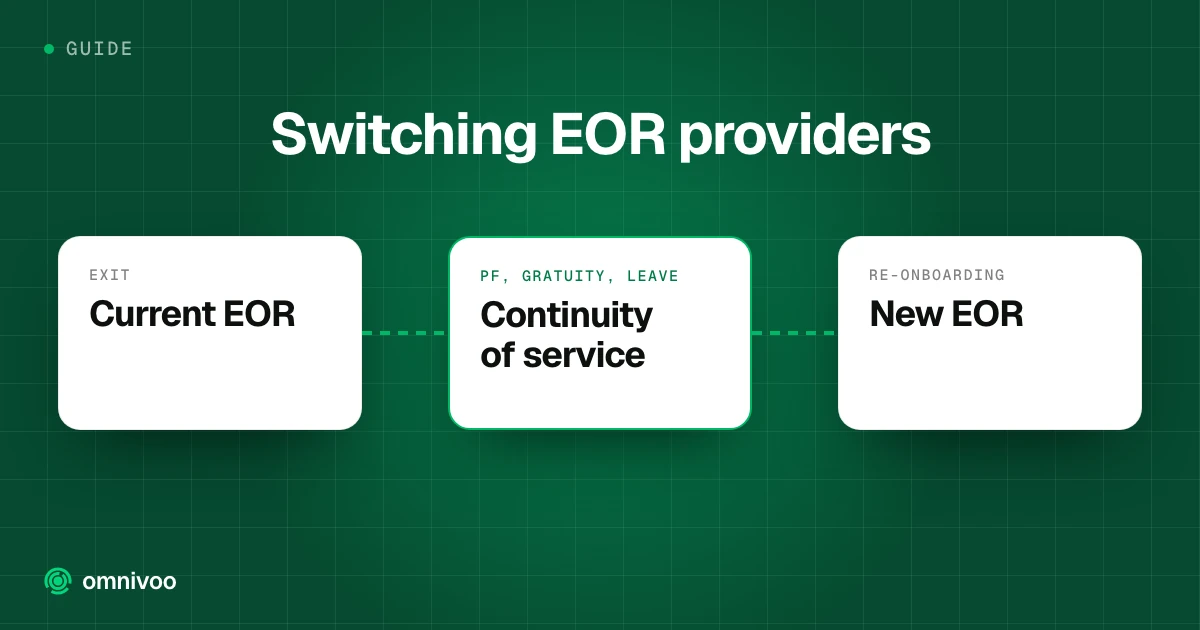
Switching EOR is a statutory exercise, not a procurement one
Most companies decide to change their India EOR for ordinary reasons: the fee stopped making sense, support degraded, or the provider could not register in a state where a new hire wanted to sit. The decision is easy. The migration is where it goes wrong, and it goes wrong in a specific, predictable way.
The contract between you and the provider is the least interesting part. What matters is that the Employer of Record is your employees’ legal employer in India, so changing it means changing who legally employs them. Every statutory thread attached to that employment relationship, Provident Fund, ESI, gratuity, Professional Tax, TDS, has to be picked up and reattached without dropping. Drop one and your employee pays for it, usually without noticing until years later.
This guide covers what actually breaks, in the order it breaks.
The thing that matters most: continuity of service
If you take one point from this guide, take this one. Gratuity under the Payment of Gratuity Act 1972 vests only after five years of continuous service. If your migration is structured as a resignation from the old EOR followed by a fresh appointment at the new one, the employee’s service legally restarts. Someone four years into their tenure goes back to zero and has to serve five more years to earn a benefit they had almost qualified for.
They will not read the paperwork closely enough to catch it. You will find out when they resign at what they believe is year six and the gratuity calculation comes back at year two.
The alternative is a transfer that recognises prior service. The old EOR entity, the new EOR entity and the employee all sign a document recording that employment moves across on terms no less favourable, that the original date of joining carries forward, and that accrued benefits transfer rather than being settled. Section 73 of the Industrial Relations Code 2020 contains the transfer-of-undertaking machinery that this pattern leans on: employees move with continuity of service and no break in tenure.
Not every provider will do this. Some EOR platforms cannot represent a start date earlier than the date the record was created in their system, so resign-and-rehire is the only shape they can offer. That is a product limitation being presented as a legal requirement. Ask directly, in writing, whether prior service is recognised in the new employment contract, and read the draft contract rather than the sales answer.
Provident Fund: the UAN is not yours to close
The Universal Account Number belongs to the employee. It follows them across every job they ever hold. No employer closes it and no employer issues a new one, which means the correct action during a migration is narrow: link the new EOR’s establishment code to the existing UAN and transfer the accumulated balance through Form 13.
For members whose Aadhaar and bank details are verified, EPFO now automates most of that transfer. What is not automated is the piece the outgoing EOR owns. They must file their final Electronic Challan cum Return and, critically, mark the date of exit against the member. A blank exit date is the most common reason a transfer claim sits unprocessed, because EPFO reads the member as still employed at the old establishment and will not move a live account.
So the PF checklist is short and it is mostly about the provider you are leaving:
- Outgoing EOR files the final ECR for the last month it ran payroll.
- Outgoing EOR marks the date of exit for every transferring member.
- New EOR links its establishment code to the same UAN, no new numbers.
- Employee raises the Form 13 transfer claim, or it auto-initiates if verified.
- You confirm the passbook shows the transferred balance before you close the old engagement.
Confirm that last step yourself. It is the only proof the transfer completed.
ESI, Professional Tax and the state question
ESI applies to employees earning at or below the wage ceiling. Where it applies, the employee’s insurance number is re-registered under the new employer, and the gap matters here more than it does with PF, because ESI is an active medical benefit rather than a savings balance. A month uncovered is a month where a hospital claim is denied.
Professional Tax is levied by state, at state-set slabs, and the new EOR needs to enrol each employee in the state where they actually work. This is where migrations quietly fail, because it is the same problem that made you leave your last provider: registration coverage.
India is 28 states and 8 union territories, and a Shops and Establishments Act registration is state-specific. An EOR that holds live registrations in Karnataka, Maharashtra and Telangana cannot compliantly employ your engineer in Kerala. Before signing, get the incoming provider’s exact list of states with live registrations, and check it against where your people sit today, not where they sat when you hired them. Remote teams drift. Someone who joined in Bengaluru may now be in Kochi.
We wrote about how much this varies in the Professional Tax state-by-state guide, and the same state-fragmentation problem drives most of the comparison between India EOR providers.
Timing: cut over at a month boundary
Run the switch so that the outgoing EOR completes one final full-month payroll and the incoming EOR starts on the first of the next month. A mid-month cutover splits a single month’s salary across two employers with two different PANs, which produces two partial payrolls, two partial statutory filings and a reconciliation nobody enjoys.
The month boundary also keeps Form 16 sane. The employee will still receive two Form 16s for a mid-year switch, one from each employer, and that is normal and unavoidable. What you want to avoid is two Form 16s that each cover a fragment of a month.
The other half of that is Form 12B. When an employee joins a new employer mid financial year, they declare their previous employer’s salary and TDS on Form 12B so the new employer computes withholding on the full-year total. Skip it and both employers independently apply the basic exemption and the lower slabs, the employee under-withholds all year, and the shortfall lands as a demand at filing time along with interest. A competent incoming EOR collects Form 12B during onboarding without being asked. Ask whether they do.
Where the gratuity money went
You have very likely been funding gratuity already. Most India EORs accrue a monthly gratuity provision, roughly 4.81 percent of basic salary, and bill it to you on the monthly invoice. Over three years on a team of ten, that is a real sum sitting somewhere.
At migration, ask the outgoing provider one question: is accrued gratuity transferred to the incoming entity, or is it settled and paid out to the employee at separation?
If it transfers and prior service is recognised, the clock keeps running and the funding follows it. If it is paid out, service restarts, the five-year qualifying period begins again, and you will fund the same benefit a second time over the following years. Neither answer is wrong on its own. Getting the answer after the migration is what costs money.
The same question applies to leave. Accrued but unused leave either carries across or is encashed at separation. Encashment is not a disaster, but employees who expected to carry 18 days into the new year and instead received a small payout will be unhappy, and you would rather set that expectation before the cutover than after.
A migration checklist you can hold a provider to
Work through this in order. Anything you cannot get a written answer to is a risk you are accepting, not a detail you are deferring.
Before you sign
- Live Shops and Establishments registrations in every state where your people currently sit.
- Confirmation in writing that prior service is recognised and the original date of joining carries into the new contract.
- Treatment of accrued gratuity: transferred, or paid out.
- Treatment of accrued leave: carried, or encashed.
- FX rate policy and the margin applied on payroll conversion, since that is often larger than the seat fee. Our EOR cost breakdown covers why that line item hides so well.
- A sample transfer letter and a sample payslip from a real client.
During the cutover month
- Outgoing EOR runs one final full-month payroll.
- Outgoing EOR files the final ECR and marks the date of exit for every member.
- New EOR collects documents, links the establishment code to each existing UAN, re-registers ESI, enrols Professional Tax by state.
- Form 12B collected from every employee.
- Tripartite transfer letters signed by both entities and each employee.
After the first payroll on the new provider
- Check each employee’s PF passbook shows the transferred balance.
- Check the first payslip carries the original date of joining, not the migration date.
- Check Professional Tax is being deducted at the correct state slab.
- Reconcile the first invoice against the quoted fee, deposit and FX rate.
When not to switch
Two situations where staying put is the better call.
If you are within a few months of an employee crossing five years of service and you cannot get written confirmation that prior service transfers, wait. The cost of a few more months on an expensive provider is smaller than the cost of resetting that employee’s gratuity entitlement and then explaining it to them.
If your real problem is that India is now large enough to justify your own entity, migrating to a second EOR is a detour. The threshold sits somewhere around twenty employees for most companies, and the trade-offs are laid out in EOR vs setting up your own entity in India. Moving from EOR to your own subsidiary raises the same continuity-of-service questions this guide covers, so the work is not wasted, but do it once rather than twice.
The short version
An India EOR migration is not hard, it is just unforgiving. The contract will be fine. What breaks is continuity of service, and it breaks silently, months or years after everyone involved has moved on.
Get prior service recognised in writing. Keep the UAN. Make the outgoing provider mark the exit date. Cut over at a month boundary. Collect Form 12B. Check the states before you sign, not after your next hire picks a city nobody is registered in.
If you are evaluating where to move, our comparison of India EOR providers covers pricing, state coverage and onboarding speed side by side.