
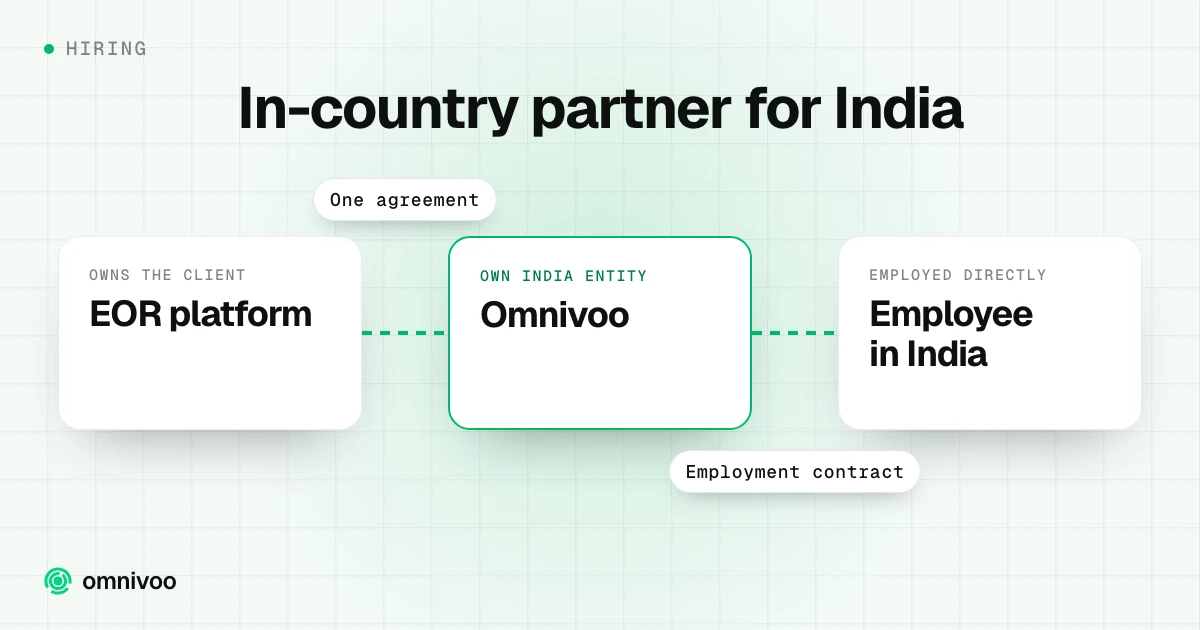
An in-country partner (ICP) is how most EOR and HR platforms cover a country where they have no entity of their own. For India, the choice of ICP decides whether your client’s employees are looked after by the company you signed with, or by a vendor two steps further away. This guide explains what an India ICP does, where partner chains go wrong, and the questions to ask before you sign. If you already know what you need, the Omnivoo partner programme covers our terms.
What an in-country partner does
An employer of record employs people on behalf of another company. When a global EOR platform has no entity in a country, it signs an agreement with a local company that does. That local company is the in-country partner.
In India, the ICP:
- Signs the Indian employment contract as the legal employer.
- Runs monthly payroll and issues payslips.
- Deposits EPF, ESI, Professional Tax and TDS, and files the returns.
- Handles gratuity, Form 16 and the full and final settlement when someone leaves.
The platform keeps the client. It sells the service, signs the client contract and sends the invoice. The ICP stays behind it. For the basics of the model, see how an employer of record works in India.
The subcontracting problem
Not every India ICP employs anyone. Some sell the service and pass the work to a local vendor. Some of those vendors pass it on again.
That creates a partner chain. Your platform contracts the ICP. The ICP contracts a vendor. The vendor signs the employment contract. Your client’s employee is now two or three companies away from the platform that sold the service.
Chains cause three problems:
- Slow answers. A payroll question goes from your client to you, to the ICP, to the vendor, and back. Each hop adds a day.
- Unclear responsibility. When a filing is late or a payslip is wrong, each company points to the next one.
- Weaker records. Statutory filings and employment documents sit with a company you have no contract with.
None of this is visible from a sales deck. You find it when something goes wrong.
Questions to ask any India ICP
Use these before you sign. A good ICP answers them in writing without hesitating.
Whose entity signs the employment contract?
Ask for the legal name of the Indian entity that will be the employer, and who owns it. If the answer is a company other than the one you are signing with, you are looking at a chain.
Is any part of the work subcontracted?
Payroll processing, statutory filings and employee support can each be outsourced separately. Ask about each one by name.
Who holds the employment contract and the records?
Your client may need the contract, payslips or filing proofs during an audit or a due diligence check. Ask who keeps them and how fast you can get copies.
Who funds payroll, and when?
Most ICPs ask the platform to fund payroll in advance each month, often with a refundable deposit per employee. Ask for the exact funding date, the deposit terms and what happens if funding is late.
How fast do they respond?
Ask for a named contact and a response time. A ticket queue in another time zone is not the same as a person who answers within a day.
Will they ever contact your clients?
The answer should be no, and it should be in the agreement. An ICP that can approach your clients can also take them.
Can you see what is happening?
Ask whether you get a dashboard with payroll approvals, payment tracking and filing status, or whether you rely on emailed reports.
Eight signs of a weak ICP
- The employer named in the contract differs from the company you sign with.
- They cannot name the entity that files EPF and ESI.
- Payroll, filings and support are run by three different firms.
- There is no named contact, only a shared inbox.
- Filing proofs arrive late or only on request.
- The agreement allows them to contact your clients.
- Offboarding steps and full and final settlement are vague.
- Terms change with every new hire instead of following a written agreement.
How it works with Omnivoo
We are an in-country partner for EOR and HR platforms that need India. We do not subcontract. We employ through our own India entity, founded and run by the same people as Omnivoo, not a third-party partner. One hop: you, then us.
- Apply and take a short call. We walk you through the programme and the agreement.
- Sign once, add employees as you place them. Add an employee on the dashboard and the employment contract is ready the same day.
- We run everything monthly. Payroll, payslips, EPF, ESI, Professional Tax, TDS, gratuity and Form 16. You track every payment on the dashboard.
You fund payroll in advance each month, plus a refundable deposit of one month’s salary per employee. The first payroll runs in 5 to 6 business days. Your client sees your brand, and we never contact them.
If you sell under your own brand, read how white-label India EOR works for agencies and recruiters.
Adding India to your platform
An India ICP should be one agreement and one hop, with your client relationship untouched. If that is what you are looking for, apply to the Omnivoo partner programme and we will reply within 24 hours with a call link. Questions first? Email contact@omnivoo.com.