
Why this guide exists
Nigeria has become one of the most active African corridors for US companies hiring offshore. Lagos in particular hosts a deep pool of software, design, and product talent, with English as the primary working language and a strong startup ecosystem. The challenges in Nigeria are different from South Asian markets: there is no US-Nigeria tax treaty, FX policy was overhauled by CBN in 2023, and the tax system was substantially reformed by the Nigeria Tax Act effective January 2026.
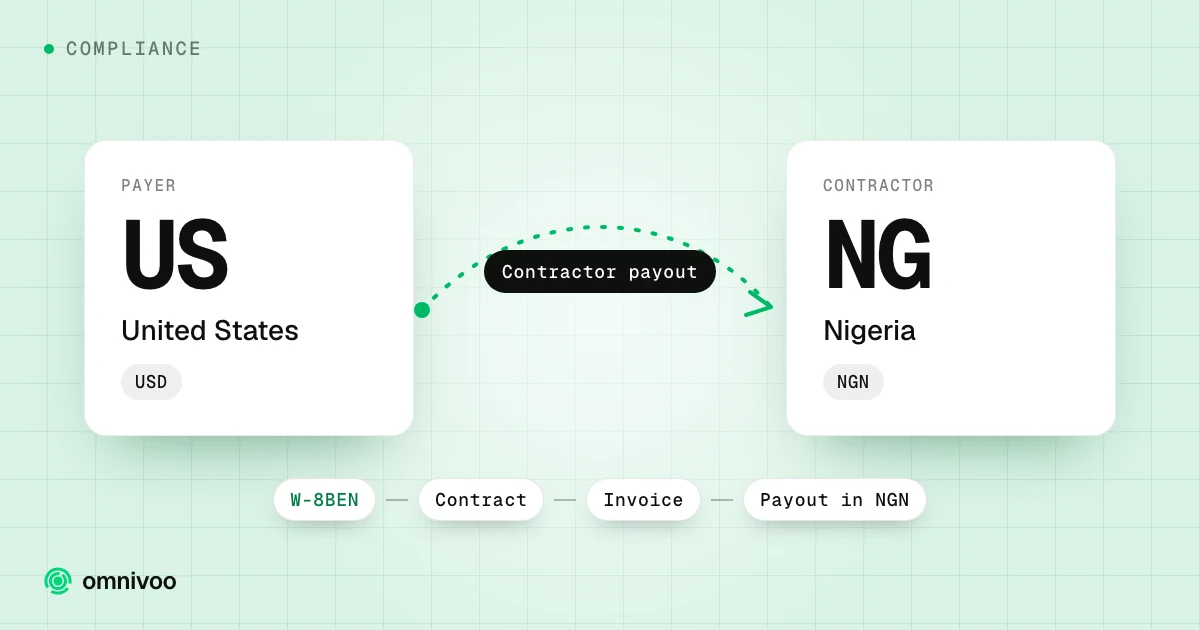
This guide walks through the full stack for US companies paying their first Nigerian contractor.
US side: what you do as the payer
Step 1. Collect a W-8BEN before the first payment
The contractor completes Form W-8BEN certifying Nigerian tax residency and beneficial ownership of the income. The form is valid from signature through December 31 of the third following calendar year. Use the free W-8BEN collection checklist to confirm you have the right form and fields.
If the contractor operates through a Nigerian Limited Liability Company or Business Name registered with the Corporate Affairs Commission, the form is W-8BEN-E.
Step 2. Confirm services are performed in Nigeria
The decisive question. Under IRS rules on source of income for personal services, services are sourced to the country where the work is physically performed. A developer in Lagos, Abuja, or Port Harcourt working entirely from Nigeria generates Nigerian source income from the US perspective.
Services performed outside the US by a nonresident alien are foreign source income and are not subject to US withholding or Form 1042-S reporting. You also do not file a 1099-NEC because 1099-NEC applies only to US person payees.
If the contractor visits the US for onsite work, days inside the US must be allocated to US source income.
Step 3. No US-Nigeria tax treaty
Nigeria is not on the IRS A-to-Z list of US income tax treaties. There is no comprehensive US-Nigeria income tax treaty in force.
This matters only for US source income. If your Nigerian contractor performs work inside the US, or earns US-source FDAP (royalties, interest, dividends), the default US withholding under IRC Sections 1441 and 1442 is 30 percent and there is no treaty rate to reduce it. The contractor can file a US tax return to claim deductions or credits, but the 30 percent at source is the starting point.
For purely offshore services performed in Nigeria, the absence of a treaty is a non-issue because the US has no withholding right in the first place under source rules.
Nigeria side: what the contractor handles
The Nigerian piece is the contractor’s responsibility, not yours. Understanding it helps you talk through invoice fields and documentation requests.
TIN, FIRS, and State Internal Revenue Services
The Federal Inland Revenue Service (FIRS) administers federal taxes including corporate income tax, VAT, and WHT. Personal income tax for resident individuals is administered by the State Internal Revenue Service of the contractor’s state of residence (LIRS for Lagos, FCT-IRS for Abuja, and so on).
Every resident individual is required to obtain a Tax Identification Number (TIN). Filing of annual personal income tax returns is done with the State IRS based on the state of residence.
Personal Income Tax bands under the Nigeria Tax Act
The Nigeria Tax Act 2025 took effect January 1, 2026 and substantially reformed personal income tax. The new PIT bands are:
- 0 percent on first NGN 800,000
- 7 percent on NGN 800,001 to NGN 1,600,000
- 11 percent on NGN 1,600,001 to NGN 4,800,000
- 15 percent on NGN 4,800,001 to NGN 6,400,000
- 25 percent on income above NGN 6,400,000
The new act also introduced a rent relief of 20 percent of rent paid, capped at NGN 500,000 per year. Note: alternative bracket structures have circulated in commentary referencing the gradual rollout. The bands above reflect the first-phase implementation under the Nigeria Tax Act 2025 effective 2026.
Withholding tax on professional services
The Nigeria Tax Act 2025 reduced withholding tax on professional, management, technical, and consultancy services for Nigerian residents from 10 percent to 5 percent. For non-resident companies, the rate remains 10 percent.
This WHT is a Nigerian-side obligation that applies when a Nigerian payer makes the payment. A US payer with no Nigerian permanent establishment is not required to deduct Nigerian WHT. The contractor is responsible for paying their own income tax on the gross amount received.
VAT under the Nigeria Tax Act
Nigeria’s VAT rate is 7.5 percent under the VAT Act (now subsumed under the Nigeria Tax Act framework). Exports of services to foreign recipients are zero rated. From January 1, 2026, food and basic consumables are zero rated and healthcare, medicines, education, and passenger road transport are exempt.
For your Nigerian contractor exporting services to your US company, the supply is zero rated. The contractor invoices in USD with no Nigerian VAT charged, subject to documentation of the foreign recipient and the foreign currency receipt.
CBN foreign exchange and the NFEM window
The Central Bank of Nigeria (CBN) is the FX regulator. In June 2023, CBN abolished the multiple-window FX structure and consolidated trading into the former Investors and Exporters (I&E) Window, now renamed the Nigerian Foreign Exchange Market (NFEM), operating on a willing-buyer willing-seller pricing model.
For your contractor, this means:
- Inward USD remittances are credited at NFEM rates by the contractor’s bank.
- There is no separate official rate to the prior multiple-window era.
- Domiciliary accounts in USD, GBP, and EUR are available to resident individuals.
The contractor can hold USD in a domiciliary account or convert to NGN at the prevailing NFEM rate.
The payment rail decision
Four real options for paying a Nigerian contractor from a US bank account.
SWIFT through your US bank. The universal rail. Cost: USD 25 to USD 50 sender fee plus intermediary deductions (USD 15 to USD 25) plus an FX margin at the contractor’s bank. Funds typically land in the contractor’s USD domiciliary account, from which conversion to NGN is the contractor’s choice.
Wise. Wise supports payouts to Nigerian bank accounts in NGN. Quotes the mid-market rate plus a transparent margin (typically 0.8 to 1.2 percent for USD to NGN). Settlement: same day to one business day.
Payoneer. Widely used by Nigerian freelancers on Upwork, Fiverr, and direct client work. Operates a withdraw-to-local-bank model. Particularly common among Nigerian developers and designers serving US clients.
Grey, Geegpay, Eversend. Africa-focused fintechs that offer virtual USD accounts to Nigerian residents, allowing the contractor to receive USD via a US bank routing number, then convert to NGN at competitive rates. These services have grown significantly post-CBN reforms.
For most US companies paying one to ten Nigerian contractors, Payoneer or one of the Africa-focused fintechs is the cleanest option. SWIFT to a domiciliary account is fine for one-off larger payments.
Misclassification risk in Nigeria
Nigeria’s Labour Act governs the employment relationship. Substance-over-form applies: a worker engaged on paper as a contractor can be reclassified as an employee if the engagement looks like employment in practice (fixed hours, exclusivity, integration, control).
Reclassification consequences include backdated National Housing Fund contributions, pension contributions under the Pension Reform Act 2014, and Industrial Training Fund contributions for qualifying employers. The US principal can be drawn into a claim even with no Nigerian entity when the contractor sues for benefits before the National Industrial Court.
The mitigations: a properly drafted service agreement, scope tied to deliverables rather than time, evidence the contractor has other clients, and a periodic review of misclassification risk. Omnivoo Contract Management builds these in by default.
End-to-end workflow
The clean version for a US company onboarding its first Nigerian contractor.
- Send the contractor an SOW that defines deliverables, payment, IP assignment, and termination.
- Collect a signed W-8BEN before any payment moves.
- Confirm the contractor has a TIN and is registered with their State Internal Revenue Service.
- Pick a payment rail (Payoneer, Grey, or Wise for most cases) and confirm the contractor has a domiciliary account if you plan to send USD via SWIFT.
- Pay invoices on schedule. Keep the W-8BEN, SOW, invoice, and payment receipt together.
- Review the engagement quarterly for misclassification risk and refresh the W-8BEN every three years.
For broader context, see our guide on FX margin in international contractor payments and our guide on how to pay international contractors from the US. If you pay contractors elsewhere in the region, see our guides on paying Kenya, South Africa, and Egypt contractors.
When a platform pays for itself
A US founder paying one Nigerian contractor can do this manually. A US team paying five or more Nigerian contractors faces enough W-8BEN refreshes, FX margin questions, and misclassification reviews that a platform pays for itself.
Omnivoo Contract Management handles the SOW with Nigeria-specific IP and misclassification clauses, collects the W-8BEN, runs the FX payment through a local NGN or USD rail, and stores the full packet for audit. Transaction fees are passed through at cost.
For pricing across both Contract Management and Contractor of Record options, our pricing page lays out the products side by side.
A simple sanity check
Three questions for every Nigerian contractor relationship.
- Is there a signed W-8BEN on file?
- Will all the work be performed in Nigeria for the foreseeable future?
- Are we paying through a rail that avoids SWIFT correspondent leakage and lands in a CBN-supervised account?
If yes to all three, you are 95 percent of the way to a clean US-Nigeria contractor payment stack. The remaining 5 percent is misclassification hygiene over time.
Want to skip the assembly entirely? See how Omnivoo Contract Management handles Nigerian contractors end to end, or talk to our team about your specific setup.