
Why this guide exists
South Africa is one of the strongest English-language talent corridors for US companies. Cape Town and Johannesburg have mature software, design, and customer-operations pools, the time zone overlaps the European morning and the US east-coast start, and rates are competitive. The two things that surprise US founders are exchange control, which South Africa still operates through the Reserve Bank, and a tax system where the distinction between an employee and an independent contractor is tested with real teeth by both the revenue authority and the labour courts.
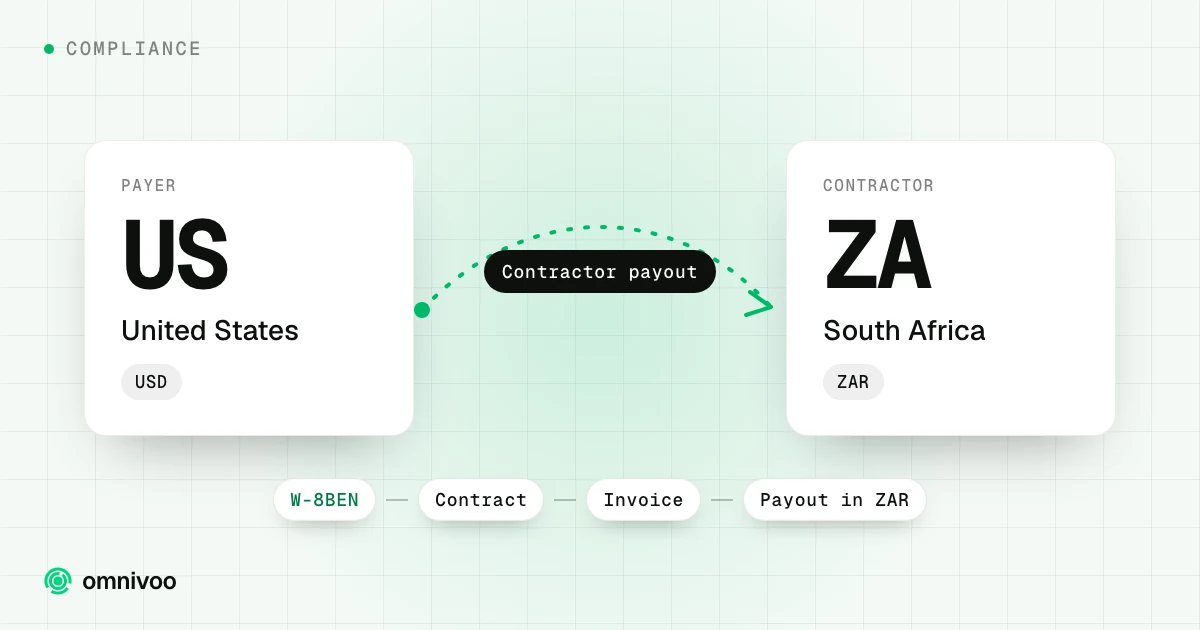
This guide covers the full stack for a US company paying contractors in South Africa. We look at the US side (W-8BEN, treaty application, 1042-S), the South Africa side (SARS registration, VAT on exported services, UIF, SARB exchange control), and the payment rail. By the end you should know exactly what to ask your contractor for and what each document is doing in the chain.
If you want to skip the assembly and let a platform run the whole stack, Omnivoo Contract Management handles SOW drafting, W-8BEN collection, invoice capture, and ZAR or USD payouts for $29 per contractor per month.
US side: what you need to do as the payer
Step 1. Collect a W-8BEN before the first payment
The first action is non-negotiable. Before any invoice is paid, the contractor must complete Form W-8BEN and return it to you. The form certifies the contractor is the beneficial owner of the income, is a tax resident of South Africa, and is not a US person. The IRS version lives on the official Form W-8BEN page.
The W-8BEN is valid through the end of the third calendar year after signature and must be refreshed when it expires or when a relevant fact changes, such as address or treaty country. If your contractor operates through a registered South African company (a Pty Ltd), the form is Form W-8BEN-E, the entity equivalent on the IRS Form W-8BEN-E page. Before you pay, run through our W-8BEN collection checklist to make sure the form is complete.
Step 2. Confirm the work is performed in South Africa
Under IRS source of income rules for personal services, services income is sourced to the place where the services are physically performed. If your contractor does the work entirely from Cape Town, Johannesburg, or Durban, the income is foreign source income from the US perspective.
The practical takeaway: no withholding, no Form 1042-S, and no 1099-NEC, which is for US persons only. You keep the W-8BEN, the SOW, the contractor’s invoice, and the payment receipt as the documentation packet.
If the contractor visits the US for an onsite stretch, the days physically worked inside the US are US source days. Those days have to be allocated and may trigger withholding plus a 1042-S. A simple onsite-days log keeps this clean.
Step 3. Know the treaty for the edge cases
South Africa appears on the IRS list of US income tax treaties. The convention was signed in 1997 and, per the IRS South Africa tax treaty documents page, is in force and applies from January 1, 1998. It governs the cases where your payment generates US source income.
The treaty’s independent personal services article generally allows South Africa to tax personal services income unless the contractor has a fixed base regularly available in the US or meets the treaty’s presence test. The royalties article limits US withholding on royalties to a treaty rate below the 30 percent statutory default. The exact article numbers and rates are in the treaty text on the IRS South Africa page.
For most pure services engagements, the independent personal services article is the relevant one and you should not need to withhold. The cleanest practice is to draft the SOW as a pure services agreement with full IP assignment for value already included in the fee, which avoids splitting the fee into a royalty component. If a treaty rate is ever claimed on US source income, the contractor uses Form 8233 or the W-8BEN to claim it, per the IRS Form 8233 page.
South Africa side: what your contractor handles
You as the US payer are not in scope for most South African taxes. The contractor is. Understanding the landscape helps you talk through invoice fields and documentation requests.
SARS registration and income tax
Every South African contractor registers with the South African Revenue Service (SARS) for an income tax number and files an annual return. Income earned from a US client for work performed in South Africa is South African source income. The contractor declares it and pays income tax at the individual rates, or corporate tax if they run a Pty Ltd. As the US payer you do not deduct South African tax. Provisional taxpayers, which most full-time contractors become, make payments to SARS through the year.
VAT on exported services
South Africa’s standard VAT rate is 15 percent. A VAT-registered vendor supplying services to a non-resident who is outside South Africa generally applies the zero rate under the VAT Act, subject to the documentation rules SARS requires for zero-rating an exported service. Many individual contractors fall below the compulsory VAT registration threshold and charge no VAT at all.
For you as the US payer, this is the contractor’s matter to handle. You do not pay or recover South African VAT on the invoice.
UIF and what does not apply
The Unemployment Insurance Fund (UIF) is a payroll contribution that applies to the employer-employee relationship. A genuine independent contractor is outside UIF, and a US payer with no South African entity does not contribute to it. The fact that UIF, skills development levy, and similar payroll obligations are absent is one reason the misclassification line matters, because reclassification would pull those obligations back in.
SARB exchange control on inbound funds
South Africa maintains exchange control administered by the South African Reserve Bank (SARB) through its Financial Surveillance Department. Inbound foreign currency must be received through an Authorised Dealer, a commercial bank licensed by SARB to deal in foreign exchange. The bank credits the funds, reports the inflow for balance of payments purposes, and may ask the contractor to state the reason for the payment (for example, services rendered to a foreign client).
For your contractor this means the money lands cleanly as long as it arrives through a normal South African bank account, which by definition operates through an Authorised Dealer. It is a reporting step, not a barrier, and it is one reason paying out in ZAR to a domestic account is usually smoother than asking the contractor to receive USD through an informal channel.
The payment rail decision
There are four real options for paying a South African contractor from a US bank account.
| Rail | Typical FX margin | Speed | Notes |
|---|---|---|---|
| US bank SWIFT wire | 2 to 4 percent | 2 to 4 business days | Lands in ZAR via the contractor’s Authorised Dealer, correspondent fees apply |
| Wise USD to ZAR | Mid-market plus a transparent margin | Same day to one business day | Supports payout to South African bank accounts in ZAR |
| Payoneer | Tiered, lower at volume | One to two business days | Common with South African freelancers serving US clients |
| ZAR EFT or PayShap on arrival | Bank spot on conversion | EFT same day, PayShap near instant | Domestic step once funds reach the South African bank |
PayShap, launched in March 2023 by BankservAfrica with the South African Reserve Bank and the payments industry, is South Africa’s real-time low-value interbank rail in rand. It runs alongside standard EFT once the converted ZAR reaches the contractor’s bank. For most US companies paying one to ten South African contractors, Wise or Payoneer is the cleanest cross-border option, with the domestic leg settling over EFT or PayShap. For how margin is built into any rail, see our guide on FX margin in international contractor payments and the SWIFT network glossary entry.
Misclassification risk in South Africa
South Africa tests the contractor line on two fronts. SARS applies the common law dominant impression test for employees tax (PAYE) purposes, set out in SARS Interpretation Note 17, weighing control, supervision, integration into the organisation, who bears the risk, and who provides the tools. Separately, the Labour Relations Act 66 of 1995 includes a rebuttable presumption (section 200A) that a person is an employee where factors such as control over hours, supervision, and economic dependence are present, for workers earning below the statutory threshold.
If a relationship that is labelled contractor looks like employment in substance, it can be reclassified, pulling in PAYE, UIF, and labour-law protections, and exposing the principal to claims at the CCMA or the labour court even with no South African entity. The mitigations are the standard ones: a properly drafted services agreement, a scope tied to deliverables rather than hours, evidence the contractor has other clients, and a documented review of worker misclassification risk at the six and twelve month checkpoints. A clean engagement also lowers the risk of creating a permanent establishment for your US company.
For more depth, see our guide on drafting an SOW for global contractors. The Omnivoo Contract Management templates build a master service agreement and statement of work with intellectual property assignment and a clear governing law clause by default.
End-to-end workflow
Here is the clean version for a US company onboarding its first South African contractor.
- Send the contractor a services agreement that defines deliverables, payment, IP assignment, governing law, and termination.
- Collect a signed W-8BEN before any payment moves.
- Confirm the contractor has a SARS income tax number and can issue a valid invoice, with VAT zero-rated or no VAT if they are below the registration threshold.
- Pick a payment rail (Wise, Payoneer, or comparable) and onboard the contractor’s ZAR bank details so funds arrive through their Authorised Dealer.
- Pay the invoice on schedule. Keep the W-8BEN, SOW, invoice, and payment receipt together as a packet.
- Review the engagement quarterly for misclassification risk and refresh the W-8BEN every three years.
If you are weighing this against employment through an entity, the contractor management versus contractor of record comparison helps you pick the right product. For the broader framework, see our guide on how to pay international contractors from the US. If you pay contractors elsewhere in the region, see our guides on paying Nigeria, Kenya, and Egypt contractors.
When a platform pays for itself
A US founder paying one South African contractor can do this manually. A US team paying five or more South African contractors faces enough W-8BEN refreshes, invoice checks, and FX margin questions that a platform pays for itself within the first few months.
Omnivoo Contract Management costs $29 per contractor per month. We draft the services agreement with South Africa-specific IP and misclassification clauses, collect the W-8BEN, capture the contractor’s invoice on every payment, run the FX payment through a ZAR rail so it lands cleanly through an Authorised Dealer, and store the full packet for audit. Transaction fees are passed through at cost, with competitive FX and no fee for contractors, cancel anytime.
A simple sanity check
Three questions for every South African contractor relationship.
- Is there a signed W-8BEN on file and is it less than three years old?
- Will all the work be performed in South Africa for the foreseeable future?
- Are we paying through a rail that lands ZAR via an Authorised Dealer with a tight FX margin?
If yes to all three, you are most of the way to a clean US-South Africa contractor payment stack. The rest is misclassification hygiene over time.
Want to skip the assembly entirely? See how Omnivoo Contract Management handles South African contractors end to end, or talk to our team about your specific setup.