
Why this guide exists
Kenya has become one of the most established African corridors for US companies hiring offshore. Nairobi hosts a deep pool of software, design, and product talent, with English as a primary working language and a fintech ecosystem second to none on the continent (M-Pesa being the global poster child for mobile money). The challenges in Kenya are different from South Asian markets: there is no US-Kenya tax treaty, KRA’s tax system has been updated under the Tax Laws (Amendment) Acts, and the payment landscape is shaped by mobile money rails that are excellent domestically but not directly accessible from US originators.
This guide walks through the full stack for US companies paying their first Kenyan contractor.
US side: what you do as the payer
Step 1. Collect a W-8BEN before the first payment
The contractor completes Form W-8BEN certifying Kenyan tax residency and beneficial ownership of the income. The form is valid from signature through December 31 of the third following calendar year. Before you pay, run through our W-8BEN collection checklist to make sure the form is complete.
If the contractor operates through a Kenyan Limited Company registered with the Business Registration Service, the form is W-8BEN-E.
Step 2. Confirm services are performed in Kenya
The decisive question. Under IRS rules on source of income for personal services, services are sourced to the country where the work is physically performed. A developer in Nairobi, Mombasa, or Kisumu working entirely from Kenya generates Kenyan source income from the US perspective.
Services performed outside the US by a nonresident alien are foreign source income and are not subject to US withholding or Form 1042-S reporting. You also do not file a 1099-NEC because 1099-NEC applies only to US person payees.
If the contractor visits the US for onsite work, days inside the US must be allocated to US source income.
Step 3. No US-Kenya tax treaty
Kenya is not on the IRS A-to-Z list of US income tax treaties. There is no comprehensive US-Kenya income tax treaty in force.
This matters only for US source income. If your Kenyan contractor performs work inside the US, or earns US-source FDAP (royalties, interest, dividends), the default US withholding under IRC Sections 1441 and 1442 is 30 percent without treaty relief. The contractor can file a US return to claim deductions or credits, but the 30 percent at source is the starting point.
For purely offshore services performed in Kenya, the absence of a treaty is a non-issue because the US has no withholding right in the first place under source rules.
Kenya side: what the contractor handles
The Kenyan piece is the contractor’s responsibility, not yours. Understanding it helps you talk through invoice fields and documentation requests.
KRA PIN and iTax filing
The Kenya Revenue Authority (KRA) administers tax. Every resident individual is required to register and obtain a KRA PIN, then file annual returns through the iTax portal. KRA also operates eTIMS (electronic Tax Invoice Management System) for VAT-registered persons.
The tax year in Kenya is the calendar year, and annual returns are due by June 30 of the year following the tax year.
Personal income tax (PAYE) bands
For 2026, Kenya’s PAYE tax bands are monthly bands applied as follows:
- 10 percent on monthly income up to KES 24,000
- 25 percent on KES 24,001 to KES 32,333
- 30 percent on KES 32,334 to KES 500,000
- 32.5 percent on KES 500,001 to KES 800,000
- 35 percent on monthly income above KES 800,000
A personal relief of KES 2,400 per month (KES 28,800 per year) applies to every resident individual taxpayer and is subtracted from the calculated PAYE.
For self-employed and contractor income, the contractor calculates tax annually using equivalent bands and remits via iTax.
Withholding tax on services
Kenya’s withholding tax on professional, management, and consultancy services is 5 percent for resident payees and 20 percent for non-resident payees. This WHT applies when a Kenyan payer makes the payment.
A US payer with no Kenyan permanent establishment is not required to deduct Kenyan WHT. The contractor handles their own tax through annual filing on iTax.
For non-resident persons with no Kenyan permanent establishment, withholding tax on income from Kenyan sources is a final tax. Resident payments through PAYE or the self-assessment process are not final.
VAT and the exports zero rating
Kenya’s VAT rate is 16 percent under the VAT Act, 2013. Effective July 1, 2023, the Finance Act 2023 amended the Second Schedule to zero rate exports of services. Previously, exported services had been subject to 16 percent VAT for one year (July 2022 to June 2023), with zero rating limited to BPO services. The 2023 amendment restored a broader zero rating for exported taxable services.
For your Kenyan contractor exporting services to your US company, the supply is zero rated. The contractor invoices in USD with no Kenyan VAT charged, subject to documentation requirements.
CBK foreign exchange and mobile money
The Central Bank of Kenya (CBK) administers FX policy. Kenya operates a relatively liberalized FX regime: residents can hold foreign currency accounts at local banks, receive inward remittances freely, and convert at market rates.
The Kenyan payments landscape has unique features:
- M-Pesa. The Safaricom-operated mobile money service. Domestic transfers and bill payments are dominant. Cross-border M-Pesa inflows are now possible via Pan-African Payment and Settlement System (PAPSS) integrations but are not native to US originators.
- Pesalink. Real-time interbank rail operated by the Kenya Bankers Association, regulated by CBK. In February 2026, Pesalink integrated with PAPSS, enabling cross-border transfers within Africa in local currencies. Still not a US-originated rail.
- USD accounts. Major Kenyan banks offer USD-denominated savings accounts. The standard pattern for receiving foreign client payments is SWIFT or Wise to a local USD account, with the contractor converting to KES on demand.
For a US payer, the cleanest pattern remains: SWIFT or Wise to a Kenyan bank account (USD or KES), with the contractor handling onward conversion or transfer to M-Pesa for domestic spending.
The payment rail decision
Four real options for paying a Kenyan contractor from a US bank account.
SWIFT through your US bank. The universal rail. Cost: USD 25 to USD 50 sender fee plus intermediary deductions (USD 15 to USD 25) plus an FX margin at the contractor’s bank. Often deposits directly into a USD account.
Wise. Wise supports payouts to Kenyan bank accounts in KES. Quotes the mid-market rate plus a transparent margin (typically 0.8 to 1.2 percent for USD to KES). Settlement: same day to one business day.
Payoneer. Widely used by Kenyan freelancers on Upwork, Fiverr, and direct client work. Operates a withdraw-to-local-bank model.
Africa-focused fintechs (Chipper Cash, Grey). Offer virtual USD or GBP accounts to Kenyan residents, enabling USD ACH receipts that convert to KES or M-Pesa. Particularly popular with younger freelancers.
For most US companies paying one to ten Kenyan contractors, Wise or Payoneer is the cleanest option. SWIFT to a USD account is fine for one-off larger payments.
Misclassification risk in Kenya
Kenya’s Employment Act 2007 governs the employment relationship. Substance-over-form applies: a worker engaged on paper as a contractor can be reclassified as an employee if the engagement looks like employment in practice (fixed hours, exclusivity, integration, control).
Reclassification consequences include backdated NSSF (National Social Security Fund) contributions, NHIF (National Hospital Insurance Fund) contributions (now folded into the Social Health Insurance Fund under recent reforms), PAYE liability, and severance under the Employment Act. The US principal can be drawn into a claim even with no Kenyan entity when the contractor sues for benefits at the Employment and Labour Relations Court.
The mitigations: a properly drafted service agreement, scope tied to deliverables rather than time, evidence the contractor has other clients, and a periodic review of misclassification risk. Omnivoo Contract Management bakes these in by default.
End-to-end workflow
The clean version for a US company onboarding its first Kenyan contractor.
- Send the contractor an SOW that defines deliverables, payment, IP assignment, and termination.
- Collect a signed W-8BEN before any payment moves.
- Confirm the contractor has a KRA PIN.
- Pick a payment rail (Wise or Payoneer for most cases) and confirm the contractor has a bank account that can receive USD or KES.
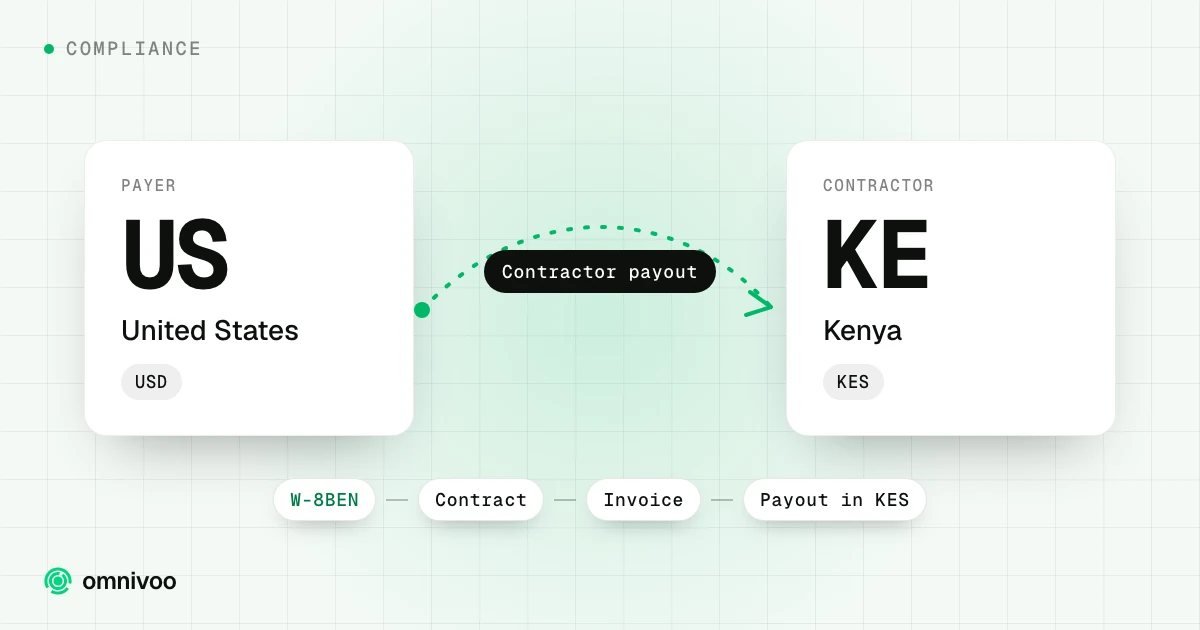
- Pay invoices on schedule. Keep the W-8BEN, SOW, invoice, and payment receipt together.
- Review the engagement quarterly for misclassification risk and refresh the W-8BEN every three years.
For broader context, see our guide on global contractor payment methods compared and our guide on how to pay international contractors from the US. If you pay contractors elsewhere in the region, see our guides on paying Nigeria, South Africa, and Egypt contractors.
When a platform pays for itself
A US founder paying one Kenyan contractor can do this manually. A US team paying five or more Kenyan contractors faces enough W-8BEN refreshes, FX margin questions, and misclassification reviews that a platform pays for itself.
Omnivoo Contract Management handles the SOW with Kenya-specific IP and misclassification clauses, collects the W-8BEN, runs the FX payment through a local KES or USD rail, and stores the full packet for audit. Transaction fees are passed through at cost.
For pricing across both Contract Management and Contractor of Record options, our pricing page lays out the products side by side.
A simple sanity check
Three questions for every Kenyan contractor relationship.
- Is there a signed W-8BEN on file?
- Will all the work be performed in Kenya for the foreseeable future?
- Are we paying through a rail that avoids SWIFT correspondent leakage and lands in a CBK-supervised account?
If yes to all three, you are 95 percent of the way to a clean US-Kenya contractor payment stack. The remaining 5 percent is misclassification hygiene over time.
Want to skip the assembly entirely? See how Omnivoo Contract Management handles Kenyan contractors end to end, or talk to our team about your specific setup.