
Why this guide exists
Ukraine has one of the largest IT contractor talent pools serving US companies, and the war that began in February 2022 has not stopped that flow. Ukrainian IT exports continued to grow in real terms through 2023 and 2024 despite the wartime conditions. US founders have continued hiring Ukrainian contractors throughout, and the industry has adapted.
This guide is for US companies paying Ukrainian contractors in 2026. The tax and compliance picture is more favourable than most founders expect. There is a US-Ukraine income tax treaty in force, the FOP single-tax regime is one of the most competitive contractor tax structures in Europe, and the payment infrastructure (Wise, Payoneer, SWIFT) continues to work normally.
What does require attention is the NBU currency-controls layer, which has been progressively liberalised since 2023 but still affects how Ukrainian contractors receive and convert foreign currency. We cover all of it. If you want to skip the assembly and let a platform handle it, Omnivoo Contract Management handles SOW drafting, W-8BEN collection, invoice capture, and USD or UAH settlement for $29 per contractor per month.
US side: what you need to do as the payer
Step 1. Collect a W-8BEN before the first payment
Before any invoice is paid, the Ukrainian contractor must complete Form W-8BEN and return it to you. The form certifies the contractor is the beneficial owner of the income, is a tax resident of Ukraine, and is not a US person.
The W-8BEN is valid for three calendar years after signature. If your contractor operates through a Ukrainian company (TOV or other), the form is W-8BEN-E, the entity equivalent. Before you pay, run through our W-8BEN collection checklist to make sure the form is complete.
Part II of the W-8BEN is where the contractor claims treaty benefits, citing Ukraine as the treaty country, when treaty benefits are needed on US source income.
A note for displaced Ukrainian contractors: if the contractor has relocated due to the war and is now a tax resident of another country (Poland, Germany, Portugal, Spain), they are no longer a Ukrainian tax resident for treaty purposes and the W-8BEN should reflect the country of current tax residency. Many contractors have re-established Ukrainian tax residency by returning, or have maintained Ukrainian tax residency while temporarily abroad under the 183-day test. The contractor’s accountant determines this.
Step 2. Confirm the work is performed outside the US
Under IRS source of income rules for personal services, services income is sourced to the place where the services are physically performed. If your Ukrainian contractor does the work entirely from Lviv, Kyiv, or wherever they are physically located outside the US, the income is foreign source income from the US perspective.
For a typical pure services engagement where the Ukrainian contractor never sets foot in the US, the result is: no withholding, no 1042-S, no 1099-NEC. The treaty is in the background but does not change the analysis.
Step 3. Know the treaty for the edge cases
The 1994 US-Ukraine income tax treaty entered into force in 2000 and is listed as the current treaty on the IRS Ukraine tax treaty documents page.
“The United States has tax treaties with a number of foreign countries. Under these treaties, residents (not necessarily citizens) of foreign countries are taxed at a reduced rate, or are exempt from U.S. taxes on certain items of income they receive from sources within the United States.”
Article 14 of the treaty covers independent personal services. Under Article 14, income derived by a resident of one country from independent professional services is taxable only in that country unless the services are performed in the other country and the person has a fixed base regularly available there for performing the activities. If the Ukrainian contractor has no US fixed base, the income from services performed for a US client is taxable only in Ukraine.
For services payments where US withholding does apply (US-day services, US source income), the Ukrainian contractor files Form 8233 and cites the relevant treaty article to claim treaty benefits. For royalty type income, the contractor uses Form W-8BEN with the relevant treaty article entered in Part II.
Ukraine side: what your contractor handles
You as the US payer are not in scope for most Ukrainian taxes. The Ukrainian contractor is. But understanding the landscape helps you have an informed conversation about which FOP group the contractor is in and how the NBU currency rules affect what hits their account.
FOP and the single-tax regime
FOP (Fizychna Osoba Pidpryiemets) is Ukraine’s sole-proprietor registration. Most Ukrainian IT contractors operate as a FOP rather than an individual under the general PIT regime because the simplified single-tax rates are dramatically lower.
The simplified single-tax regime has four groups:
- Group 1. Smallest microbusinesses, retail to individual buyers only, no employees. Not used by international contractors.
- Group 2. Limited turnover, service to individuals and other single-tax payers only. Not used by international contractors because foreign clients are excluded.
- Group 3. The standard for IT contractors and other service providers. Allows service to any client type (individual or business, domestic or foreign). Single tax rate is 5 percent of revenue without VAT, or 3 percent of revenue with VAT registration.
- Group 4. Agricultural producers. Not relevant for IT contractors.
Most Ukrainian IT contractors are on Group 3 at the 5 percent rate without VAT registration, since exports of services to foreign clients are out of scope of Ukrainian VAT.
The 2025 military levy addition
In 2025 Ukraine added a 1 percent military levy on the single tax for Groups 1 to 3 to fund the defence effort. For Group 3 contractors this brings the effective tax on revenue to 6 percent (5 percent single tax + 1 percent military levy) in 2026.
ESV (unified social contribution)
In addition to the single tax, FOPs pay a fixed monthly ESV (Unified Social Contribution) for pension and social insurance. The base is set annually by the Ukrainian government. During the early martial-law period some FOPs were exempted from ESV on a temporary basis. As of 2026 the exemption has been wound down for most categories of FOPs, so the contractor pays a fixed monthly ESV regardless of revenue.
Group 3 revenue limits
Group 3 has an annual revenue cap. Above the cap the contractor must migrate to the general PIT regime or split activities across multiple FOPs. The cap is indexed periodically by reference to the minimum wage. The contractor’s accountant tracks the cap on their behalf.
For you as the US payer, the practical takeaway is: Ukrainian IT contractors typically operate on Group 3 with a 6 percent effective tax rate on revenue plus fixed ESV. The contractor handles their own filings. You pay the gross invoice amount and the contractor manages Ukrainian tax compliance on their side.
NBU currency rules in 2026
This is the unique part of the Ukrainian context. Since martial law began in February 2022, the National Bank of Ukraine (NBU) has imposed a layered set of foreign-currency controls to stabilise the hryvnia (UAH). The NBU has progressively liberalised these controls through 2024, 2025, and into 2026, but the framework is still meaningfully different from a fully liberalised currency regime.
For your Ukrainian contractor receiving USD from a US client, the practical effects in 2026 are:
- USD received from a foreign client lands in the contractor’s foreign currency account at a Ukrainian bank.
- The contractor’s bank converts the USD to UAH at the NBU official rate on the day of receipt, or holds it in USD if the contractor has a USD account and chooses to retain foreign currency.
- The contractor can also receive USD into foreign-issued accounts (Wise USD, Payoneer USD, accounts held outside Ukraine) without it touching Ukrainian banks, though this comes with the contractor’s own NBU-reporting obligations on foreign assets.
- Outbound transfers from Ukraine, repatriation of dividends, and certain capital-account operations remain subject to NBU restrictions in 2026, though these mostly affect Ukrainian companies remitting funds abroad rather than contractors receiving funds.
The NBU continues to liberalise step by step. Any specific operation should be verified with the contractor’s Ukrainian bank because the rules can change with new NBU resolutions.
The payment rail decision
There are four real options for paying a Ukrainian contractor from a US bank account in 2026.
| Rail | Typical FX margin | Speed | Notes |
|---|---|---|---|
| US bank SWIFT wire | 2 to 4 percent plus bank conversion | 2 to 4 business days | Highest leakage. Lands UAH unless contractor has a USD account |
| Wise USD to UAH | ~0.5 to 0.8 percent | One to two business days | Lands UAH via bank transfer |
| Payoneer USD to UAH or USD balance | Tiered | One to two business days | Widely used by Ukrainian IT contractors |
| USD to a foreign USD account the contractor controls | None on the rail | Same day | Useful when contractor holds Wise USD, Payoneer USD, or other foreign-issued account |
Many Ukrainian contractors have set up Wise USD or Payoneer USD accounts during the war to maintain access to USD outside the immediate UAH conversion. For you as the US payer, USD-to-USD into one of these foreign-issued balances is typically the cleanest option and gives the contractor maximum flexibility in how they use the funds.
SWIFT to a Ukrainian USD account also works. SWIFT to a Ukrainian UAH account triggers immediate conversion at the NBU rate on receipt, which the contractor may or may not prefer depending on their UAH liquidity needs.
Misclassification risk in Ukraine
Ukraine’s Labour Code and case law treat employment as the default form of working relationship when there is subordination, fixed hours, exclusive engagement, and integration into the company’s hierarchy. A FOP engaged on paper as a contractor can be reclassified as an employee, with retroactive entitlement to vacation, severance, sick pay, and full employee-rate social contributions.
The reclassification risk is highest when the FOP has only one client (your US company), works fixed hours, and looks like an employee in substance. The Ukrainian state tax service and the State Labour Service have both taken active enforcement actions against companies that pejorise employment relationships into FOP arrangements.
The mitigations are the same as in other markets: a properly drafted services agreement that establishes the contractor relationship in substance, a legitimate scope tied to deliverables not time, evidence the contractor has other clients, and a documented review at six and twelve months. For more depth, see our guide on drafting an SOW for global contractors. The Omnivoo Contract Management SOW templates bake these protections in by default.
End-to-end workflow
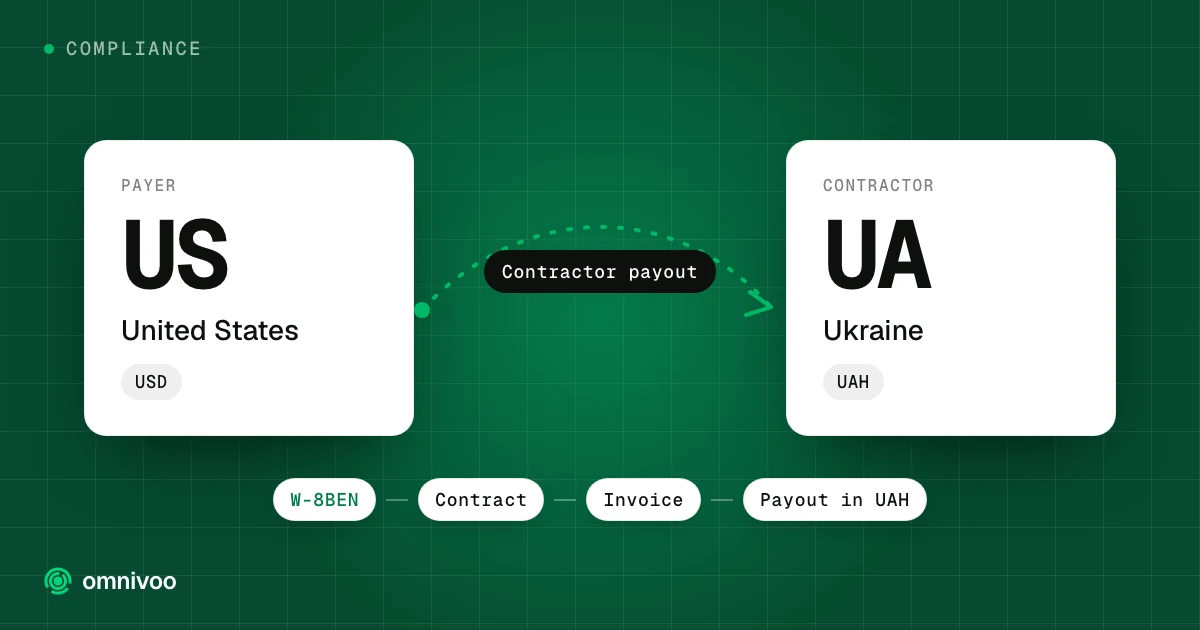
Here is the clean version for a US company onboarding its first Ukrainian contractor.
- Send the contractor a services agreement that defines deliverables, payment, IP assignment, and termination.
- Collect a signed W-8BEN before any payment moves. Part II references Ukraine as the treaty country (or the contractor’s current country of tax residency if displaced).
- Confirm the contractor has an active FOP registration on Group 3 and can issue an invoice or service act (akt vykonanykh robit) that satisfies Ukrainian bank documentation requirements for foreign currency receipt.
- Pick a payment rail. USD-to-USD into a Wise USD or Payoneer USD balance is often preferred. SWIFT or Wise USD-to-UAH works for contractors who want immediate UAH liquidity.
- Pay the invoice on schedule. Keep the W-8BEN, services agreement, invoice or service act, and payment receipt together as a packet.
- Review the engagement quarterly for misclassification risk and refresh the W-8BEN every three years.
If you are also paying contractors in other CEE countries, our guide on paying Polish contractors from a US company covers the EU side, and our guides on paying Romania and Serbia contractors cover the neighbouring markets. For the broader framework, see our guide on how to pay international contractors from the US. The Form 8233 treaty exemption guide covers the treaty-benefit filing for any cases where US source income is involved.
When a platform pays for itself
A US founder paying one Ukrainian contractor can do this manually. A US team paying five or more Ukrainian contractors faces enough W-8BEN refreshes, currency-rule changes, and FX timing decisions that a platform pays for itself within a few months.
Omnivoo Contract Management costs $29 per contractor per month. We draft the services agreement with Ukraine-specific IP and misclassification clauses, collect the W-8BEN, capture the invoice or service act on every payment, run the FX payment via USD-to-USD or USD-to-UAH depending on the contractor’s preference, and store the full packet for audit. Transaction fees are passed through at cost.
A simple sanity check
Three questions for every Ukrainian contractor relationship.
- Is there a signed W-8BEN on file and is it less than three years old, with the correct country of tax residency?
- Will the work be performed in Ukraine (or another non-US country) for the foreseeable future?
- Are we paying through a rail that gives the contractor a choice between immediate UAH conversion and holding USD?
If yes to all three, you are in great shape on the US-Ukraine stack. The remaining work is misclassification hygiene and tracking NBU rule changes as the war and reconstruction phase evolve.
Want to skip the assembly entirely? See how Omnivoo Contract Management handles Ukrainian contractors end to end, or talk to our team about your specific setup.