
Why this guide exists
The UAE, and Dubai in particular, has become a hub for global freelancers in software, design, marketing, and consulting, drawing professionals from across the region and beyond into a tax-light, business-friendly base. US companies hire there for that talent density and for the convenient time zone bridging Asia, Europe, and Africa. The hiring is easy. The tax picture surprises US founders because the UAE has no personal income tax, no US tax treaty, a relatively new 9 percent corporate tax, and a licensing system built around free zones.
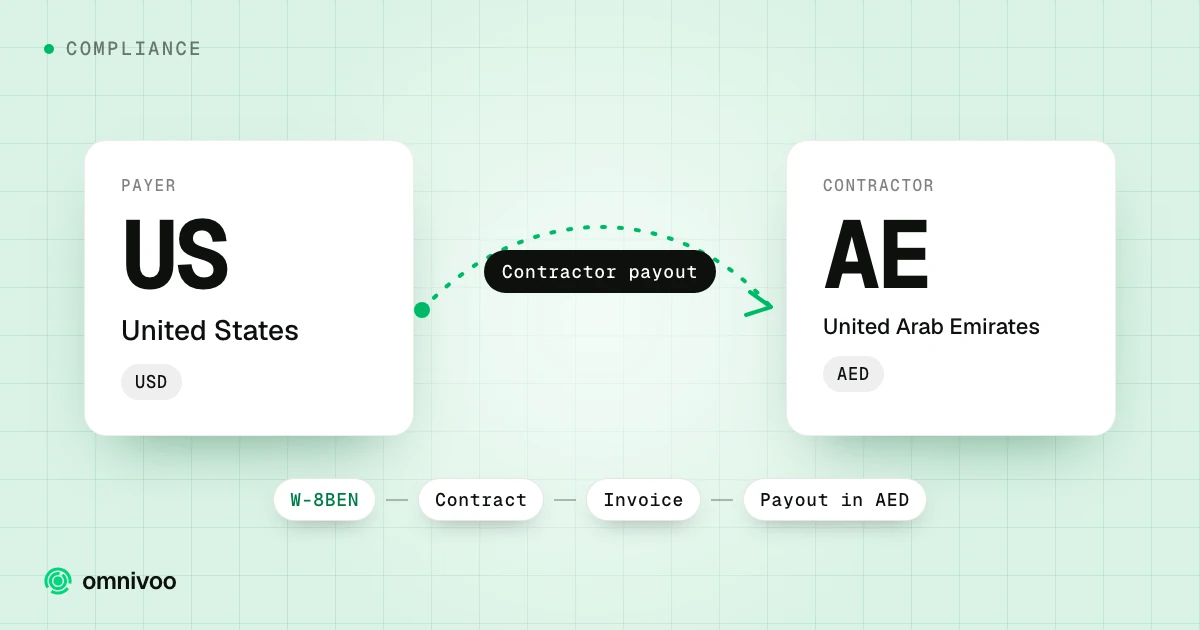
This guide covers the full stack for a US company paying contractors in the UAE. We look at the US side (W-8BEN, the no-treaty reality, 1042-S), the UAE side (freelance permits, corporate tax, VAT, social security), and the payment rail. By the end you should know exactly what to ask your contractor for and what each document is doing in the chain.
If you want to skip the assembly and let a platform run the whole stack, Omnivoo Contract Management handles SOW drafting, W-8BEN collection, invoice capture, and AED or USD payouts for $29 per contractor per month.
US side: what you need to do as the payer
Step 1. Collect a W-8BEN before the first payment
Before any invoice is paid, the contractor completes Form W-8BEN and returns it to you. The form certifies the contractor is the beneficial owner of the income, is a tax resident of the UAE, and is not a US person.
The W-8BEN is valid through the end of the third calendar year after signature and must be refreshed when it expires or when a relevant fact changes. If your contractor operates through a UAE company or free-zone entity, the form is W-8BEN-E, the entity equivalent. The form is required even though the UAE has no treaty, because it documents foreign status. The treaty-benefits section simply stays unused. Not sure the form is filled in correctly? Our W-8BEN checklist walks through what to verify.
Step 2. Confirm the work is performed in the UAE
Under IRS source of income rules for personal services, services income is sourced to where the services are physically performed. If your contractor works entirely from Dubai, Abu Dhabi, or Sharjah, the income is UAE source income from the US perspective.
The practical result: no withholding, no 1042-S, and no 1099-NEC, because the 1099-NEC is for US persons only. You keep the W-8BEN, the SOW, the invoice, and the payment receipt together as your documentation packet.
If the contractor visits the US for onsite work, the days physically worked inside the US are US source days that must be allocated and may trigger withholding plus a 1042-S.
Step 3. The no-treaty reality
The UAE is not on the IRS A-to-Z list of US income tax treaties. There is no US-UAE income tax treaty in force. This is the correct answer, not a gap.
The absence of a treaty matters only for US source income. For purely offshore services performed in the UAE, the US has no withholding right under source rules, so no treaty is needed. Where it bites is US source FDAP, such as royalties, or income tied to US-performed days. There the default US withholding under IRC Sections 1441 and 1442 is 30 percent, and there is no treaty rate to reduce it.
The practical takeaway: draft the SOW as a pure services agreement with full IP assignment for value already in the fee, and keep all work in the UAE. That keeps you out of the US withholding question.
UAE side: what your contractor handles
You as the US payer are not in scope for UAE taxes. The contractor is. Understanding the landscape helps you talk through invoice fields.
Freelance permit or free-zone licence
A UAE freelancer typically operates under a freelance permit or a free-zone licence. Free zones such as those covering media, technology, and creative industries issue freelance licences, and the Ministry of Human Resources and Emiratisation also runs freelance arrangements. The licence lets the contractor invoice legally and, where applicable, sponsor their own residence visa. This is the contractor’s setup. You do not arrange it, but the licence details often appear on their invoice.
No personal income tax, but a corporate tax
The UAE has no federal personal income tax. What it does have, since June 2023, is a federal corporate tax. Under the Ministry of Finance corporate tax framework and the Federal Tax Authority, the rate is 0 percent on taxable income up to AED 375,000 and 9 percent above that. Qualifying free-zone persons can access a 0 percent rate on qualifying income if they meet specific conditions. A freelancer operating as a business and crossing the AED 375,000 threshold can fall within corporate tax. Whether and how it applies depends entirely on the contractor’s structure, which is their concern, not yours.
VAT at 5 percent
The UAE VAT standard rate is 5 percent, introduced in January 2018 and administered by the Federal Tax Authority. Exported services to a recipient outside the UAE are generally zero rated when the conditions are met. A contractor exporting services to your US company typically applies the zero rate, which they confirm with the FTA. As the US payer, you do not pay or recover UAE VAT.
Social security
UAE social security through the General Pension and Social Security Authority (GPSSA) applies to UAE and GCC nationals. Expatriate workers are not covered by GPSSA and instead receive end-of-service gratuity when employed. For a genuine independent contractor, social security is not your obligation.
Banking
Once a USD payment lands in the contractor’s UAE bank account, it is converted to AED at the bank’s rate, or held in USD if the account supports it. UAE bank accounts use IBANs and are well integrated for international receipts. A payment platform that supports the UAE delivers AED or USD into the contractor’s account, which avoids the layered correspondent fees of a raw SWIFT wire.
The payment rail decision
There are four real options for paying a UAE contractor from a US bank account.
| Rail | Typical FX margin | Speed | Notes |
|---|---|---|---|
| US bank SWIFT wire | 2 to 4 percent | 1 to 3 business days | Sender fee plus correspondent deductions; bank receipt only |
| Wise USD to AED | Transparent, low single-digit | Same day to one day | Confirm current AED payout support before onboarding |
| Payoneer USD to AED | Tiered, lower at volume | One business day | Common for freelancers serving US clients |
| Keep funds in USD | None at send | Same day | Many UAE accounts hold USD directly |
For most US companies paying one to ten UAE contractors, Wise or Payoneer is the cleanest option, though many UAE contractors are happy to receive USD directly into a USD account. Always confirm current currency support with the provider before onboarding.
Misclassification risk in the UAE
The UAE labour relationship is governed by Federal Decree-Law No. 33 of 2021 on the Regulation of Labour Relations, with free-zone employers such as the DIFC and ADGM operating their own employment frameworks. A worker engaged on paper as a contractor can be treated as an employee where the relationship shows direction, control, fixed hours, and integration into the business, bringing entitlements such as end-of-service gratuity that do not apply to genuine contractors.
The exposure can reach the US principal even with no UAE entity if the contractor pursues a claim. The mitigations: a properly drafted services agreement that establishes the contractor relationship in substance, a scope tied to deliverables rather than time, evidence the contractor serves other clients, and a periodic review of worker misclassification risk.
For more depth, see our guide on drafting an SOW for global contractors. The Omnivoo Contract Management SOW templates build these protections in by default, with a clear IP assignment clause and a governing law clause suited to cross-border work.
End-to-end workflow
Here is the clean version for a US company onboarding its first UAE contractor.
- Send the contractor a services agreement that defines deliverables, payment, IP assignment, and termination, built on a master service agreement and a statement of work.
- Collect a signed W-8BEN before any payment moves, or a W-8BEN-E if they operate through a company or free-zone entity.
- Confirm the contractor holds a valid freelance permit or licence and can issue a compliant invoice.
- Pick a payment rail (Wise, Payoneer, or USD direct) and onboard the contractor’s AED or USD payout details.
- Pay the invoice on schedule. Keep the W-8BEN, SOW, invoice, and payment receipt together.
- Review the engagement quarterly for misclassification risk and refresh the W-8BEN every three years.
If you also pay contractors elsewhere in the region, see our guides on paying Egyptian, Turkish, and Pakistani contractors, plus the new guides on paying Moroccan and Ghanaian contractors. For the broader framework, see our guide on how to pay international contractors from the US.
When a platform pays for itself
A US founder paying one UAE contractor can do this manually. A US team paying five or more UAE contractors faces enough W-8BEN refreshes, invoice handling, and FX margin questions that a platform pays for itself within the first few months.
Omnivoo Contract Management costs $29 per contractor per month. We draft the services agreement with UAE-aware IP and misclassification clauses, collect the W-8BEN, capture the invoice on every payment, run the FX payment through an AED or USD rail to avoid SWIFT leakage, and store the full packet for audit. Transaction fees are passed through at cost, with competitive FX, cancel anytime.
A simple sanity check
Three questions for every UAE contractor relationship.
- Is there a signed W-8BEN on file and is it less than three years old?
- Will all the work be performed in the UAE for the foreseeable future?
- Are we paying through a rail that lands AED or USD without SWIFT correspondent leakage?
If yes to all three, you are most of the way to a clean US-UAE contractor payment stack. The remaining work is misclassification hygiene over time.
Want to skip the assembly entirely? See how Omnivoo Contract Management handles UAE contractors end to end, browse the how to pay contractors for the full picture, or talk to our team about your specific setup.