
Why this guide exists
Türkiye has become a serious offshore engineering and design corridor for US companies. Istanbul, Ankara, and Izmir host a deep pool of software, product, and creative talent, the time zone overlaps a full European workday, and rates sit well below US and Western European levels. The friction is rarely the talent. It is the paperwork: a tax system with a withholding-at-source culture, an electronic invoicing mandate, and a currency that has moved fast enough that FX margin and payment timing genuinely affect what your contractor takes home.
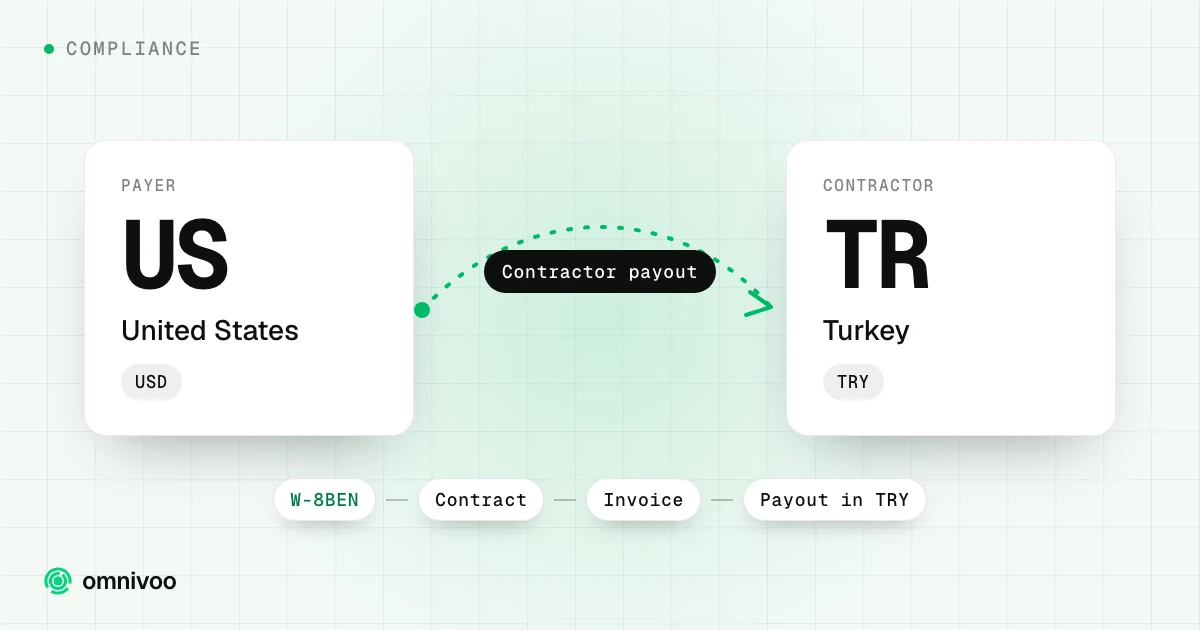
This guide covers the full stack for a US company paying contractors in Türkiye. We look at the US side (W-8BEN, treaty application, 1042-S), the Türkiye side (VKN, the serbest meslek or şahıs şirketi setup, KDV on exported services, Bağ-Kur social security, e-Fatura and e-Arşiv), and the payment rail. By the end you should know exactly what to ask your contractor for and what each document is doing in the chain.
If you want to skip the assembly and let a platform run the whole stack, Omnivoo Contract Management handles SOW drafting, W-8BEN collection, invoice capture, and TRY or USD payouts for $29 per contractor per month.
US side: what you need to do as the payer
Step 1. Collect a W-8BEN before the first payment
The first action is non-negotiable. Before any invoice is paid, the contractor must complete Form W-8BEN and return it to you. The form certifies the contractor is the beneficial owner of the income, is a tax resident of Türkiye, and is not a US person. The IRS version of the form lives on the official Form W-8BEN page.
The W-8BEN is valid through the end of the third calendar year after signature and must be refreshed when it expires or when a relevant fact changes, such as address or treaty country. If your contractor operates through a registered Turkish company rather than as an individual, the form is Form W-8BEN-E, the entity equivalent on the IRS Form W-8BEN-E page. Our W-8BEN checklist walks through what to verify before the first payment.
Step 2. Confirm the work is performed in Türkiye
Under IRS source of income rules for personal services, services income is sourced to the place where the services are physically performed. If your Turkish contractor does the work entirely from Istanbul or Izmir, the income is foreign source income from the US perspective.
The practical takeaway: no withholding, no Form 1042-S, and no 1099-NEC, which is for US persons only. You keep the W-8BEN, the SOW, the contractor’s invoice, and the payment receipt as the documentation packet.
If the contractor visits the US for an onsite sprint or a planning week, the days physically worked inside the US are US source days. Those days have to be allocated and may trigger withholding plus a 1042-S. Most US companies that hire steadily in Türkiye keep a simple onsite-days log so this stays clean.
Step 3. Know the treaty for the edge cases
Türkiye appears on the IRS list of US income tax treaties. The convention was signed in 1996 and, per the IRS Türkiye tax treaty documents page, applies from January 1, 1998. It governs the cases where your payment generates US source income.
The treaty’s independent personal services article generally allows Türkiye to tax personal services income unless the contractor has a fixed base regularly available in the US or is present in the US beyond the treaty’s threshold period. The royalties article limits US withholding on royalties to a treaty rate below the 30 percent statutory default. The exact article numbers and rates are set out in the treaty text on the IRS Türkiye page.
For most pure services engagements (development, design, marketing), the independent personal services article is the relevant one and you should not need to withhold. The cleanest practice is to draft the SOW as a pure services agreement with full IP assignment for value already included in the fee, which avoids splitting the fee into a royalty component. If a treaty rate is ever claimed on US source income, the contractor uses Form 8233 or the W-8BEN to claim it, per the IRS Form 8233 page.
Türkiye side: what your contractor handles
This is where US founders get lost. You as the US payer are not in scope for most Turkish taxes. The Turkish contractor is. But it helps to understand the landscape so you can have an informed conversation when the contractor asks for specific invoice fields or your company details.
VKN and the business form
Every Turkish contractor who invoices must register with the Revenue Administration (Gelir İdaresi Başkanlığı) and obtain a VKN, the Vergi Kimlik Numarası or tax identification number. Two common setups exist. A serbest meslek erbabı is a self-employed professional (the closest match for many freelance developers and designers) who issues a serbest meslek makbuzu, the professional receipt. A şahıs şirketi is a sole proprietorship that issues standard invoices.
You do not need to know which form your contractor uses. You only need to know they are registered, hold a VKN, and can issue a valid invoice.
KDV on exported services
Türkiye’s standard KDV (Katma Değer Vergisi, the VAT) rate is 20 percent, raised from 18 percent in July 2023. Exported services to a foreign recipient are exempt under Articles 11 and 12 of VAT Law No. 3065, provided the service is rendered to a customer located abroad and the benefit of the service is used outside Türkiye.
For you as the US payer, this is the contractor’s matter to document. You do not pay or recover KDV on a Turkish invoice. Türkiye also operates a partial withholding system on VAT known as tevkifat for certain domestic supplies, where the buyer remits part of the VAT directly. That mechanism applies to domestic transactions, not to a US buyer with no Turkish tax presence, so it should not appear on your invoice when the supply qualifies as an export of services.
Bağ-Kur social security
Self-employed individuals in Türkiye, including serbest meslek professionals and sole proprietors, are covered under the Bağ-Kur scheme, classified as 4/b insured under the Social Security Institution (SGK). Registration is compulsory and contributions are calculated on declared earnings between a minimum and maximum threshold. This is the contractor’s own obligation. A US payer does not deduct or remit SGK contributions.
e-Fatura and e-Arşiv
Türkiye runs a mandatory electronic invoicing regime administered by the Revenue Administration. e-Fatura is the format exchanged between taxpayers registered in the system, and e-Arşiv covers invoices issued to recipients outside that system, which includes foreign customers like your US company. Whether a given contractor must use these formats depends on turnover thresholds and activity rules set by the Revenue Administration.
For your US accounting team, what matters is that the invoice you receive is valid in Türkiye and shows the contractor’s VKN, the service description, the amount, the currency, and the KDV treatment (exempt as an export of services). The electronic format is the contractor’s responsibility.
High inflation and the lira
The Turkish lira has lost value quickly in recent years. This matters for two practical reasons. First, contractors increasingly prefer to invoice and be paid in USD or EUR to protect their purchasing power, holding funds in a foreign currency account and converting only as needed. Second, FX margin on a USD-to-TRY conversion is a real cost that compounds with timing. A tight rate and a fast settlement protect what your contractor actually receives.
The payment rail decision
There are four real options for paying a Turkish contractor from a US bank account.
| Rail | Typical FX margin | Speed | Notes |
|---|---|---|---|
| US bank SWIFT wire | 2 to 4 percent | 2 to 4 business days | Lands in TRY or a USD foreign currency account, correspondent fees apply |
| Wise USD to TRY | Mid-market plus a transparent margin | Same day to one business day | Supports payout to Turkish bank accounts in TRY |
| Payoneer | Tiered, lower at volume | One to two business days | Common with Turkish freelancers serving US clients |
| USD to a Turkish FX account | Bank spot on conversion | Varies by bank | Lets the contractor hold USD and convert on their own timing |
For most US companies paying one to ten Turkish contractors, Wise or Payoneer is the cleanest option. SWIFT to a foreign currency account is fine for one-off larger payments where the percentage cost matters less, and it suits contractors who want to hold USD given lira volatility. For the mechanics of how margin is built into any of these, see our guide on FX margin in international contractor payments and the SWIFT network glossary entry.
Misclassification risk in Türkiye
The legal frame in Türkiye is stricter than the US. Turkish Labour Law No. 4857 defines the employment relationship around subordination: a worker who takes instruction, works fixed hours, is integrated into the company’s operations, and depends on a single payer can be treated as an employee in substance regardless of the contract label. A relationship structured on paper as a contractor engagement can be reclassified, with retroactive exposure to severance, notice, and social security obligations.
The mitigations are well established: a properly drafted services agreement that establishes the contractor relationship in substance, a scope tied to deliverables rather than hours, evidence the contractor has other clients, and a documented review of worker misclassification risk at the six and twelve month checkpoints. A clean engagement also reduces the risk of creating a permanent establishment for your US company in Türkiye.
For more depth on structuring these contracts, see our guide on drafting an SOW for global contractors. The Omnivoo Contract Management templates build a master service agreement and statement of work with intellectual property assignment and a clear governing law clause by default.
End-to-end workflow
Here is the clean version for a US company onboarding its first Turkish contractor.
- Send the contractor a services agreement that defines deliverables, payment, IP assignment, governing law, and termination.
- Collect a signed W-8BEN before any payment moves.
- Confirm the contractor has an active VKN and can issue a valid invoice (e-Fatura or e-Arşiv where required) showing the service as a KDV-exempt export.
- Pick a payment rail (Wise, Payoneer, or comparable) and onboard the contractor’s payout details, either a TRY account or a USD foreign currency account.
- Pay the invoice on schedule. Keep the W-8BEN, SOW, invoice, and payment receipt together as a packet.
- Review the engagement quarterly for misclassification risk and refresh the W-8BEN every three years.
If you are weighing this against bringing the worker on as an employee through an entity, the contractor management versus contractor of record comparison helps you pick the right product. For the broader framework, see our guide on how to pay international contractors from the US. If you pay contractors elsewhere in the region, see our guides on paying Egypt, Nigeria, and Kenya contractors.
When a platform pays for itself
A US founder paying one Turkish contractor can do this manually. A US team paying five or more Turkish contractors faces enough W-8BEN refreshes, invoice checks, and FX margin questions that a platform pays for itself within the first few months.
Omnivoo Contract Management costs $29 per contractor per month. We draft the services agreement with Türkiye-specific IP and misclassification clauses, collect the W-8BEN, capture the contractor’s invoice on every payment, run the FX payment through a TRY or USD rail to limit leakage, and store the full packet for audit. Transaction fees are passed through at cost, with competitive FX and no fee for contractors, cancel anytime.
A simple sanity check
Three questions for every Turkish contractor relationship.
- Is there a signed W-8BEN on file and is it less than three years old?
- Will all the work be performed in Türkiye for the foreseeable future?
- Are we paying through a rail with a tight FX margin that lands TRY or USD without heavy correspondent fees?
If yes to all three, you are most of the way to a clean US-Türkiye contractor payment stack. The rest is misclassification hygiene over time.
Want to skip the assembly entirely? See how Omnivoo Contract Management handles Turkish contractors end to end, or talk to our team about your specific setup.