
Why this guide exists
Ghana has become an active West African corridor for US companies hiring software, design, data, and support talent, with Accra offering an English-speaking, increasingly digital workforce and a growing startup scene. The hiring is straightforward. The compliance picture differs from many markets on several points: there is no US-Ghana tax treaty, VAT is layered with separate levies, taxpayers are identified by the Ghana Card PIN, and foreign exchange is overseen by the Bank of Ghana.
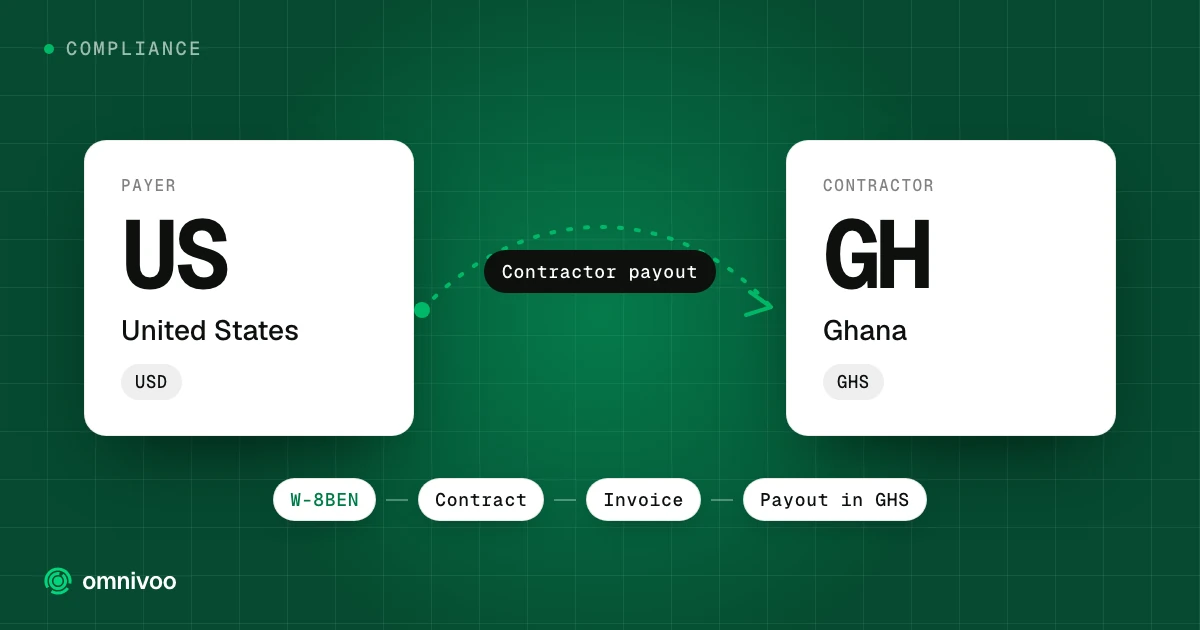
This guide covers the full stack for a US company paying contractors in Ghana. We look at the US side (W-8BEN, the no-treaty reality, 1042-S), the Ghana side (business registration, Ghana Card PIN as TIN, VAT and levies, SSNIT, e-VAT, foreign exchange), and the payment rail. By the end you should know exactly what to ask your contractor for and what each document is doing in the chain.
If you want to skip the assembly and let a platform run the whole stack, Omnivoo Contract Management handles SOW drafting, W-8BEN collection, invoice capture, and GHS or USD payouts for $29 per contractor per month.
US side: what you need to do as the payer
Step 1. Collect a W-8BEN before the first payment
Before any invoice is paid, the contractor completes Form W-8BEN and returns it to you. The form certifies the contractor is the beneficial owner of the income, is a tax resident of Ghana, and is not a US person.
The W-8BEN is valid through the end of the third calendar year after signature and must be refreshed when it expires or when a relevant fact changes. If your contractor operates through a registered Ghanaian company, the form is W-8BEN-E, the entity equivalent. The form is required even though Ghana has no treaty, because it documents foreign status. The treaty-benefits section simply stays unused. Not sure the form is filled in correctly? Our W-8BEN checklist walks through what to verify.
Step 2. Confirm the work is performed in Ghana
Under IRS source of income rules for personal services, services income is sourced to where the services are physically performed. If your Ghanaian contractor works entirely from Accra, Kumasi, or Takoradi, the income is Ghanaian source income from the US perspective.
The practical result: no withholding, no 1042-S, and no 1099-NEC, because the 1099-NEC is for US persons only. You keep the W-8BEN, the SOW, the invoice, and the payment receipt together as your documentation packet.
If the contractor visits the US for onsite work, the days physically worked inside the US are US source days that must be allocated and may trigger withholding plus a 1042-S.
Step 3. The no-treaty reality
Ghana is not on the IRS A-to-Z list of US income tax treaties. There is no US-Ghana income tax treaty in force. This is the correct answer, not a gap.
The absence of a treaty matters only for US source income. For purely offshore services performed in Ghana, the US has no withholding right under source rules, so no treaty is needed. Where it bites is US source FDAP, such as royalties, or income tied to US-performed days. There the default US withholding under IRC Sections 1441 and 1442 is 30 percent, and there is no treaty rate to reduce it. The contractor can file a US return to claim deductions or credits, but 30 percent at source is the starting point.
The practical takeaway: draft the SOW as a pure services agreement with full IP assignment for value already in the fee, and keep all work in Ghana. That keeps you out of the US withholding question.
Ghana side: what your contractor handles
You as the US payer are not in scope for Ghanaian taxes. The contractor is. Understanding the landscape helps you talk through invoice fields.
Business registration and the Ghana Card PIN
A Ghanaian freelancer typically registers a business name with the Office of the Registrar of Companies, formerly the Registrar General’s Department. For tax, since 2021 the Ghana Revenue Authority (GRA) uses the Ghana Card Personal Identification Number (PIN) as the Taxpayer Identification Number for individuals. These are the contractor’s registrations. You do not deduct Ghanaian tax as a foreign payer with no Ghanaian presence.
VAT and the layered levies
Ghana’s VAT standard rate is 15 percent, administered by the Ghana Revenue Authority. On top of VAT sit separate levies, principally the National Health Insurance Levy (NHIL) at 2.5 percent and the Ghana Education Trust Fund Levy (GETFund) at 2.5 percent, with a COVID-19 Health Recovery Levy that applied at 1 percent in recent years. Because some of these levies are charged on the VAT-exclusive value rather than as part of the VAT itself, the combined effective burden on a standard-rated supply has historically been higher than the headline 15 percent.
Ghana has been reforming this structure, with VAT changes announced for 2026 that affect the levies and the effective rate. Because the figures are in transition, treat the layered structure above as the recent baseline and confirm the current rates directly with the GRA before relying on a specific number.
Whether your contractor charges VAT depends on their registration and the nature of the service. As a foreign payer, you generally do not bear Ghanaian VAT on an exported service, but confirm the treatment shown on the contractor’s invoice.
e-VAT electronic invoicing
The GRA has been rolling out an electronic VAT (e-VAT) system to bring VAT-registered businesses onto electronic invoicing in phases. Whether your contractor is on e-VAT depends on their registration and the rollout stage. For you as a foreign payer, it is the contractor’s concern, but it explains how a Ghanaian invoice may arrive as a system-generated electronic document.
SSNIT social security
Social security in Ghana runs through the Social Security and National Insurance Trust (SSNIT), which administers the national pension scheme. A self-employed contractor can contribute on a voluntary basis. This is the contractor’s contribution, not your obligation as a US payer.
Foreign exchange and banking
Foreign exchange in Ghana is overseen by the Bank of Ghana. Contractors commonly receive USD into a foreign-currency or domiciliary account, then convert to cedi or hold dollars where the rules permit. Mobile money (MoMo) is the dominant domestic rail for cedi payments within Ghana, but inbound foreign currency from abroad generally lands through a bank account first. Your role is to send cleanly through a transparent rail.
The payment rail decision
There are four real options for paying a Ghanaian contractor from a US bank account.
| Rail | Typical FX margin | Speed | Notes |
|---|---|---|---|
| US bank SWIFT wire | 2 to 4 percent | 1 to 3 business days | Lands in a USD or domiciliary account; bank receipt only |
| Wise USD to GHS | Transparent where supported | Same day to a few days | GHS payout support can be limited; confirm before onboarding |
| Payoneer USD to GHS | Tiered, lower at volume | One to a few business days | Common among Ghanaian freelancers serving US clients |
| Keep funds in USD | None at send | Same day | Where the contractor holds a USD or domiciliary account |
For Ghana, currency support varies by provider, and GHS coverage on some platforms can be limited. Confirm current support with the provider and check the contractor’s account options before onboarding. A SWIFT wire to a USD or domiciliary account remains a reliable fallback, after which the contractor decides whether to convert to cedi.
Misclassification risk in Ghana
Ghana’s Labour Act, 2003 (Act 651) governs the employment relationship and applies a substance test. A worker engaged on paper as a contractor can be treated as an employee where the relationship shows control, integration, fixed hours, and economic dependence. Reclassification brings employee entitlements and statutory contributions, including SSNIT, that do not apply to genuine independent contractors.
The exposure can reach the US principal even with no Ghanaian entity if the contractor pursues a claim. The mitigations: a properly drafted services agreement that establishes the contractor relationship in substance, a scope tied to deliverables rather than time, evidence the contractor serves other clients, and a periodic review of worker misclassification risk.
For more depth, see our guide on drafting an SOW for global contractors. The Omnivoo Contract Management SOW templates build these protections in by default, with a clear IP assignment clause.
End-to-end workflow
Here is the clean version for a US company onboarding its first Ghanaian contractor.
- Send the contractor a services agreement that defines deliverables, payment, IP assignment, and termination, built on a master service agreement and a statement of work.
- Collect a signed W-8BEN before any payment moves, or a W-8BEN-E if they operate through a company.
- Confirm the contractor has a Ghana Card PIN used as TIN and, if a business, is registered with the Office of the Registrar of Companies, and can issue a compliant invoice.
- Pick a payment rail and onboard the contractor’s GHS or USD payout details, checking whether they hold a domiciliary account.
- Pay the invoice on schedule. Keep the W-8BEN, SOW, invoice, and payment receipt together.
- Review the engagement quarterly for misclassification risk and refresh the W-8BEN every three years.
If you also pay contractors elsewhere in the region, see our guides on paying Nigerian, Kenyan, and South African contractors, plus the new guides on paying Moroccan and UAE contractors. For the broader framework, see our guide on how to pay international contractors from the US.
When a platform pays for itself
A US founder paying one Ghanaian contractor can do this manually. A US team paying five or more Ghanaian contractors faces enough W-8BEN refreshes, invoice handling, and FX margin questions that a platform pays for itself within the first few months.
Omnivoo Contract Management costs $29 per contractor per month. We draft the services agreement with Ghana-aware IP and misclassification clauses, collect the W-8BEN, capture the invoice on every payment, run the FX payment through a GHS or USD rail to avoid SWIFT leakage, and store the full packet for audit. Transaction fees are passed through at cost, with competitive FX, cancel anytime.
A simple sanity check
Three questions for every Ghanaian contractor relationship.
- Is there a signed W-8BEN on file and is it less than three years old?
- Will all the work be performed in Ghana for the foreseeable future?
- Are we paying through a transparent rail that lands in a Bank of Ghana-supervised account without SWIFT correspondent leakage?
If yes to all three, you are most of the way to a clean US-Ghana contractor payment stack. The remaining work is misclassification hygiene over time.
Want to skip the assembly entirely? See how Omnivoo Contract Management handles Ghanaian contractors end to end, browse the how to pay contractors for the full picture, or talk to our team about your specific setup.