
Why this guide exists
Uruguay has become one of the steadier engineering and services talent markets in Latin America for US companies. Montevideo has a strong software and shared-services tradition, the country sits in a time zone close to US Eastern time, and Uruguay has a stable, business-friendly reputation in the region. For a US company building a nearshore team in the Americas, Uruguay is an easy place to hire.
The wrinkle that catches US founders off guard is the treaty position. Uruguay does not have an income tax treaty with the US, which changes how the W-8BEN analysis reads. The freelancer setup itself is standard and well documented, with the independent professional registering with the Direccion General Impositiva and issuing an electronic invoice. The pieces that look unfamiliar, such as IVA on personal services and the contractor’s social security contributions, are Uruguayan domestic items your contractor handles, not obligations that land on you.
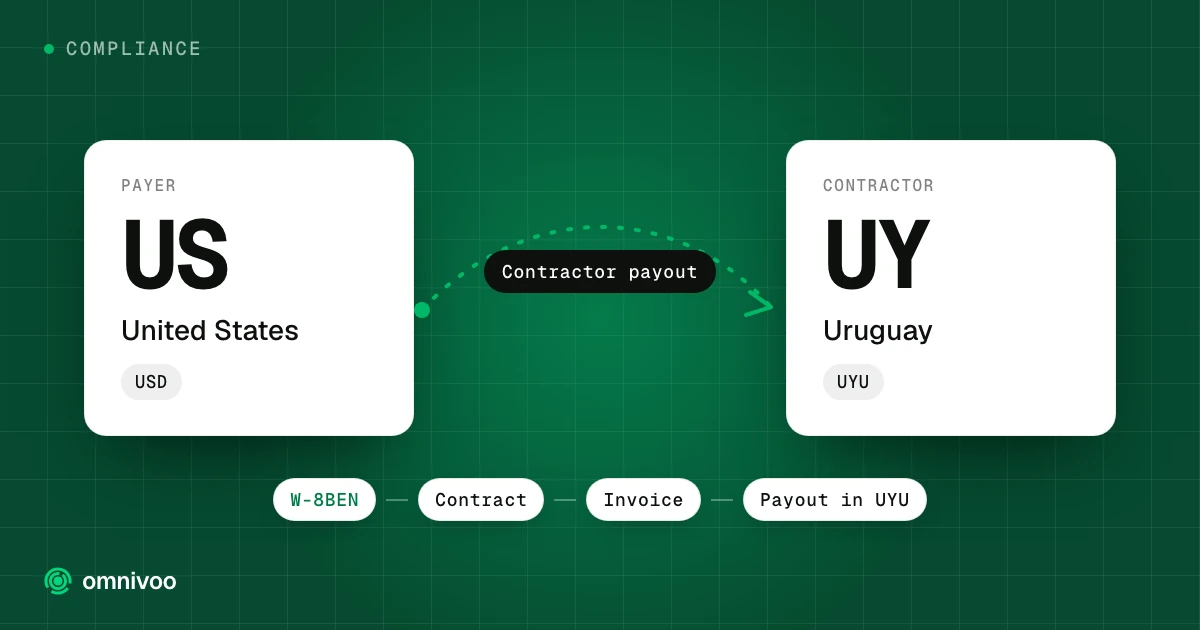
This guide covers what a US company needs to pay Uruguayan contractors. We cover the US side (W-8BEN, the no-treaty reality, 1042-S), the Uruguay side (RUT, the DGI, the factura electronica, IVA, IRPF, social security), and the payment rail decision. This is general information, not tax or legal advice. If you want to skip the assembly and let a platform handle it, Omnivoo Contract Management handles SOW drafting, W-8BEN collection, invoice capture, and FX settlement for $29 per contractor per month.
US side: what you need to do as the payer
Step 1. Collect a W-8BEN before the first payment
Before any invoice is paid, the Uruguayan contractor must complete Form W-8BEN and return it to you. The form certifies the contractor is the beneficial owner of the income, is a tax resident of Uruguay, and is not a US person. The IRS Form W-8BEN page has the current form and instructions.
The W-8BEN is valid for three calendar years after signature and must be refreshed when it expires or when a relevant fact changes, such as address. If your contractor operates through a registered Uruguayan company (an SA, SRL, or similar), the form is Form W-8BEN-E, the entity equivalent, available on the IRS W-8BEN-E page. Because there is no treaty (covered below), the treaty-claim section of the form is left blank. The form’s value here is documenting foreign status, not claiming a reduced rate. Our W-8BEN checklist walks through what to verify before the first payment.
Step 2. Confirm the work is performed in Uruguay
Under IRS source of income rules for personal services, services income is sourced to the place where the services are physically performed, regardless of where the contract was made or the residence of the payer. If your Uruguayan contractor does the work entirely from Montevideo, Punta del Este, Salto, or anywhere else in Uruguay, the income is foreign source income from the US perspective.
For a typical pure services engagement where the Uruguayan contractor never sets foot in the US, the result is: no withholding, no Form 1042-S, and no 1099-NEC, which is for US persons only. You keep the W-8BEN, the services agreement, the contractor’s factura, and the payment receipt as the documentation packet.
If the contractor visits the US for an onsite sprint, the days physically worked inside the US are US source days. Those days have to be allocated and may trigger withholding plus a 1042-S, so keep a simple onsite-days log. This matters more here because there is no treaty rate to soften the US source piece.
Step 3. No US-Uruguay income tax treaty
This is the part that distinguishes Uruguay from a treaty country like Chile. Uruguay is not on the IRS list of US income tax treaties A to Z. There is no comprehensive income tax treaty in force between the two countries.
What that means in practice is narrow. For US source income, such as days a contractor physically works inside the US or a US-source royalty characterisation, the default US withholding under the statute is 30 percent and there is no treaty rate to reduce it, and no Form 8233 treaty exemption to file. For purely offshore services performed in Uruguay, the absence of a treaty is a non-issue, because the US has no withholding right in the first place under the source rules. The clean practice is the same as everywhere: draft the SOW as a pure services agreement with full IP assignment, so the fee is not split into a royalty component that could create US source income. For background on how treaties work in general, and why their absence matters here, see our income tax treaty glossary entry.
Uruguay side: what your contractor handles
You as the US payer are not in scope for most Uruguayan taxes. The Uruguayan contractor is. Understanding the landscape helps you have an informed conversation about invoice format, IVA treatment, and the contractor’s setup.
The RUT, the DGI, and the factura electronica
Most Uruguayan freelancers working with international clients operate as an independent professional or a single-owner business (unipersonal). They register their activity with the Direccion General Impositiva (DGI), hold a RUT (Registro Unico Tributario, the tax number), and issue an electronic invoice, the comprobante fiscal electronico (CFE) or factura electronica, for each engagement. Per the DGI, new IVA taxpayers must issue electronic invoices from the moment of registration.
The factura electronica is the contractor’s invoice. You as the US payer do not need to know the internal mechanics. You only need to receive a valid factura and keep it in your packet alongside the W-8BEN and services agreement.
IVA 22 percent and the export-of-services treatment
Uruguay’s standard IVA (Impuesto al Valor Agregado) rate is 22 percent, the basic rate confirmed on the DGI publication on goods and services at the basic 22 percent rate. The DGI states that, in principle, all goods and services are taxed at the basic rate of 22 percent.
For personal and professional services specifically, the DGI publication on services covered by IVA on personal services states that personal services are in principle taxed at the basic rate of 22 percent, while noting that services used entirely abroad fall outside the Uruguayan IVA scope. That is the mechanism by which an export of services to a US client is generally treated as outside Uruguayan IVA. The exact treatment depends on the contractor’s registration and how the export is documented, which their accountant confirms. For you as the US payer, this is the contractor’s matter to handle. You do not pay or recover Uruguayan IVA on the invoice.
IRPF, IRAE, and the monotributo question
Per the DGI, an independent professional’s income is taxed under IRPF (Impuesto a la Renta de las Personas Fisicas, personal income tax), with IVA on the service. A monotributo is a simplified regime for small taxpayers, but it does not cover professional personal services, so a software, design, or consulting contractor working with a US client generally files under the IRPF and IVA regimes rather than the monotributo. A contractor whose activity grows past the relevant turnover threshold may instead fall under IRAE (the business income tax). These are the contractor’s regimes to navigate with their accountant. None of them create an obligation for you as the US payer.
Social security contributions
Independent workers in Uruguay generally contribute to the Banco de Prevision Social (BPS), the social security fund that covers health and pension, based on their declared activity. These contributions are the contractor’s own obligation. A US payer does not deduct or remit BPS contributions. This matters for misclassification, because the BPS can reassess a relationship and treat a supposed contractor as a worker who should have been covered as an employee.
The payment rail decision
There are a few real options for paying a Uruguayan contractor from a US bank account. Uruguay uses the Uruguayan peso (UYU), and many contractors also hold USD accounts.
| Rail | Typical FX margin | Speed | Notes |
|---|---|---|---|
| US bank SWIFT wire | 2 to 4 percent | 2 to 4 business days | Highest leakage, correspondent fees |
| USD to a Uruguayan USD account | Bank spot on conversion | Varies by bank | Many Uruguayan banks offer USD accounts, simplifying settlement |
| USD to UYU via a transparent provider | Low to mid-market plus margin | Same to next business day | Confirm current UYU payout support before relying on it |
For USD-denominated invoices, a provider that lets the contractor hold a USD or multi-currency balance gives the most flexibility, and many Uruguayan contractors already bank in dollars. For UYU payouts, choose a rail that converts USD to UYU at a fair rate into the contractor’s Uruguayan bank account. A SWIFT wire remains a fallback for one-off larger payments, though it loses the most to FX margin. The 2 to 4 percent figure in the table is the typical bank markup on international transfers reported by Monito’s exchange rate margin wiki. For a deeper comparison, see our guide on FX margin in international contractor payments.
Misclassification risk in Uruguay
Uruguay, like much of Latin America, distinguishes a genuine independent contractor from a disguised employment relationship, and the principle that the true nature of the relationship governs over the contract label (primacia de la realidad) applies. The risk is highest when the contractor has only one client (your US company), works fixed hours under your direction, uses your equipment, and is integrated into your team like an employee. A reclassification can carry retroactive entitlement to benefits, social contributions, and severance.
The mitigations are the same as in other markets: a properly drafted services agreement that establishes the contractor relationship in substance, a scope tied to deliverables not hours, evidence the contractor has other clients, and a documented review of worker misclassification risk at six and twelve months. A clean engagement also lowers the risk of creating a permanent establishment for your US company. For more depth, see our guide on drafting an SOW for global contractors. The Omnivoo Contract Management SOW templates bake these protections in by default, including clear IP assignment and a governing law clause.
End-to-end workflow
Here is the clean version for a US company onboarding its first Uruguayan contractor.
- Send the contractor a B2B services agreement that defines deliverables, payment, IP assignment, and termination, anchored by a master service agreement and a statement of work.
- Collect a signed W-8BEN before any payment moves, leaving the treaty section blank since there is no income tax treaty.
- Confirm the contractor is registered with the DGI, holds a RUT, and can issue a factura electronica for each payment.
- Pick a payment rail (a USD account, a USD-to-UYU provider, or comparable) and onboard the contractor’s payout details.
- Pay the invoice on schedule. Keep the W-8BEN, services agreement, factura electronica, and payment receipt together as a packet.
- Review the engagement quarterly for misclassification risk and refresh the W-8BEN every three years.
If you are also comparing rails across countries, our global contractor payment methods compared 2026 guide covers the broader options, and our guide on how to pay international contractors from the US walks the general framework. If you pay contractors elsewhere in Latin America, see our guides on paying Argentine, Brazilian, Chilean, and Peruvian contractors, plus our regional overview on paying Latin American contractors from the US.
When a platform pays for itself
A US founder paying one Uruguayan contractor can do this manually. A US team paying five or more Uruguayan contractors faces enough W-8BEN refreshes, factura confirmations, and FX margin questions that a platform pays for itself within the first few months.
Omnivoo Contract Management costs $29 per contractor per month. We draft the B2B services agreement with Uruguay-specific IP and misclassification clauses, collect the W-8BEN, capture the factura electronica on every payment, run the FX payment through a USD or UYU rail to avoid SWIFT leakage, and store the full packet for audit. Transaction fees are passed through at cost, with competitive FX and no fee for contractors, cancel anytime.
A simple sanity check
Three questions for every Uruguayan contractor relationship.
- Is there a signed W-8BEN on file (treaty section blank) and is it less than three years old?
- Will all the work be performed in Uruguay for the foreseeable future?
- Are we paying through a rail that handles USD or UYU cleanly and captures the factura electronica for every payment?
If yes to all three, you are most of the way to a clean US-Uruguay contractor payment stack. The remaining work is misclassification hygiene over time.
Want to skip the assembly entirely? See how Omnivoo Contract Management handles Uruguayan contractors end to end, or talk to our team about your specific setup. This guide is general information, not tax or legal advice.