
Why this guide exists
Sweden has one of the strongest engineering and product talent pools in Europe, with a deep bench of independent contractors in software, design, and consulting. Stockholm and the wider Nordic region are a natural place for US companies to hire. For a US company, the US-side tax mechanics are clean, and Sweden is a treaty country with a well-run tax administration, so the documentation is straightforward.
The Swedish side has two features worth understanding. The first is F-skatt, the F-tax approval a genuine self-employed contractor holds, which signals they handle their own tax and contributions. The second is moms, the Swedish VAT, which for cross-border B2B services to a US customer generally falls outside the Swedish VAT scope. Both are the contractor’s matters to manage, not obligations that land on you, but knowing what they are helps you read an invoice and run due diligence.
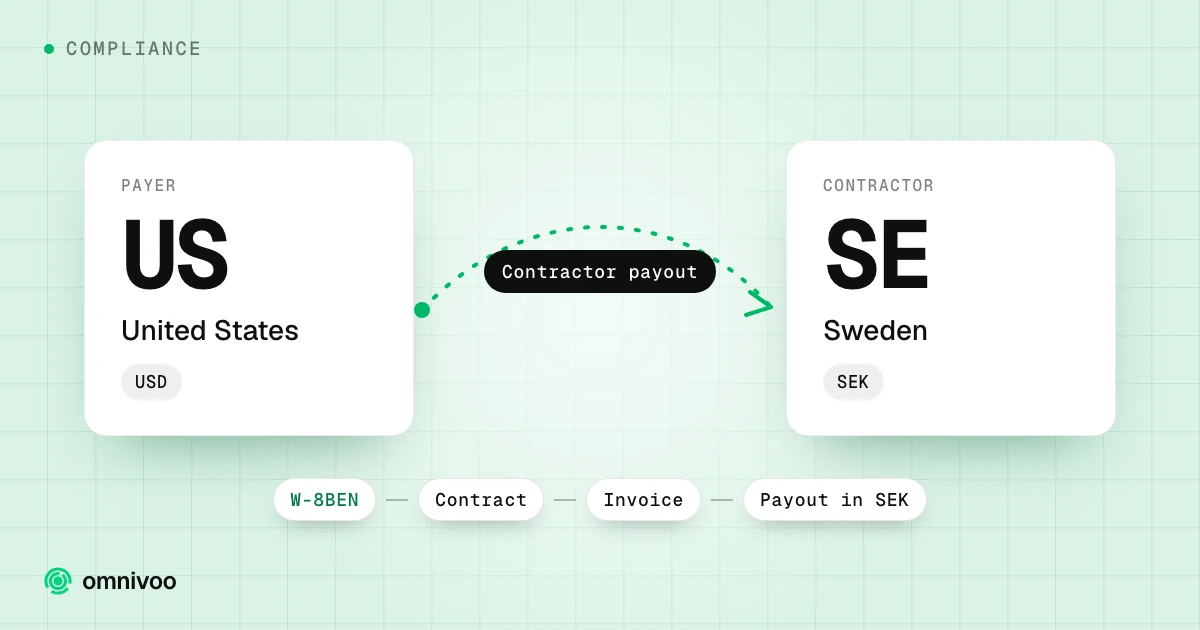
This guide covers what a US company needs to pay Swedish contractors. We cover the US side (W-8BEN, source of income, the treaty for edge cases), the Sweden side (F-skatt, moms, the contractor’s setup), and the payment rail decision. This is general information, not tax or legal advice. If you want to skip the assembly and let a platform handle it, Omnivoo Contract Management handles SOW drafting, W-8BEN collection, invoice capture, and FX settlement for $29 per contractor per month.
US side: what you need to do as the payer
Step 1. Collect a W-8BEN before the first payment
The first action is non-negotiable. Before any invoice is paid, the Swedish contractor must complete Form W-8BEN and return it to you. The form certifies the contractor is the beneficial owner of the income, is a tax resident of Sweden, and is not a US person. The IRS Form W-8BEN page has the current form and instructions.
A Swedish contractor who is not a US person provides a W-8BEN, not a Form 1099-NEC. The 1099-NEC is for US persons only. The W-8BEN is valid for three calendar years after signature and must be refreshed when it expires or when a relevant fact changes, such as address. If your contractor operates through a Swedish company (an aktiebolag, AB, for example), the form is Form W-8BEN-E, the entity equivalent, available on the IRS W-8BEN-E page. Our W-8BEN checklist walks through what to verify before the first payment.
Part II of the W-8BEN is where the contractor claims treaty benefits, citing Sweden as the treaty country. This is filled in only when treaty benefits are needed on US source income.
Step 2. Confirm the work is performed in Sweden
Under IRS source of income rules for personal services, services income is sourced to the place where the services are physically performed, regardless of where the contract was made or the residence of the payer. If your Swedish contractor does the work entirely from Stockholm, Gothenburg, Malmo, or anywhere else in Sweden, the income is foreign source income from the US perspective.
For a typical pure services engagement where the Swedish contractor never sets foot in the US, the result is: no withholding, no Form 1042-S, and no 1099-NEC. You keep the W-8BEN, the services agreement, the contractor’s invoice, and the payment receipt as the documentation packet.
If the contractor visits the US for an onsite sprint, the days physically worked inside the US are US source days. Those days have to be allocated and may trigger withholding plus a 1042-S, so keep a simple onsite-days log.
Step 3. Know the treaty for the edge cases
There is a US-Sweden income tax treaty in force. Sweden appears on the IRS list of income tax treaties A to Z, and the treaty texts are linked from the IRS Sweden tax treaty documents page. We do not state specific article numbers or withholding rates here, because the right citation depends on the type of income and should be confirmed with a qualified advisor. For background on how treaties work in general, see our income tax treaty glossary entry.
The treaty matters only when your payment generates US source income, such as onsite days worked in the US or a royalty characterisation in the SOW. In those cases the contractor uses Form 8233 (for services) or Form W-8BEN (for other income types) to claim the relevant treaty article, and the contractor’s Swedish accountant identifies the correct one. For more on this mechanic, see our Form 8233 treaty exemption guide.
For independent personal services, the treaty generally allocates taxing rights so that a Swedish resident’s service income is taxable in the US only to the extent it is attributable to a US presence the contractor maintains in the US. For a contractor working entirely from Sweden with no US presence, there is no US source income to begin with, so treaty article citations are not needed. The cleanest practice is to draft the SOW as a pure services agreement with full IP assignment for value already included in the fee, which avoids splitting the fee into a royalty component.
Sweden side: what your contractor handles
You as the US payer are not in scope for most Swedish taxes. The Swedish contractor is. Understanding the landscape helps you have an informed conversation about invoice format, VAT treatment, and how the contractor is set up.
F-skatt (F-tax) approval
Swedish self-employed people apply to Skatteverket, the Swedish Tax Agency, to be approved for F-tax (F-skatt). Per the Skatteverket guidance on approval for F-tax, approval means the person is responsible for paying their own preliminary tax and self-employed contributions on their income.
The payer-side meaning is the key point. Skatteverket explains that if a contractor is not approved for F-tax, a payer must normally first deduct tax from the fee, and if the recipient is a natural person the payer must also pay employer contributions. When the contractor is approved for F-tax, those obligations fall away. This rule sits inside the Swedish tax system, so it applies most directly when the payer is itself in Sweden. For you as a US payer with no Swedish payroll presence, the value is in due diligence: confirming the contractor holds F-skatt is good evidence that they are set up as a genuine independent business rather than a disguised employee.
Moms (VAT) 25 percent and the place-of-supply rule
Sweden’s standard moms (VAT) rate is 25 percent, with reduced rates of 12 percent and 6 percent for certain goods and services, per the Skatteverket VAT rates page. For B2B services, the place of supply is generally where the business customer is established.
When your Swedish contractor invoices your US company for services, the customer is established in the US, so the supply is generally outside the scope of Swedish VAT. The contractor issues the invoice without Swedish VAT, and you as the US payer do not pay or recover it. If the contractor is below the Swedish VAT registration threshold they may not be registered for moms at all, with the same net effect for you: no Swedish VAT on the cross-border B2B service.
Swedish income tax and social contributions
A genuinely self-employed Swedish contractor manages their own income tax and self-employed social contributions, settled through their F-tax and annual return. These are the contractor’s own obligations. You as the US client do not withhold Swedish tax and have no Swedish payroll obligation in a clean pure-services engagement. The exception is the reclassification risk below, where a contractor treated as a disguised employee can pull employment obligations into the picture.
The payment rail decision
There are a few real options for paying a Swedish contractor from a US bank account. Sweden uses the Swedish krona (SEK) and is part of the SEPA area for EUR transfers.
| Rail | Typical FX margin | Speed | Notes |
|---|---|---|---|
| US bank SWIFT wire | 2 to 4 percent | 1 to 3 business days | Highest leakage, correspondent fees |
| USD to SEK via a transparent provider | Low to mid-market plus margin | Same to next business day | Lands SEK in the contractor’s Swedish bank account |
| EUR via SEPA | Low | Same day to one day | Useful if the contractor invoices and banks in EUR |
| USD to a USD account the contractor holds | Low or none | Same to next day | Useful if contractor banks in USD |
For most US companies paying one to ten Swedish contractors, a transparent SEK provider or a EUR SEPA transfer is the cleanest option. The SWIFT network remains a fallback for one-off larger payments where the percentage cost matters less. For a deeper view of where FX cost leaks, see our guide on FX margin in international contractor payments and the FX margin glossary entry.
Misclassification risk in Sweden
Sweden, like the rest of the EU, distinguishes a genuine independent contractor from a disguised employment relationship, and the substance of the relationship governs over the contract label. The risk is highest when the contractor has only one client (your US company), works fixed hours under your direction, uses your equipment, and is integrated into your team like an employee. A reclassification can carry retroactive entitlement to employment protections and contributions.
The mitigations are the standard ones: a properly drafted services agreement that establishes the contractor relationship in substance, a scope tied to deliverables not hours, evidence the contractor has other clients (and holds F-skatt), and a documented review of worker misclassification risk at six and twelve months. A clean engagement also lowers the risk of creating a permanent establishment for your US company. For more depth, see our guide on drafting an SOW for global contractors. The Omnivoo Contract Management templates build a master service agreement and statement of work with IP assignment and a clear governing law clause by default.
End-to-end workflow
Here is the clean version for a US company onboarding its first Swedish contractor.
- Send the contractor a B2B services agreement that defines deliverables, payment, IP assignment, and termination, anchored by a master service agreement and a statement of work.
- Collect a signed W-8BEN before any payment moves. Part II references Sweden as the treaty country only when US source income is involved. Do not issue a 1099-NEC to a non-US person.
- Confirm the contractor holds F-skatt, is set up to issue a compliant invoice, and treats the cross-border B2B service as outside Swedish VAT.
- Pick a payment rail (a SEK provider, EUR via SEPA, or comparable) and onboard the contractor’s payout details.
- Pay the invoice on schedule. Keep the W-8BEN, services agreement, invoice, and payment receipt together as a packet.
- Review the engagement quarterly for misclassification risk and refresh the W-8BEN every three years.
If you also pay contractors in other treaty countries, our Form 8233 treaty exemption guide covers how that side works. For the broader framework, see our guide on how to pay international contractors from the US. If you pay contractors elsewhere in Europe, see our guides on paying German, Dutch, French, Polish, and Irish contractors.
When a platform pays for itself
A US founder paying one Swedish contractor can do this manually. A US team paying five or more Swedish contractors faces enough W-8BEN refreshes, F-skatt and VAT confirmations, and FX margin questions that a platform pays for itself within the first few months.
Omnivoo Contract Management costs $29 per contractor per month. We draft the B2B services agreement with Sweden-specific IP and misclassification clauses, collect the W-8BEN, capture the invoice on every payment, run the FX payment through a SEK or EUR rail to avoid SWIFT leakage, and store the full packet for audit. Transaction fees are passed through at cost, with competitive FX and no fee for contractors, cancel anytime.
A simple sanity check
Three questions for every Swedish contractor relationship.
- Is there a signed W-8BEN on file and is it less than three years old?
- Will all the work be performed in Sweden, and have we confirmed the contractor holds F-skatt?
- Are we paying through a rail that lands SEK or EUR cleanly and captures the invoice for every payment?
If yes to all three, you are in great shape on the US-Sweden stack. The remaining work is misclassification hygiene over time.
Want to skip the assembly entirely? See how Omnivoo Contract Management handles Swedish contractors end to end, or talk to our team about your specific setup. This guide is general information, not tax or legal advice.