
Why this guide exists
Germany has the deepest engineering talent pool in continental Europe and a long history of high-quality independent contractors in software, hardware, industrial design, and consulting. For a US company, the US-side tax mechanics are clean. The complication is entirely on the German side, where false self-employment, known as Scheinselbstständigkeit, is the single most serious risk a US buyer faces. It is enforced aggressively, the exposure is large, and the contract label is irrelevant.
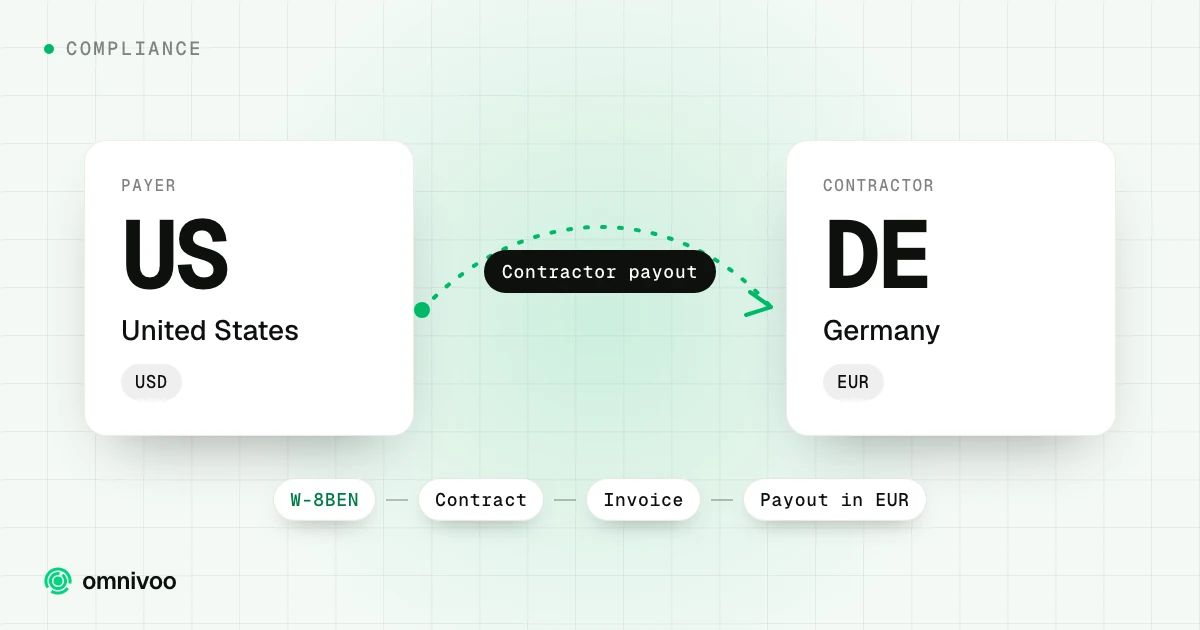
This guide covers the full stack for a US company paying contractors in Germany. We look at the US side (W-8BEN, source of income, the treaty for edge cases), the German side (Freiberufler vs Gewerbe, Steuernummer, USt-IdNr, VAT), and the payment rail, then point you to the dedicated reclassification guide for the Scheinselbstständigkeit detail. By the end you should know exactly what to ask your contractor for.
If you want to skip the assembly and let a platform run the whole stack, Omnivoo Contract Management handles SOW drafting, W-8BEN collection, invoice capture, and EUR or USD payouts for $29 per contractor per month.
US side: what you need to do as the payer
Step 1. Collect a W-8BEN before the first payment
The first action is non-negotiable. Before any invoice is paid, the contractor must complete Form W-8BEN and return it to you. The form certifies the contractor is the beneficial owner of the income, is a tax resident of Germany, and is not a US person.
A German contractor who is not a US person provides a W-8BEN, not a Form 1099-NEC. The 1099-NEC is for US persons only. The W-8BEN is valid for three calendar years after signature and must be refreshed when it expires or when a relevant fact changes. If your contractor operates through a German company (a GmbH or UG, for example), the form is W-8BEN-E, the entity equivalent. Use the free W-8BEN collection checklist to confirm you have the right form and fields.
Step 2. Confirm the work is performed in Germany
Under IRS source of income rules for personal services, services income is sourced to the place where the services are physically performed. If your German contractor does the work entirely from Berlin, Munich, Hamburg, or Cologne, the income is German source income from the US perspective.
The practical takeaway for a typical pure services engagement where the German contractor never sets foot in the US: no withholding, no 1042-S, no 1099-NEC. If the contractor travels to the US for an onsite sprint, the days physically worked inside the US are US source days, which may trigger withholding plus a 1042-S and need to be allocated.
Step 3. Know the treaty for the edge cases
The US-Germany income tax convention was signed in 1989 and is in force. It was amended by a protocol signed in 2006 that came into force in late 2007, which among other things added mandatory arbitration to the mutual agreement procedure. It is the current treaty listed on the IRS Germany tax treaty documents page.
The treaty matters only when your payment generates US source income, such as onsite days worked in the US or a royalty characterisation in the SOW. In those cases the contractor uses Form 8233 (for services) or W-8BEN (for other income types) to claim the relevant treaty article. For pure services performed in Germany there is no US source income, so the treaty stays in the background. The cleanest practice is to draft the SOW as a pure services agreement with full IP assignment for value already included in the fee, which avoids splitting the fee into a royalty component.
Germany side: what your contractor handles
You as the US payer are not in scope for most German taxes. The German contractor is. But understanding the landscape helps you have an informed conversation about invoice format, VAT treatment, and how the contractor is set up.
Freiberufler vs Gewerbe, Steuernummer, and USt-IdNr
German law draws a sharp line between two categories of self-employment. A Freiberufler is a member of a liberal profession (engineers, certain software developers, designers, writers, consultants, and similar) who registers directly with the local tax office (Finanzamt) and is not subject to trade tax (Gewerbesteuer). A Gewerbe is a registered trade or commercial business, which must register with the trade office (Gewerbeamt) and is generally subject to trade tax.
Which category applies is determined by the German tax office based on the nature of the activity, not by what the contractor prefers. Every contractor has a Steuernummer (tax number) from the Finanzamt, and a contractor who deals across EU borders or wants to reverse-charge typically also holds a USt-IdNr (VAT identification number) issued by the Federal Central Tax Office (BZSt). You as the US payer do not need to know which category the contractor is in. You only need a valid invoice.
VAT 19 percent and the reverse-charge rule
The German standard VAT rate (Umsatzsteuer) is 19 percent, governed by the Umsatzsteuergesetz (UStG). For B2B services, the place of supply is generally where the business customer is established. When your German contractor invoices your US company for services, the customer is established in the US, so the supply is generally outside the scope of German VAT under the reverse-charge rules.
The contractor issues the invoice without German VAT. As the US payer, you do not pay German VAT and do not recover it. Because the United States is a third country outside the EU and does not operate a VAT reverse charge in the way EU member states do, the practical result is simply that no German VAT is charged on the cross-border B2B service. If the contractor is below the German small-business VAT threshold (Kleinunternehmer) the invoice is issued without VAT for that reason instead, with the same net effect for you.
Social security and German income tax
A genuinely self-employed German contractor manages their own income tax and, depending on profession, their own pension and health insurance arrangements. These are the contractor’s own obligations. You as the US client do not withhold German tax and have no German payroll obligation in a clean pure-services engagement. The exception is the reclassification risk below, where a contractor treated as a disguised employee pulls social security into the picture retroactively.
The payment rail decision
There are four real options for paying a German contractor from a US bank account.
| Rail | Typical FX margin | Speed | Notes |
|---|---|---|---|
| US bank SWIFT wire | 2 to 4 percent | 1 to 3 business days | Highest leakage, correspondent fees |
| Wise USD to EUR | ~0.4 to 0.7 percent | Same day to one day | Lands EUR via SEPA |
| Payoneer USD to EUR | Tiered, lower at volume | One business day | Widely accepted |
| USD to a USD account the contractor holds | Low or none | Same day to one day | Useful if contractor banks in USD |
German banking is part of SEPA (Single Euro Payments Area), so EUR-denominated transfers land in the contractor’s German bank account quickly and cheaply. For most US companies paying one to ten German contractors, Wise or Payoneer is the cleanest option. The SWIFT network remains a fallback for one-off larger payments where the percentage cost matters less. For a deeper view of where FX cost leaks, see our guide on FX margin in international contractor payments.
Misclassification risk in Germany
This is where US buyers face their largest exposure. Scheinselbstständigkeit, or false self-employment, is when a person is engaged as a contractor on paper but the working relationship has the characteristics of dependent employment under German law. The Deutsche Rentenversicherung applies a substance-over-form test drawn from case law, and the contract label carries no weight against the reality of the relationship.
The core factors are personal subordination to instructions about content, time, and place of work, integration into the client’s work organisation, and absence of genuine entrepreneurial risk. A widely cited red flag is the 5/6 rule: when more than five-sixths of a contractor’s revenue in the prior twelve months comes from a single client, the authority presumes false self-employment. A contractor or a client can run the official Statusfeststellungsverfahren (status determination procedure) under section 7a of the Social Code Book IV to get a binding decision, ideally early in the engagement.
The consequences and the criminal-liability angle are serious enough that we cover them in a dedicated guide. Read our Germany contractor reclassification risk for US buyers for the full picture on audits, back-payment exposure, and how to protect your company. The short version: a US buyer should either run the Statusfeststellungsverfahren before engaging, structure the relationship to satisfy every substantive independence test, or use an employer of record for genuinely employee-like roles. For the contract structure that supports independence, see our guide on drafting an SOW for global contractors. The Omnivoo Contract Management templates use a master service agreement plus statement of work structure and keep worker misclassification evidence per contractor.
End-to-end workflow
Here is the clean version for a US company onboarding its first German contractor.
- Send the contractor a services agreement that defines deliverables, payment, IP assignment, and termination.
- Collect a signed W-8BEN before any payment moves. Do not issue a 1099-NEC to a non-US person.
- Confirm the contractor is set up as a Freiberufler or Gewerbe and assess Scheinselbstständigkeit risk for the engagement before you start.
- Pick a payment rail (Wise, Payoneer, or comparable) and onboard the contractor’s payout details (German IBAN for SEPA, or a USD account if they have one).
- Pay the invoice on schedule. Keep the W-8BEN, services agreement, invoice, and payment receipt together as a packet.
- Review the engagement quarterly for reclassification risk and refresh the W-8BEN every three years.
If you also pay contractors in other treaty countries, our Form 8233 treaty exemption guide covers how that side works. For the broader framework, see our guide on how to pay international contractors from the US. If you pay contractors elsewhere in Europe, see our guides on paying Spain, Portugal, and United Kingdom contractors.
When a platform pays for itself
A US founder paying one German contractor can do this manually, but the Scheinselbstständigkeit exposure makes a single mistake expensive. A US team paying five or more German contractors faces enough W-8BEN refreshes, VAT confirmations, reclassification reviews, and FX margin questions that a platform pays for itself within the first few months.
Omnivoo Contract Management costs $29 per contractor per month. We draft the services agreement with Germany-specific IP and misclassification clauses, collect the W-8BEN, capture the invoice on every payment, run the FX payment through a SEPA rail to avoid SWIFT leakage, and store the full packet for audit. Transaction fees are passed through at cost, with competitive FX and no fee for contractors, cancel anytime.
A simple sanity check
Three questions for every German contractor relationship.
- Is there a signed W-8BEN on file and is it less than three years old?
- Will all the work be performed in Germany, and have we assessed Scheinselbstständigkeit risk (including the 5/6 single-client signal)?
- Are we paying through a rail that lands EUR via SEPA and captures the invoice for every payment?
If yes to all three, the US-Germany payment stack is clean. The remaining work, and the one that matters most in Germany, is reclassification hygiene over time.
Want to skip the assembly entirely? See how Omnivoo Contract Management handles German contractors end to end, or talk to our team about your specific setup.