
Why this guide exists
Portugal has become a magnet for remote talent and a strong source of engineering, design, and product contractors for US companies. Lisbon and Porto have dense developer communities, English is widely spoken, and the time zone overlaps the US East Coast morning. For a US company building an EU-facing or nearshore-to-EU team, Portugal is an easy first stop.
The compliance picture is clean once you know the parts. There is an income tax treaty in force, the freelancer regime (the trabalhador independente issuing recibos verdes) is standard and well documented, and Portugal is inside the euro and SEPA, so payouts are cheap and fast. The features that look intimidating, the ATCUD code and the SAF-T audit file, are domestic compliance items your contractor handles, not obligations that land on you.
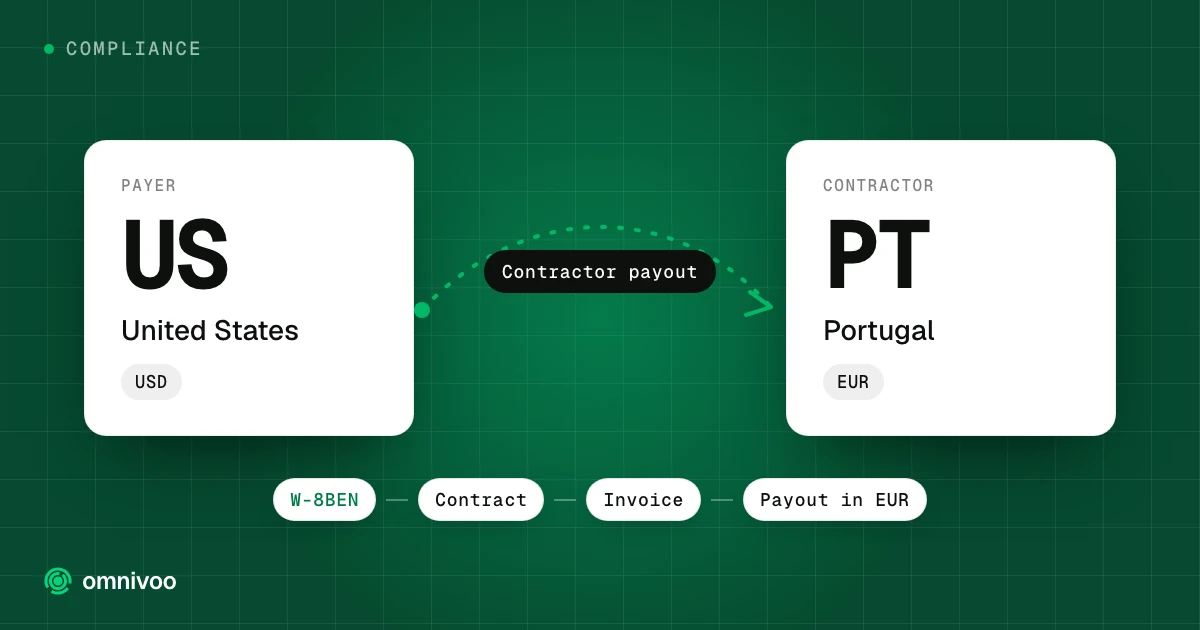
This guide covers what a US company needs to pay Portuguese contractors. We cover the US side (W-8BEN, treaty application), the Portugal side (recibos verdes, NIF, the Autoridade Tributaria, IVA, Seguranca Social, ATCUD), and the payment rail decision. If you want to skip the assembly and let a platform handle it, Omnivoo Contract Management handles SOW drafting, W-8BEN collection, invoice capture, and SEPA settlement for $29 per contractor per month.
US side: what you need to do as the payer
Step 1. Collect a W-8BEN before the first payment
Before any invoice is paid, the Portuguese contractor must complete Form W-8BEN and return it to you. The form certifies the contractor is the beneficial owner of the income, is a tax resident of Portugal, and is not a US person. The IRS Form W-8BEN page has the current form and instructions.
The W-8BEN is valid for three calendar years after signature. If your contractor operates through a Portuguese company (an Lda or similar), the form is Form W-8BEN-E, the entity equivalent, available on the IRS W-8BEN-E page. Our W-8BEN checklist walks through what to verify before the first payment.
Part II of the W-8BEN is where the contractor claims treaty benefits, citing Portugal as the treaty country. This is filled in only when treaty benefits are needed on US source income.
Step 2. Confirm the work is performed in Portugal
Under IRS source of income rules for personal services, services income is sourced to the place where the services are physically performed. If your Portuguese contractor does the work entirely from Lisbon, Porto, Braga, or Coimbra, the income is Portuguese source income from the US perspective.
For a typical pure services engagement where the Portuguese contractor never sets foot in the US, the result is: no withholding, no Form 1042-S, no 1099-NEC. The treaty is in the background but does not change the analysis.
If the contractor visits the US for an onsite sprint, the days physically worked inside the US are US source days. Those days have to be allocated and may trigger withholding and a 1042-S, so keep a simple onsite-days log.
Step 3. Know the treaty for the edge cases
The 1994 US-Portugal income tax convention, signed on 6 September 1994 and in force since 18 December 1995, governs the cases where your payment generates US source income. It was the first income tax treaty between the two countries, and its provisions generally took effect from 1 January 1996. The Treasury technical explanation walks through how each article applies.
As of 2026, the IRS Portugal tax treaty documents page lists the 1994 treaty and its technical explanation, and Portugal appears on the IRS list of income tax treaties A to Z. The 1994 treaty is the current treaty in force.
For services payments where US withholding does apply, the Portuguese contractor files Form 8233 to claim treaty benefits on the services portion, using the IRS Form 8233. For royalty type payments, the contractor relies on Form W-8BEN with the relevant 1994 treaty article entered in Part II. The contractor’s Portuguese accountant identifies the correct article. For more on this mechanic, see our Form 8233 treaty exemption guide.
For pure services performed in Portugal, treaty article citations are not needed because there is no US source income to begin with. The treaty only enters the picture when US withholding would otherwise apply.
Portugal side: what your contractor handles
You as the US payer are not in scope for most Portuguese taxes. The Portuguese contractor is. Understanding the landscape helps you have an informed conversation about invoice format, IVA treatment, and the contractor’s setup.
Trabalhador independente, the NIF, and recibos verdes
Most Portuguese freelancers working with international clients register as a trabalhador independente (independent worker). They open an activity with the Autoridade Tributaria (AT), use their NIF (Numero de Identificacao Fiscal, the tax number), and issue a recibo verde (green receipt) for each engagement through the AT portal.
The recibo verde is the contractor’s invoice. For an international B2B engagement, the contractor selects the correct VAT treatment when issuing it. You as the US payer do not need to know the internal mechanics. You only need to receive a valid recibo verde with the correct IVA treatment and keep it in your packet.
Briefly, on tax regimes: Portugal has long offered favourable regimes for new residents (the older Non-Habitual Resident regime, and the successor incentive often called IFICI). These affect the contractor’s own Portuguese income tax position, not yours. You pay the gross invoice amount and the contractor optimises their Portuguese taxation on their side.
IVA 23 percent and the place-of-supply rule
Portugal’s standard IVA rate is 23 percent on the mainland (the Azores and Madeira apply lower regional rates). You can confirm the current rate on the European Commission VAT rates page or the Portuguese tax portal.
Portuguese IVA follows the EU VAT system, which means for B2B services the place of supply is generally where the customer is established. When your Portuguese contractor invoices your US company for services, the place of supply is the United States, outside the scope of EU VAT. The contractor issues the recibo verde marked as out of scope of Portuguese IVA, or as reverse charge, and you do not pay IVA on it.
If the contractor is below the Portuguese IVA registration threshold and is not voluntarily registered, the receipt is issued without IVA and the same out-of-scope treatment applies.
ATCUD, the QR code, and SAF-T: domestic compliance, not yours
Portuguese invoices generated by certified software carry an ATCUD unique document code and a QR code, mandatory since 1 January 2023, and businesses report through the SAF-T (PT) audit file to the Autoridade Tributaria. These are domestic compliance features. They make Portuguese invoices look unusual to a US accounting team, but they create no obligation for you as the payer. You receive the recibo verde with its ATCUD and QR code, and you pay it. The contractor’s certified software and accountant handle the rest.
Seguranca Social contributions
A trabalhador independente pays Portuguese social security (Seguranca Social) on a relevant income base, assessed quarterly for self-employed workers. The Seguranca Social portal covers the current contribution rules.
Seguranca Social is the contractor’s own obligation on their own income. You as the US client do not pay it, do not contribute to it, and have no Portuguese social security reporting obligation.
The payment rail decision
There are four real options for paying a Portuguese contractor from a US bank account.
| Rail | Typical FX margin | Speed | Notes |
|---|---|---|---|
| US bank SWIFT wire | 2 to 4 percent | 2 to 3 business days | Highest leakage |
| Wise USD to EUR | ~0.4 to 0.7 percent | Same day | Lands EUR via SEPA |
| Payoneer USD to EUR or USD balance | Tiered | One business day | Widely accepted |
| USD to EUR via any SEPA provider | Low | One business day | Portugal uses the euro |
Portugal uses the euro and is part of SEPA (Single Euro Payments Area), so a EUR transfer from any EUR-supporting provider lands in the contractor’s Portuguese bank account quickly and cheaply. For USD-denominated invoices, Wise USD-to-EUR is typically the cleanest. A SWIFT wire remains a fallback for one-off larger payments, though it loses the most to FX margin. For a deeper comparison, see our guide on FX margin in international contractor payments.
Misclassification risk in Portugal
Portugal has one of the more aggressive presumption-of-employment rules in the EU. Under Article 12 of the Portuguese Labour Code (Codigo do Trabalho, Lei n.o 7/2009), an employment relationship is presumed when the working arrangement shows characteristics such as: the work is performed at a place owned by or determined by the beneficiary, the equipment and tools belong to the beneficiary, the worker observes start and end times set by the beneficiary, the worker is paid a set amount at regular intervals, and the worker performs functions inside the beneficiary’s organisation. When some of these are present, the law presumes employment and shifts the burden onto the company to prove the relationship is genuinely independent.
The reclassification risk is highest when the contractor has only one client (your US company), works fixed hours at your direction, uses your equipment, and is integrated into your team like an employee. A finding can carry retroactive entitlement to leave, holiday pay, severance, and employer social contributions.
The mitigations are the same as in other markets: a properly drafted services agreement that establishes the contractor relationship in substance, a scope tied to deliverables not time, evidence the contractor has other clients, and a documented review at six and twelve months. For more depth, see our guide on drafting an SOW for global contractors. The Omnivoo Contract Management SOW templates bake these protections in by default, including clear IP assignment and a governing law clause, and they avoid the Article 12 triggers in how the relationship is described.
End-to-end workflow
Here is the clean version for a US company onboarding its first Portuguese contractor.
- Send the contractor a B2B services agreement that defines deliverables, payment, IP assignment, and termination, anchored by a master service agreement and a statement of work.
- Collect a signed W-8BEN before any payment moves. Part II references Portugal as the treaty country only when US source income is involved.
- Confirm the contractor is registered as a trabalhador independente with a NIF and can issue a recibo verde with the correct IVA treatment.
- Pick a payment rail (Wise, Payoneer, or SEPA-aware provider) and onboard the contractor’s payout details (Portuguese IBAN).
- Pay the invoice on schedule. Keep the W-8BEN, services agreement, recibo verde, and payment receipt together as a packet.
- Review the engagement quarterly for misclassification risk, watching the Article 12 triggers, and refresh the W-8BEN every three years.
If you are also comparing rails across countries, our global contractor payment methods compared 2026 guide covers the broader options, and our guide on how to pay international contractors from the US walks the general framework. If you pay contractors elsewhere in Europe, see our guides on paying Spain, Germany, and United Kingdom contractors.
When a platform pays for itself
A US founder paying one Portuguese contractor can do this manually. A US team paying five or more Portuguese contractors faces enough W-8BEN refreshes, IVA treatment confirmations, and FX margin questions that a platform pays for itself within a few months.
Omnivoo Contract Management costs $29 per contractor per month. We draft the B2B services agreement with Portugal-specific IP and misclassification clauses, collect the W-8BEN, capture the recibo verde on every payment, run the FX payment through a SEPA or USD-to-EUR rail to avoid SWIFT leakage, and store the full packet for audit. Transaction fees are passed through at cost, with competitive FX and no fee for contractors, cancel anytime.
A simple sanity check
Three questions for every Portuguese contractor relationship.
- Is there a signed W-8BEN on file and is it less than three years old?
- Will all the work be performed in Portugal for the foreseeable future?
- Are we paying through a rail that handles SEPA or USD-to-EUR cleanly and captures the recibo verde for every payment?
If yes to all three, you are in great shape on the US-Portugal stack. The remaining work is misclassification hygiene over time, watching the Article 12 presumption.
Want to skip the assembly entirely? See how Omnivoo Contract Management handles Portuguese contractors end to end, or talk to our team about your specific setup.