
Why this guide exists
Spain has become a major hub for remote contractors serving US companies, with strong developer, design, and creative talent, a friendly time-zone overlap with the US East Coast, and a growing community of internationally minded freelancers. The US-side tax mechanics are clean. The Spanish side has two things US founders should understand: the autonomo regime that almost every Spanish freelancer operates under, and a misclassification regime, falso autonomo, that has teeth after the Riders Law reshaped the rules.
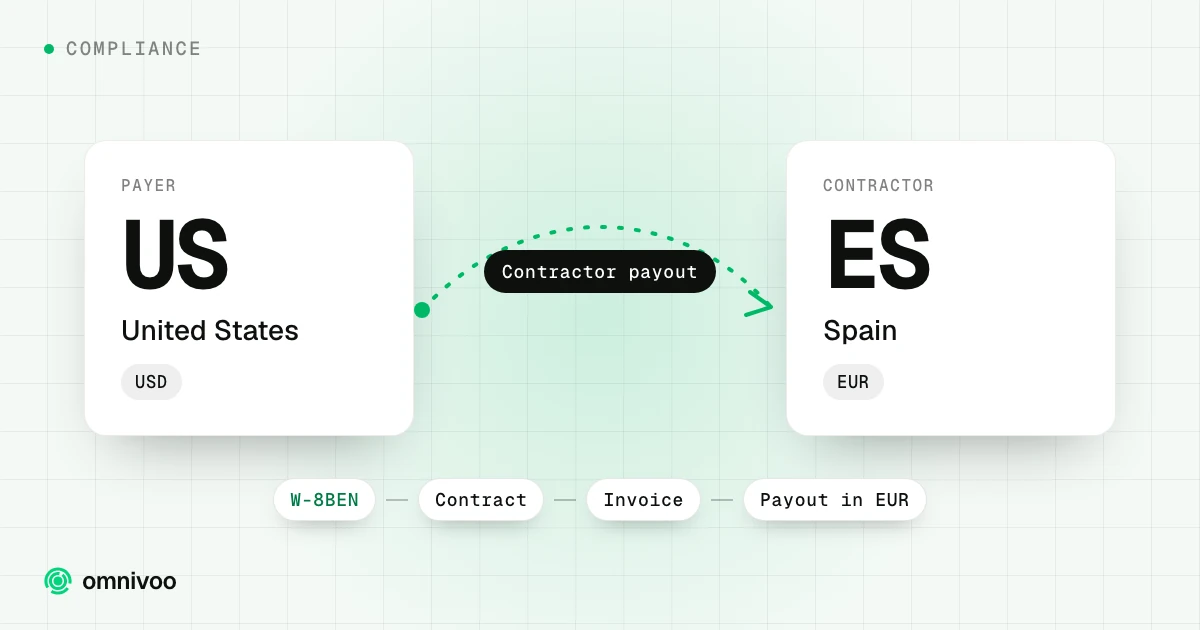
This guide covers the full stack for a US company paying contractors in Spain. We look at the US side (W-8BEN, source of income, the treaty for edge cases), the Spanish side (autonomo, NIF, RETA, IVA, the e-invoicing timeline), and the payment rail. By the end you should know exactly what to ask your contractor for and where the risks sit.
If you want to skip the assembly and let a platform run the whole stack, Omnivoo Contract Management handles SOW drafting, W-8BEN collection, invoice capture, and EUR or USD payouts for $29 per contractor per month.
US side: what you need to do as the payer
Step 1. Collect a W-8BEN before the first payment
The first action is non-negotiable. Before any invoice is paid, the contractor must complete Form W-8BEN and return it to you. The form certifies the contractor is the beneficial owner of the income, is a tax resident of Spain, and is not a US person.
A Spanish contractor who is not a US person provides a W-8BEN, not a Form 1099-NEC. The 1099-NEC is for US persons only. The W-8BEN is valid for three calendar years after signature and must be refreshed when it expires or when a relevant fact changes. If your contractor operates through a Spanish company (a sociedad limitada, for example), the form is W-8BEN-E, the entity equivalent. Use the free W-8BEN collection checklist to confirm you have the right form and fields.
Step 2. Confirm the work is performed in Spain
Under IRS source of income rules for personal services, services income is sourced to the place where the services are physically performed. If your Spanish contractor does the work entirely from Madrid, Barcelona, Valencia, or Seville, the income is Spanish source income from the US perspective.
The practical takeaway for a typical pure services engagement where the Spanish contractor never sets foot in the US: no withholding, no 1042-S, no 1099-NEC. If the contractor flies to the US for an onsite sprint, the days physically worked inside the US are US source days, which may trigger withholding plus a 1042-S and need to be allocated.
Step 3. Know the treaty for the edge cases
The US-Spain income tax convention was signed in 1990 and is in force. A protocol signed in 2013 significantly modernised the treaty, and it entered into force on 27 November 2019, cutting many interest and royalty withholding rates and revising the dividend rules. It is the current treaty listed on the IRS Spain tax treaty documents page.
The treaty matters only when your payment generates US source income, such as onsite days worked in the US or a royalty characterisation in the SOW. The 2019 protocol is good news here because it reduced withholding on several income types. In those cases the contractor uses Form 8233 (for services) or W-8BEN (for other income types) to claim the relevant treaty article. For pure services performed in Spain there is no US source income, so the treaty stays in the background. The cleanest practice is to draft the SOW as a pure services agreement with full IP assignment for value already included in the fee, which avoids splitting the fee into a royalty component.
Spain side: what your contractor handles
You as the US payer are not in scope for most Spanish taxes. The Spanish contractor is. But understanding the landscape helps you have an informed conversation about invoice format, IVA treatment, and how the contractor is set up.
Autonomo, NIF, and RETA
Almost every Spanish freelancer operates as an autonomo, the self-employed regime. To work this way the contractor registers with the Agencia Tributaria (the tax agency) and enrols in social security, files quarterly IRPF (income tax) and IVA returns, and operates as a sole trader. The contractor’s tax identifier is the NIF (Numero de Identificacion Fiscal).
For social security, autonomos contribute through RETA (Regimen Especial de Trabajadores Autonomos), the special regime for self-employed workers, administered by the social security treasury (TGSS). Monthly RETA contributions are income-based under the current system. These are the contractor’s own obligations. You as the US client do not contribute to RETA, do not withhold Spanish tax, and have no Spanish payroll obligation. You do not need the NIF to pay them. You only need a valid invoice.
IVA 21 percent and the place-of-supply rule
The Spanish standard IVA rate is 21 percent. For B2B services, the place of supply is generally where the business customer is established. When your Spanish contractor invoices your US company for services, the customer is established in the US, so the supply is outside the scope of Spanish IVA.
The contractor issues the invoice without Spanish IVA. As the US payer, you do not pay or recover Spanish IVA. The contractor still reports the transaction on their quarterly returns but does not charge you IVA on the cross-border B2B service.
Spain’s e-invoicing mandate is coming, not yet universal
This is an area where it is easy to overstate the current state, so the precise position matters. Spain has two parallel developments. First, the Veri*factu regime under Royal Decree 1007/2023 sets requirements for certified invoicing software, with deadlines that have shifted and currently land in 2027 for corporate taxpayers and self-employed persons. Second, the Crea y Crece law (Law 18/2022) establishes a mandatory B2B e-invoicing regime, implemented through Royal Decree 1090/2026 and follow-on regulations.
The B2B e-invoicing mandate is phasing in, with large companies expected to comply first (around October 2027) and smaller businesses and self-employed professionals following (around October 2028), subject to the final implementing order. The key point for you: this governs invoicing between Spanish businesses, and it does not impose an obligation on you as a foreign US payer. It is worth knowing it is on the way so you understand why your contractor’s invoicing tooling may change, but as of 2026 it is not yet a universal in-force requirement and you should not treat it as one. The Agencia Tributaria and the official state gazette (BOE) are the authoritative sources for the live dates.
The payment rail decision
There are four real options for paying a Spanish contractor from a US bank account.
| Rail | Typical FX margin | Speed | Notes |
|---|---|---|---|
| US bank SWIFT wire | 2 to 4 percent | 1 to 3 business days | Highest leakage, correspondent fees |
| Wise USD to EUR | ~0.4 to 0.7 percent | Same day to one day | Lands EUR via SEPA |
| Payoneer USD to EUR | Tiered, lower at volume | One business day | Widely accepted |
| USD to a USD account the contractor holds | Low or none | Same day to one day | Useful if contractor banks in USD |
Spanish banking is part of SEPA (Single Euro Payments Area), so EUR-denominated transfers land in the contractor’s Spanish bank account quickly and cheaply. For most US companies paying one to ten Spanish contractors, Wise or Payoneer is the cleanest option. The SWIFT network remains a fallback for one-off larger payments where the percentage cost matters less. For a side-by-side view of rails across corridors, see our global contractor payment methods compared guide.
Misclassification risk in Spain
Spain decides worker status by substance, and the regime got sharper after the Riders Law. The Estatuto de los Trabajadores (Workers’ Statute) defines an employment relationship as one where a person provides remunerated services within the organisation and direction of another. A falso autonomo (false self-employed person) is someone registered as autonomo whose actual working relationship shows the dependence and integration of employment.
The Riders Law (Ley 12/2021) amended the Workers’ Statute to create a presumption of employment for delivery platform workers managed by an algorithm, and it sharpened the broader scrutiny of the falso autonomo figure across the economy. While the presumption itself targets platform delivery work, the case it built (substance over label, dependence over paperwork) is the lens Spanish labour authorities and courts apply to disguised employment generally.
If a Spanish contractor is reclassified as an employee, the exposure includes retroactive social security contributions and employee entitlements. The mitigations are the same as in other markets: a properly drafted services agreement that establishes the contractor relationship in substance, a legitimate scope tied to deliverables not time, evidence the contractor has other clients, and a documented review at the six and twelve month checkpoints.
For more depth on contract structure, see our guide on drafting an SOW for global contractors. The Omnivoo Contract Management templates use a master service agreement plus statement of work structure and keep worker misclassification evidence per contractor.
End-to-end workflow
Here is the clean version for a US company onboarding its first Spanish contractor.
- Send the contractor a services agreement that defines deliverables, payment, IP assignment, and termination.
- Collect a signed W-8BEN before any payment moves. Do not issue a 1099-NEC to a non-US person.
- Confirm the contractor is registered as autonomo with a NIF, and review falso autonomo risk for the engagement.
- Pick a payment rail (Wise, Payoneer, or comparable) and onboard the contractor’s payout details (Spanish IBAN for SEPA, or a USD account if they have one).
- Pay the invoice on schedule. Keep the W-8BEN, services agreement, invoice, and payment receipt together as a packet.
- Review the engagement quarterly for misclassification risk and refresh the W-8BEN every three years.
If you also pay contractors in other treaty countries, our Form 8233 treaty exemption guide covers how that side works. For the broader framework, see our guide on how to pay international contractors from the US. If you pay contractors elsewhere in Europe, see our guides on paying Portugal, Germany, and United Kingdom contractors.
When a platform pays for itself
A US founder paying one Spanish contractor can do this manually. A US team paying five or more Spanish contractors faces enough W-8BEN refreshes, IVA confirmations, falso autonomo reviews, and FX margin questions that a platform pays for itself within the first few months.
Omnivoo Contract Management costs $29 per contractor per month. We draft the services agreement with Spain-specific IP and misclassification clauses, collect the W-8BEN, capture the invoice on every payment, run the FX payment through a SEPA rail to avoid SWIFT leakage, and store the full packet for audit. Transaction fees are passed through at cost, with competitive FX and no fee for contractors, cancel anytime.
A simple sanity check
Three questions for every Spanish contractor relationship.
- Is there a signed W-8BEN on file and is it less than three years old?
- Will all the work be performed in Spain, and have we reviewed falso autonomo risk?
- Are we paying through a rail that lands EUR via SEPA and captures the invoice for every payment?
If yes to all three, you are in good shape on the US-Spain stack. The remaining work is misclassification hygiene over time, with an eye on the e-invoicing rules as they phase in.
Want to skip the assembly entirely? See how Omnivoo Contract Management handles Spanish contractors end to end, or talk to our team about your specific setup.