
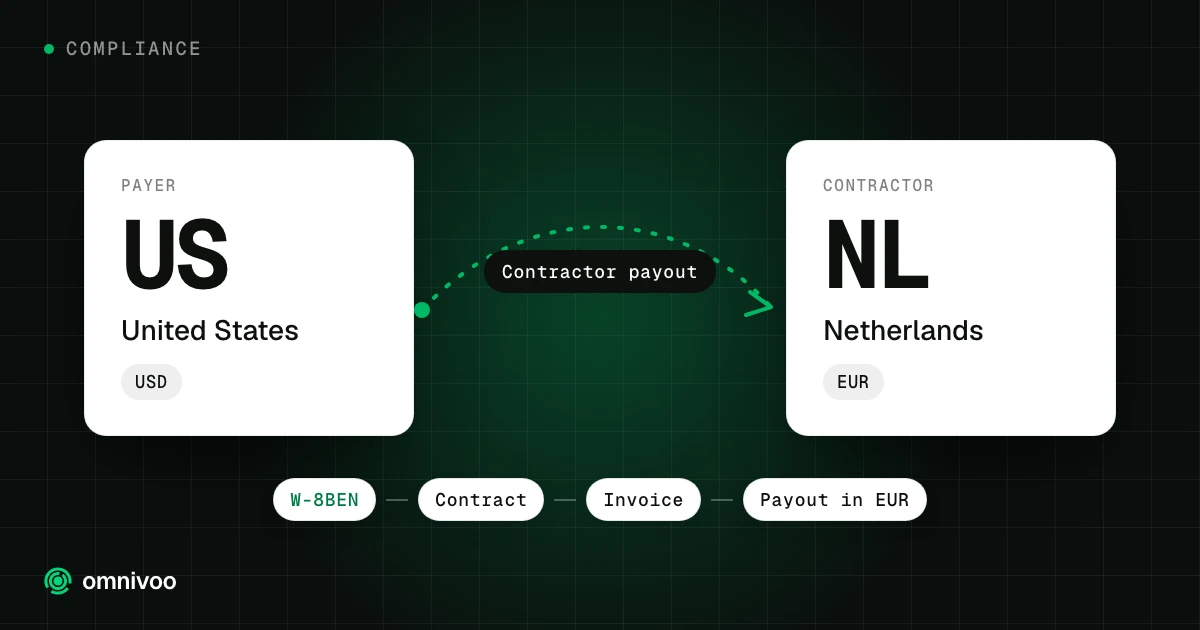
Why this guide exists
You found a great developer in Amsterdam, a designer in Rotterdam, or a marketer in Utrecht. You want to pay them quickly and legally without setting up a Dutch entity or guessing at tax rules. This guide walks through exactly what a US company must do, what the contractor handles on their side, and how to move money without losing a chunk to fees.
The short version: paying a contractor in the Netherlands is mostly about documentation and classification, not withholding. Get the paperwork right, pick a clean payment rail, and keep the relationship genuinely contractor-shaped.
US side: what you need to do as the payer
Step 1: Collect a Form W-8BEN before the first payment
Before money moves, have your contractor complete and sign Form W-8BEN. This IRS form certifies that the contractor is not a US person and that the income they earn from you is foreign-source income earned outside the United States.
Keep the signed form on file. You do not send it to the IRS. You retain it as evidence that you correctly treated the payments as non-US income not subject to US withholding. A W-8BEN is valid for three calendar years after the year it is signed. Not sure the form is filled in correctly? Our W-8BEN checklist walks through what to verify.
Step 2: Confirm where the work is performed
US tax rules turn on where the contractor does the work, not where you are. When a Dutch contractor performs services physically in the Netherlands, that income is foreign-source and is not subject to US income tax or withholding.
This is why the W-8BEN matters. It documents the contractor’s status and supports your treatment of the payments as outside US withholding.
Step 3: Treaty edge cases
The US-Netherlands income tax treaty is in force and provides relief from double taxation. For a typical contractor doing all their work in the Netherlands, the treaty rarely changes the day-to-day mechanics because the income is already foreign-source. It matters most if the contractor spends time working inside the United States or earns US-source income, in which case the treaty can reduce or eliminate US withholding.
If your contractor ever travels to the US to perform work for you, that portion of their income can become US-source. In that situation, a Form 8233 may let them claim a treaty exemption from withholding. For most remote relationships this never comes up, but it is worth knowing. If you ever engage a Dutch company rather than an individual, the entity signs a Form W-8BEN-E instead.
One more US-side concept worth understanding is permanent establishment. A single remote contractor working from their own home office does not create a US taxable presence for your company, and it does not create a Dutch taxable presence for you either as long as the contractor is genuinely independent. The risk only grows if a contractor starts acting like an employee or signs contracts on your behalf, which is one more reason to keep the relationship at arm’s length. A clean master service agreement with a tightly scoped statement of work is the simplest way to keep that line clear.
Netherlands side: what your contractor handles
This is the part that reassures nervous founders: almost none of it is your responsibility. Your Dutch contractor is running their own business and handles their own obligations.
Business registration and the KVK
Most Dutch freelancers operate as a ZZP’er, a zelfstandige zonder personeel, which is a sole proprietor without staff. They register with the Netherlands Chamber of Commerce, the KVK, which assigns a business number and passes their details to the tax authority. Registration and reporting are their responsibility, not yours.
Tax ID and income tax
Dutch contractors receive a BTW-id (VAT identification number) and file their own income tax with the Belastingdienst, the Dutch tax authority. How they file is between them and the tax office.
BTW (VAT)
The standard Dutch BTW rate is 21 percent. For B2B services sold to a US company, the place-of-supply rules generally put the supply outside Dutch BTW, so the contractor usually does not add BTW to your invoice. They confirm their own position.
There is one wrinkle worth knowing about Dutch BTW for very small operators. The Netherlands runs a small businesses scheme, the kleineondernemersregeling (KOR), which lets an entrepreneur whose annual turnover does not exceed 20,000 euro opt out of charging and remitting BTW entirely. A contractor on the KOR issues invoices without BTW, which lines up with the out-of-scope treatment for services sold to a US company anyway. Either way, you as the US payer do not pay Dutch BTW. The contractor decides their own VAT position with their accountant, and your only job is to accept whichever compliant invoice they send.
Social contributions
Self-employed Dutch contractors arrange their own social and pension cover and pay contributions through their income tax return. You never contribute to the Dutch social system for an independent contractor. Unlike an employer hiring an employee in the Netherlands, you have no obligation to register with any Dutch payroll or social security body, no withholding to operate, and no monthly filing. That is the core advantage of a genuine contractor relationship, and it is exactly what the wet DBA enforcement is designed to police, so the freedom comes with the responsibility to keep the relationship genuinely independent.
The payment rail decision
Once the paperwork is sorted, the only remaining question is how to move money efficiently. Dutch contractors typically hold euro accounts. Here is how the common rails compare.
| Rail | Typical FX margin | Speed | Notes |
|---|---|---|---|
| SWIFT wire | 2 to 4 percent baked into the rate | 1 to 4 business days | Familiar to every bank but you pay for it in the exchange rate and fixed fees on both ends. |
| Wise | 0.4 to 0.7 percent over mid-market | Same day to 1 day | Transparent fee shown upfront. Pays into Dutch euro accounts cheaply. |
| Payoneer | 1 to 2 percent | 1 to 2 days | Works if your contractor already uses it. Less transparent than Wise on FX. |
| SEPA transfer | Bank dependent if euro to euro | Same day to 1 day | Cheapest when you hold euro and your contractor holds a euro account. No FX if both sides are euro. |
The pattern across these rails is simple. The more transparent the provider is about the exchange rate, the less you lose to FX margin. A SWIFT wire that advertises no fee often hides 2 to 4 percent in the rate. A provider that shows the mid-market rate and a flat fee is almost always cheaper for the contractor. The SWIFT network is reliable but rarely the cheapest option.
A practical point worth settling up front is which currency the invoice is in. If you invoice and pay in euro, the conversion from US dollars happens once, on your side, and the contractor receives a clean euro amount with no surprise on their end. If you invoice in dollars and the contractor’s bank converts on receipt, you lose visibility into the rate they actually get, and they often get a worse one than a specialist provider would offer. For a Dutch contractor who holds a euro account, the cheapest and most predictable setup is usually to agree the fee in euro and send a euro payment over SEPA or a low-margin provider, so both sides know exactly what will land. Settle the currency question in the contract so it does not become a recurring point of friction.
Misclassification risk in the Netherlands
This is the part that actually carries risk for a US company. The IRS cares about classification, and so does the Netherlands. If you treat someone as a contractor but the relationship looks like employment, both countries can push back.
The Dutch test centers on the wet DBA, the law on the assessment of working relationships. It targets schijnzelfstandigheid, false self-employment, where a worker is treated as a freelancer but the relationship is really employment. After years of light-touch enforcement, the Belastingdienst resumed active enforcement of the wet DBA from 1 January 2025. That makes genuine contractor relationships more important than ever.
If a Dutch contractor works only for you, on your schedule, under your direction, and with your equipment, the authorities can treat the relationship as employment. The consequences land on both sides: reassessment of payroll taxes, social contributions, interest, and penalties.
What does a genuinely independent relationship look like in practice? The contractor sets their own hours, uses their own equipment, can send a substitute or subcontract parts of the work, carries the commercial risk of their own business, and ideally has more than one client. The agreement should describe deliverables and outcomes rather than a fixed weekly schedule, and you should avoid language that reads like an employment contract, such as job titles, probation periods, or paid leave. The Dutch authorities look at how the relationship actually works day to day, not just what the paper says, so the substance has to match.
Keep the relationship genuinely contractor-shaped. See our contract management guide for how to structure agreements that hold up, and our note on worker misclassification for the warning signs.
End-to-end workflow
Here is the whole process from start to first payment.
- Sign a contract. Use a written agreement with a clear statement of work, deliverables, and an IP assignment clause so you own what you pay for.
- Collect a W-8BEN. Have the contractor complete Form W-8BEN before the first payment.
- Pick a payment rail. Choose SEPA or a low-margin provider over a raw SWIFT wire where you can.
- Pay on a schedule. Agree invoice timing and stick to it.
- Keep records. Retain the W-8BEN, contract, and invoices.
- Re-collect the W-8BEN every three years or when anything changes.
The documentation packet to keep
For each Dutch contractor, keep one folder with the signed agreement and statement of work, the signed W-8BEN, every invoice, and a record of every payment. If a US tax question ever arises, the W-8BEN and the work-location facts are your support for treating the payments as foreign-source income with no withholding. If a Dutch classification question arises, the contract terms and the way the work actually ran are what the authorities will look at. Keeping the packet current is cheap insurance, and it is far easier to maintain from day one than to reconstruct later.
How often to revisit the relationship
A contractor engagement is not set and forget. A good rhythm is a light review at six and twelve months: confirm the W-8BEN is still valid, check that the scope still reads like project work rather than a standing role, and note whether the contractor has taken on other clients. If the relationship has quietly drifted toward looking like employment, that is the moment to either restructure it or move the person onto a proper employment arrangement through an employer of record. Catching the drift early is much cheaper than a reassessment.
When a platform pays for itself
You can absolutely do all of this yourself. Collect the W-8BEN, sign a clean contract, send a Wise transfer, and keep your records. For one or two contractors that is completely reasonable.
The math changes as you add people. Every contractor means another W-8BEN to track, another contract to store, another renewal date to remember, and another monthly payment to reconcile. Miss a renewal or misfile a contract and you have a compliance gap.
This is where Omnivoo contract management helps. You get a clean contract with the right clauses, W-8BEN collection built into onboarding, and payment handled on one of the rails above. Pricing is $29 per contractor per month, with any payment fees passed through at cost, competitive FX and no fee for contractors, cancel anytime.
The value is not just the paperwork. It is having one place where the signed agreement, the W-8BEN, the invoices, and the payment records all live together, so that if a question ever comes up you can answer it in minutes rather than digging through email. For a company paying a single contractor that may be overkill. For a company building a team across several countries, that consistency is what keeps the compliance picture clean as you grow.
A simple sanity check
Before you send the first payment, ask three questions.
- Do I have a signed Form W-8BEN on file?
- Is the relationship genuinely contractor-shaped, not disguised employment under the wet DBA?
- Am I paying on a rail that does not quietly cost me FX margin?
If you can answer all three cleanly, you are in good shape.
For the bigger picture across countries, see our guide to paying international contractors and our country guides for Germany, France, and Ireland. You can also compare options on our pay contractors hub.
Ready to pay your Dutch contractor the right way? Talk to us or explore Omnivoo contract management to get started.
This guide is general information, not legal or tax advice. Tax rules change and individual situations vary. Confirm specifics with a qualified cross-border tax professional before you act.
Reviewed by the Omnivoo Compliance Team. Last reviewed May 2026.