
Why this guide exists
You found a great developer in Sydney, a designer in Melbourne, or a marketer in Brisbane. You want to pay them quickly and legally without setting up an Australian entity or guessing at tax rules. This guide walks through exactly what a US company must do, what the contractor handles on their side, and how to move money without losing a chunk to fees.
The short version: paying a contractor in Australia is mostly about documentation and classification, not withholding. Get the paperwork right, pick a clean payment rail, and keep the relationship genuinely contractor-shaped.
Australia is a natural hiring market for US companies. English is the working language, the talent pool in software, design, and professional services is deep, and the time-zone overlap suits teams with an APAC focus. The tax mechanics for a US payer are clean because the income is foreign-source. The two things that catch people out are Australia’s superannuation rule, which can pull a labour-only contractor into employee treatment for retirement contributions, and the sham contracting provisions in the Fair Work Act. Both sit largely on the contractor’s side, but they shape how you should structure the engagement. For the cross-country picture, our contract management overview shows how the same documentation pattern repeats in every market.
US side: what you need to do as the payer
Step 1: Collect a Form W-8BEN before the first payment
Before money moves, have your contractor complete and sign Form W-8BEN. This IRS form certifies that the contractor is not a US person and that the income they earn from you is foreign-source income earned outside the United States.
Keep the signed form on file. You do not send it to the IRS. You retain it as evidence that you correctly treated the payments as non-US income not subject to US withholding. A W-8BEN is valid for three calendar years after the year it is signed. Our free W-8BEN collection checklist helps you confirm the form is complete before you pay.
Step 2: Confirm where the work is performed
US tax rules turn on where the contractor does the work, not where you are. When an Australian contractor performs services physically in Australia, that income is foreign-source and is not subject to US income tax or withholding.
This is why the W-8BEN matters. It documents the contractor’s status and supports your treatment of the payments as outside US withholding.
Step 3: Treaty edge cases
The US-Australia income tax treaty is in force and provides relief from double taxation. For a typical contractor doing all their work in Australia, the treaty rarely changes the day-to-day mechanics because the income is already foreign-source. It matters most if the contractor spends time working inside the United States or earns US-source income, in which case the treaty can reduce or eliminate US withholding.
If your contractor ever travels to the US to perform work for you, that portion of their income can become US-source. In that situation, a Form 8233 may let them claim a treaty exemption from withholding. For most remote relationships this never comes up, but it is worth knowing. If you engage an Australian company rather than an individual, the entity signs a Form W-8BEN-E instead.
The related concept of permanent establishment is worth a quick mention. A single Australian contractor working independently from their own premises does not create a taxable presence in Australia for your US company. That only becomes a concern if the contractor routinely concludes contracts in your name or functions as a fixed extension of your business. Keeping the relationship at arm’s length, with a clear master service agreement, keeps that line clean.
Australia side: what your contractor handles
This is the part that reassures nervous founders: almost none of it is your responsibility. Your Australian contractor is running their own business and handles their own obligations.
Business registration and the ABN
Most Australian freelancers operate as a sole trader with an Australian Business Number (ABN), which they use to invoice clients and deal with the Australian Taxation Office. Registration and reporting are their responsibility, not yours.
Tax ID and income tax
Australian contractors have a TFN (Tax File Number) and lodge their own income tax return with the ATO, often through the pay-as-you-go instalment system. How they file is between them and the ATO.
GST
The Australian GST rate is 10 percent, and a sole trader must register for GST only once their annual turnover reaches or is expected to reach A$75,000. Even when registered, services exported to a non-resident outside Australia are generally GST-free, so the contractor usually does not add GST to your invoice. They confirm their own position.
It is worth understanding how the GST threshold interacts with exported services. Because GST-free export sales still count toward the 75,000 Australian dollar turnover figure, a busy contractor can cross the registration threshold even though the income from your US company is itself GST-free. If that happens, the contractor registers for GST and manages their domestic obligations, but they still do not add GST to your invoice, because the export remains GST-free. None of this changes what you pay. The contractor handles their own GST position with their accountant, and you simply pay the invoiced amount.
Superannuation
Superannuation is Australia’s compulsory retirement system. Here is the edge case worth knowing: under ATO rules a contractor who is paid wholly or principally for their labour can be treated as an employee for superannuation guarantee purposes, even if they quote an ABN. This is more likely when the contractor is paid for hours worked rather than a result, does the work personally, and cannot delegate. The practical takeaway is to pay for outcomes and deliverables rather than for raw hours of personal labour wherever the work genuinely allows it, and to let the contractor delegate or subcontract where they can. One way to sidestep the deeming rule entirely is to contract with the worker’s company, trust, or partnership rather than the individual, because the labour-only super rule applies to contracts with the person who actually does the work. It is one more reason to keep the relationship genuinely contractor-shaped.
The payment rail decision
Once the paperwork is sorted, the only remaining question is how to move money efficiently. Australian contractors hold Australian dollar accounts. Here is how the common rails compare.
| Rail | Typical FX margin | Speed | Notes |
|---|---|---|---|
| SWIFT wire | 2 to 4 percent baked into the rate | 1 to 4 business days | Familiar to every bank but you pay for it in the exchange rate and fixed fees on both ends. |
| Wise | 0.4 to 0.7 percent over mid-market | Same day to 1 day | Transparent fee shown upfront. Pays into Australian dollar accounts cheaply. |
| Payoneer | 1 to 2 percent | 1 to 2 days | Works if your contractor already uses it. Less transparent than Wise on FX. |
| PayID / Osko (domestic NPP) | No FX once funds are in AUD | Near instant within Australia | Australia’s real-time domestic rail. Useful for the final leg once money has reached an Australian account, not for the cross-border conversion itself. |
The pattern across these rails is simple. The more transparent the provider is about the exchange rate, the less you lose to FX margin. A SWIFT wire that advertises no fee often hides 2 to 4 percent in the rate. A provider that shows the mid-market rate and a flat fee is almost always cheaper for the contractor. The SWIFT network is reliable but rarely the cheapest option.
A practical point worth settling up front is the currency and the final leg of the payment. Australian contractors hold Australian dollar accounts, so the cross-border conversion from US dollars happens once, and the cheapest result comes from a provider that shows the mid-market rate and a flat fee rather than a bank that buries the margin. Once the money has reached an Australian account, domestic real-time rails such as PayID and Osko move it instantly, but those rails do not handle the currency conversion itself, so the savings are made at the conversion step, not the final hop. Agree the fee in Australian dollars and the rail in the contract so the contractor knows exactly what will land each month and you avoid recurring friction over exchange differences.
Misclassification risk in Australia
This is the part that actually carries risk for a US company. The IRS cares about classification, and so does Australia. If you treat someone as a contractor but the relationship looks like employment, both countries can push back.
Australia treats sham contracting as illegal under the Fair Work Act 2009. A sham arrangement is one that disguises an employment relationship as independent contracting to avoid employee entitlements. The Fair Work Ombudsman enforces these rules and penalties can apply. On top of that, the superannuation rule above means a labour-only contractor can be deemed an employee for super even without a finding of sham contracting.
If an Australian contractor works only for you, on your schedule, under your direction, the relationship can be treated as employment. The consequences land on both sides: back superannuation, back entitlements, interest, and penalties.
The factors that matter mirror those elsewhere. A genuine contractor runs their own business, can subcontract or delegate, supplies their own tools, sets their own hours, carries commercial risk, and serves other clients. A worker paid for their time, embedded in your team, and unable to delegate looks like an employee, and under the superannuation rule above they may be treated as one for super even without a formal employment finding. Define the work around deliverables and a result, keep employment-style terms out of the agreement, and let the contractor operate as the independent business they are.
Keep the relationship genuinely contractor-shaped. See our contract management guide for how to structure agreements that hold up, and our note on worker misclassification for the warning signs.
End-to-end workflow
Here is the whole process from start to first payment.
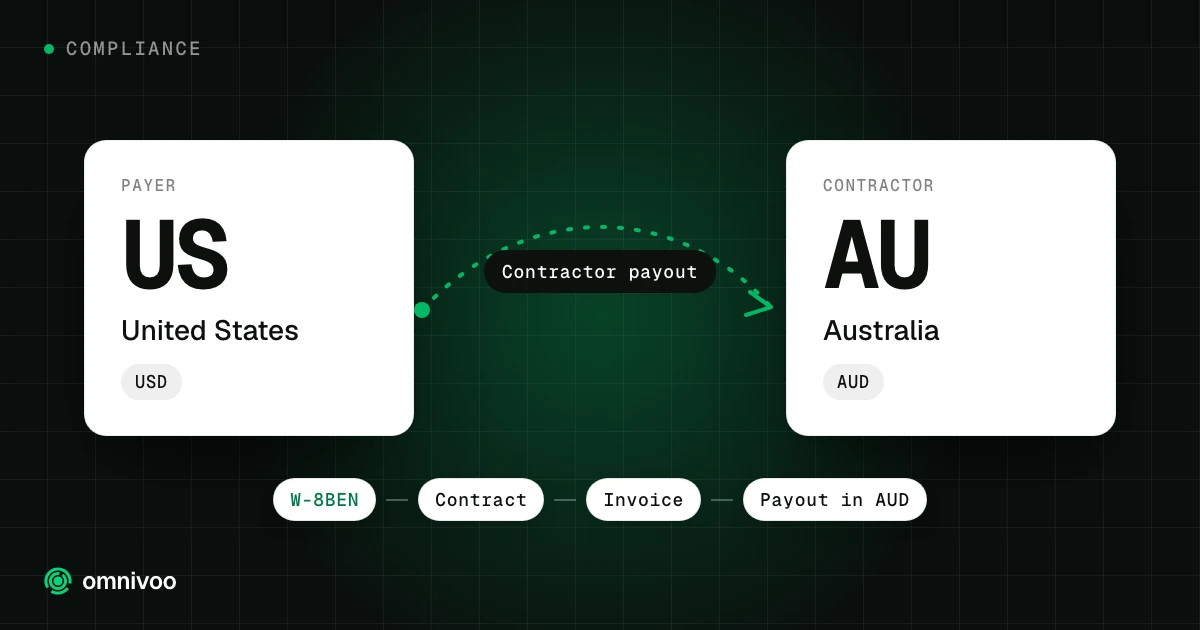
- Sign a contract. Use a written agreement with a clear statement of work, deliverables, and an IP assignment clause so you own what you pay for.
- Collect a W-8BEN. Have the contractor complete Form W-8BEN before the first payment.
- Pick a payment rail. Choose a low-margin provider over a raw SWIFT wire where you can.
- Pay on a schedule. Agree invoice timing and stick to it.
- Keep records. Retain the W-8BEN, contract, and invoices.
- Re-collect the W-8BEN every three years or when anything changes.
The documentation packet to keep
For each Australian contractor, keep one folder with the signed agreement and statement of work, the signed W-8BEN, every invoice, and a record of every payment. If a US tax question ever arises, the W-8BEN and the work-location facts support treating the payments as foreign-source income with no withholding. If an Australian classification or superannuation question arises, the contract terms and the way the work actually ran are what the ATO or the Fair Work Ombudsman will weigh. Keeping the packet current is cheap insurance, and it is far easier to maintain from day one than to reconstruct later.
How often to revisit the relationship
A contractor engagement is not set and forget. A good rhythm is a light review at six and twelve months: confirm the W-8BEN is still valid, check that the scope still reads like project work rather than a standing role, and note whether the contractor has taken on other clients. Pay particular attention to whether the engagement has become mostly payment for the contractor’s personal labour, which can pull it into superannuation territory. If the relationship has drifted toward looking like employment, that is the moment to either restructure it or move the person onto a proper employment arrangement through an employer of record. Catching the drift early is far cheaper than back super and penalties.
When a platform pays for itself
You can absolutely do all of this yourself. Collect the W-8BEN, sign a clean contract, send a Wise transfer, and keep your records. For one or two contractors that is completely reasonable.
The math changes as you add people. Every contractor means another W-8BEN to track, another contract to store, another renewal date to remember, and another monthly payment to reconcile. Miss a renewal or misfile a contract and you have a compliance gap.
This is where Omnivoo contract management helps. You get a clean contract with the right clauses, W-8BEN collection built into onboarding, and payment handled on one of the rails above. Pricing is $29 per contractor per month, with any payment fees passed through at cost, competitive FX and no fee for contractors, cancel anytime.
The benefit is having the signed agreement, the W-8BEN, the invoices, and the payment records together in one place, so any question can be answered quickly. For a single Australian contractor that may be more than you need. For a team across several countries, that consistency is what keeps the compliance picture clean as you grow.
A simple sanity check
Before you send the first payment, ask three questions.
- Do I have a signed Form W-8BEN on file?
- Is the relationship genuinely contractor-shaped, not sham contracting or labour-only work that triggers super?
- Am I paying on a rail that does not quietly cost me FX margin?
If you can answer all three cleanly, you are in good shape.
For the bigger picture across countries, see our guide to paying international contractors and our country guides for India and the Philippines. You can also compare options on our pay contractors hub.
Ready to pay your Australian contractor the right way? Talk to us or explore Omnivoo contract management to get started.
This guide is general information, not legal or tax advice. Tax rules change and individual situations vary. Confirm specifics with a qualified cross-border tax professional before you act.
Reviewed by the Omnivoo Compliance Team. Last reviewed May 2026.