
COMPLIANCE
The Estimated Tax Underpayment Penalty: How Self-Employed Contractors Avoid It
Self-employed and behind on estimated tax? Here are the IRS safe harbors that avoid the Form 2210 underpayment penalty, and how it gets computed.
Reviewed by Rohan Sasne on Jun 18, 2026
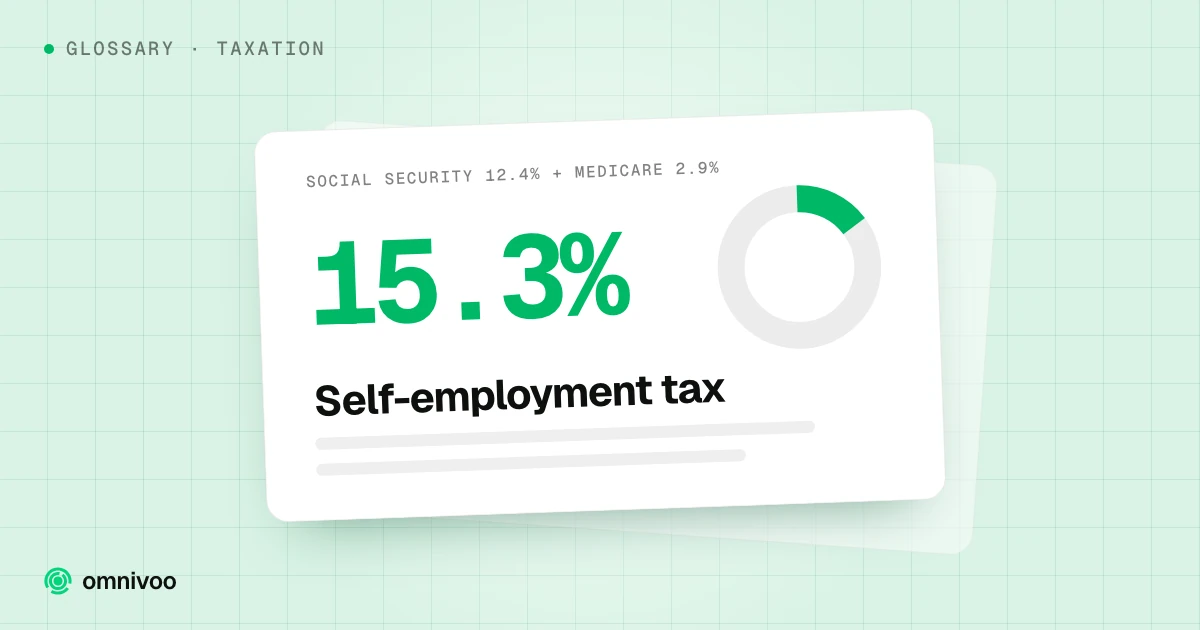
Self-employment tax is the Social Security and Medicare tax that people who work for themselves pay on their net earnings, at a combined rate of 15.3 percent that splits into 12.4 percent for Social Security up to the annual wage base and 2.9 percent for Medicare with no cap, figured on Schedule SE of Form 1040.
Self-employment tax is the Social Security and Medicare tax paid by people who work for themselves rather than for an employer. When someone earns a wage, the employer withholds the employee share of Social Security and Medicare tax and pays a matching employer share. A self-employed person has no employer, so they cover both halves directly. The IRS describes this on its Self-Employment Tax page, which states that the tax is “a tax consisting of Social Security and Medicare taxes primarily for individuals who work for themselves.”
According to the IRS, “the self-employment tax rate is 15.3%. The rate consists of two parts: 12.4% for social security (old-age, survivors, and disability insurance) and 2.9% for Medicare (hospital insurance).”
The two parts behave differently:
The IRS generally requires you to file Schedule SE and pay self-employment tax if your net earnings from self-employment were 400 dollars or more. This covers sole proprietors, independent contractors, and general partners. Self-employment tax is figured on net earnings, which is your business income after deductible business expenses, not on gross receipts.
The tax is calculated on Schedule SE, which attaches to Form 1040 or Form 1040-SR. A common-law employee, by contrast, is not subject to self-employment tax on that work, because the employer already withholds and matches Social Security and Medicare tax on wages. Worker classification therefore decides which side of this line a person falls on.
The IRS allows a self-employed person to deduct the employer-equivalent portion of self-employment tax, equal to one half of the tax, when figuring adjusted gross income. This mirrors the fact that an employer’s share of payroll tax is a business expense. The deduction reduces income tax. It does not reduce the self-employment tax itself.
Because no employer withholds Social Security, Medicare, or income tax from a self-employed person, the IRS expects the tax to be paid as income is earned, usually through quarterly estimated tax payments rather than a single year-end payment.
Omnivoo classifies each worker correctly at onboarding and produces the tax records a US payer needs, so the line between an employee and a self-employed contractor is documented from the start.
Collect W-8BEN and W-9, sign country-aware contracts, and pay contractors in 220+ countries and territories.
A common-law employee is a worker whose business has the right to control what will be done and how it will be done, even if the worker has freedom of action. Under the IRS common-law rules the determination weighs three categories of evidence: behavioral control, financial control, and the type of relationship between the parties.
Estimated taxes are the periodic payments the IRS uses to collect income tax, and other taxes such as self-employment tax, on income that is not subject to withholding. Individuals, including sole proprietors, partners, and S corporation shareholders, generally pay estimated tax in four installments across the year using Form 1040-ES when they expect to owe enough tax at filing.
Schedule C (Form 1040), Profit or Loss from Business (Sole Proprietorship), is the IRS form a sole proprietor or single-member LLC owner uses to report income and expenses from a business they operated or a profession they practiced. The net profit flows to Form 1040 and is also the base for self-employment tax figured on Schedule SE.
FICA is the federal payroll tax that funds Social Security and Medicare. On the employee side it is 6.2 percent for Social Security up to the annual wage base plus 1.45 percent for Medicare, for 7.65 percent total, and the employer matches each portion, so the combined rate is 15.3 percent. A 0.9 percent Additional Medicare Tax applies to high earners.
Form 2210, Underpayment of Estimated Tax by Individuals, Estates, and Trusts, is the IRS form used to figure whether a taxpayer owes a penalty for paying too little estimated tax during the year and, if so, how much. It matters most to self-employed people such as independent contractors, who pay tax in quarterly installments instead of through employer withholding.
A gross-up is an upward adjustment to a payment so the recipient nets a target amount after taxes or fees are deducted, with the payer absorbing the added cost. The grossed-up figure is found by dividing the desired net by one minus the applicable rate.
Collect the right tax form before you pay, sign a country-aware contract, and pay contractors in 220+ countries and territories. $29 per contractor per month.
Get startedFull details in our Terms of Service →