
COMPLIANCE
The Estimated Tax Underpayment Penalty: How Self-Employed Contractors Avoid It
Self-employed and behind on estimated tax? Here are the IRS safe harbors that avoid the Form 2210 underpayment penalty, and how it gets computed.
Reviewed by Rohan Sasne on May 15, 2026
Estimated taxes are the periodic payments the IRS uses to collect income tax, and other taxes such as self-employment tax, on income that is not subject to withholding. Individuals, including sole proprietors, partners, and S corporation shareholders, generally pay estimated tax in four installments across the year using Form 1040-ES when they expect to owe enough tax at filing.
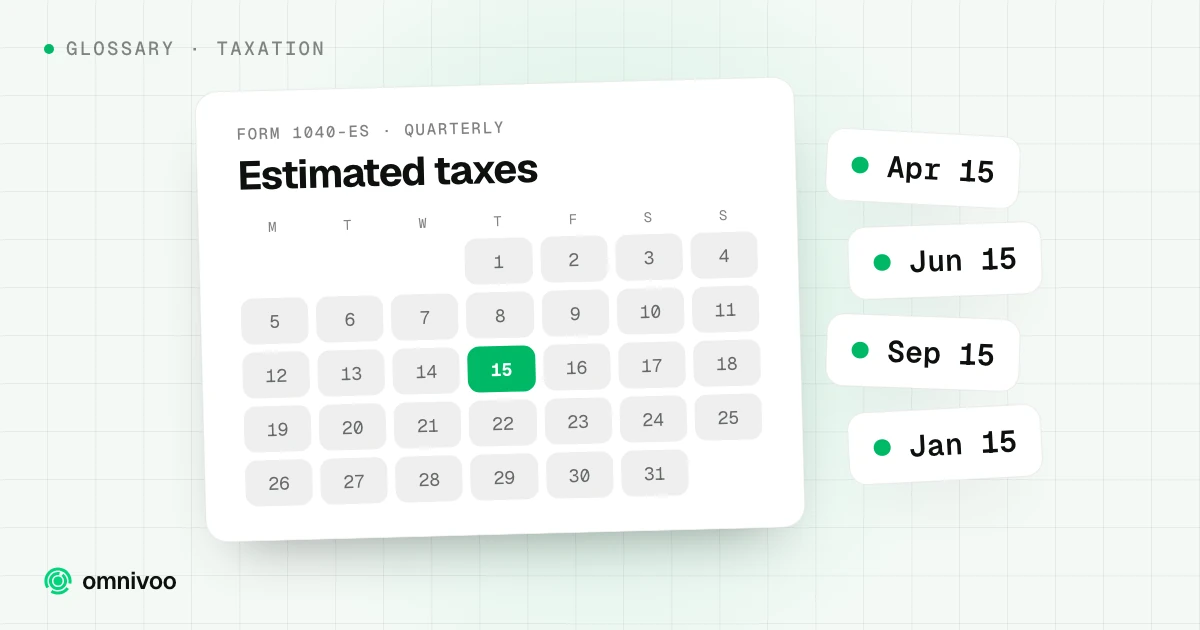
Estimated taxes are how the US tax system collects tax on income that nobody withholds for you. Wages run through payroll, where an employer deducts income tax and remits it on the worker’s behalf. Income such as independent contractor earnings, business profit, interest, dividends, and rent usually arrives with nothing taken out. To keep that income current with the government, the payee makes estimated tax payments directly to the IRS during the year. The IRS describes the system on its Estimated Taxes page.
The core principle is that tax is owed as income is earned, not in a single lump sum after the year ends. The IRS puts it plainly: “Taxes must be paid as you earn or receive income during the year, either through withholding or estimated tax payments.” For a salaried employee, withholding satisfies this automatically. For a self-employed person, estimated tax is the substitute. The IRS also notes that estimated tax covers “not only income tax, but other taxes such as self-employment tax and alternative minimum tax.”
According to the IRS, “individuals, including sole proprietors, partners, and S corporation shareholders, generally have to make estimated tax payments if they expect to owe tax of $1,000 or more when their return is filed.” In practice this captures most freelancers, gig workers, and independent contractors who receive payments with no withholding. A person who has both a job and side income can often increase wage withholding on Form W-4 instead of sending separate estimated payments.
Individuals generally use Form 1040-ES to figure estimated tax. The form’s worksheet projects the year’s expected income, deductions, and credits to arrive at the tax owed, which is then spread across the year. The IRS states that “the year is divided into four payment periods,” each with its own due date, so estimated tax is paid in four installments. Paying too little can trigger a penalty: the IRS says “you may have to pay a penalty for underpayment of estimated tax” unless you meet one of its safe harbors, such as owing less than the threshold after withholding and credits.
A US business paying an independent contractor does not withhold income tax from those payments. The contractor receives the gross amount, often reported later on a Form 1099-NEC, and is responsible for their own income tax and self-employment tax through estimated payments. This is the structural difference from payroll tax on wages, where the employer handles deduction and remittance. Missing a valid taxpayer ID on a Form W-9 can also expose those payments to backup withholding, a separate mechanism from estimated tax.
Omnivoo Contract Management collects each US contractor’s W-9, tracks payments through the year, and produces the 1099-NEC records that let the contractor reconcile their estimated tax at filing.
Backup withholding is a 24 percent federal income tax that a US payer must withhold from certain reportable payments when the payee fails to provide a correct TIN or when the IRS notifies the payer that the payee is delinquent on prior reporting.
Form 1099-NEC is the IRS information return a US business files to report nonemployee compensation paid to a US independent contractor during a calendar year. The threshold is $2,000 for payments made in 2026, up from $600 for earlier years.
The collective employer-side taxes and statutory contributions deducted or contributed alongside salary payments in India, including PF, ESI, professional tax, and TDS.
Constructive receipt is the cash-method tax doctrine under which income is treated as received, and therefore taxable, when an amount is credited to the taxpayer's account or made available without substantial restriction, even if the taxpayer has not physically taken possession of it. It fixes the year a cash-basis taxpayer must report income to the period the money first became available.
Form 2210, Underpayment of Estimated Tax by Individuals, Estates, and Trusts, is the IRS form used to figure whether a taxpayer owes a penalty for paying too little estimated tax during the year and, if so, how much. It matters most to self-employed people such as independent contractors, who pay tax in quarterly installments instead of through employer withholding.
Self-employment tax is the Social Security and Medicare tax that people who work for themselves pay on their net earnings, at a combined rate of 15.3 percent that splits into 12.4 percent for Social Security up to the annual wage base and 2.9 percent for Medicare with no cap, figured on Schedule SE of Form 1040.
Collect the right tax form before you pay, sign a country-aware contract, and pay contractors in 220+ countries and territories. $29 per contractor per month.
Get startedFull details in our Terms of Service →