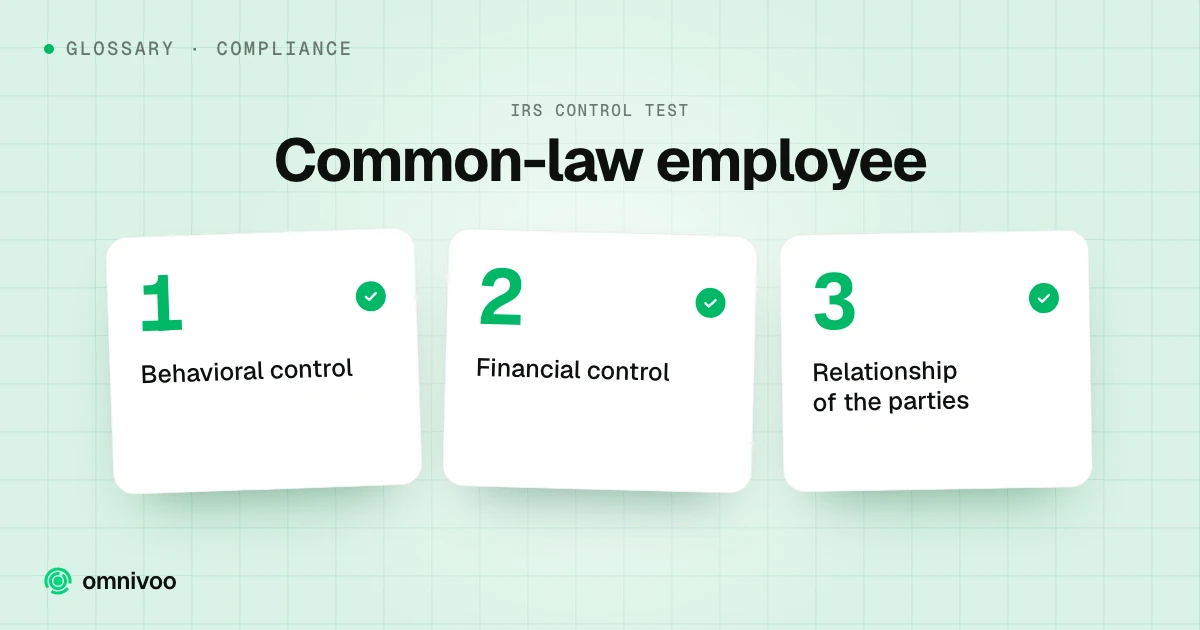
A common-law employee is a worker who, under the IRS common-law rules, is subject to the business’s right to control both what work is done and how it is done. The IRS sets out the standard on its Independent Contractor (Self-Employed) or Employee? page, which states that a worker is an employee “if you can control what will be done and how it will be done.” The phrase common law means the test comes from long-standing agency principles rather than a single statute, and it is the default classification the IRS applies when deciding employment tax treatment.
The Right to Control
The defining feature is the right to control, not whether control is used in practice. A business can give a worker freedom of action and still have an employee, because what matters is whether the business retains the right to direct the means and methods of the work. This separates a common-law employee from a contractor, where the payer can direct only the outcome.
The Three Categories of Evidence
The IRS does not use a single deciding factor. It groups the evidence into three categories and weighs the entire relationship. According to the IRS worker classification guidance:
- Behavioral control. Does the company “control or have the right to control what the worker does and how the worker does his or her job?” Instructions on when, where, and how to work, and training in company methods, point toward employee status.
- Financial control. “Are the business aspects of the worker’s job controlled by the payer?” This includes how the worker is paid, whether expenses are reimbursed, and who provides the tools and supplies. A worker with a significant investment and exposure to profit or loss looks more like a contractor.
- Type of relationship. Are there “written contracts or employee type benefits (that is, pension plan, insurance, vacation pay, etc.),” will the relationship continue, and “is the work performed a key aspect of the business?” Benefits and permanency point toward employment.
Contrast With an Independent Contractor
The IRS frames the contractor side of the line in terms of result versus method. On its Independent contractor defined page, the IRS states the general rule that an individual is an independent contractor if the person for whom the services are performed has the right to control or direct only the result of the work and not what will be done and how it will be done. A common-law employee, by contrast, is subject to control over the means and methods. The broader IRS 20 factor test is the historical checklist that fed into these three modern categories. A separate federal standard, the economic reality test, governs Fair Labor Standards Act coverage and uses a different analysis, so a worker can be classified one way for tax purposes and another for wage-and-hour purposes.
Why the Classification Matters
Calling a common-law employee an independent contractor is worker misclassification, and it can leave the business liable for employment taxes it failed to withhold, along with penalties. When status is genuinely unclear, the IRS allows either party to file Form SS-8 for an official determination, which the IRS notes “may take at least six months.” Publication 15-A, the Employer’s Supplemental Tax Guide, gives the detailed rules employers use to apply the categories.
Omnivoo Contract Management documents each engagement’s control terms, payment structure, and relationship type, so a business can show how a worker was classified and keep contractor relationships from drifting into common-law employment.