
COMPLIANCE
The Estimated Tax Underpayment Penalty: How Self-Employed Contractors Avoid It
Self-employed and behind on estimated tax? Here are the IRS safe harbors that avoid the Form 2210 underpayment penalty, and how it gets computed.
Reviewed by Rohan Sasne on May 11, 2026
FUTA is the federal unemployment tax imposed on employers under the Federal Unemployment Tax Act. According to IRS Topic 759, the rate is 6.0 percent on the first $7,000 of each employee's wages, and employers who pay state unemployment tax on time generally receive a credit of up to 5.4 percent, for a net federal rate of 0.6 percent. It is reported annually on Form 940.
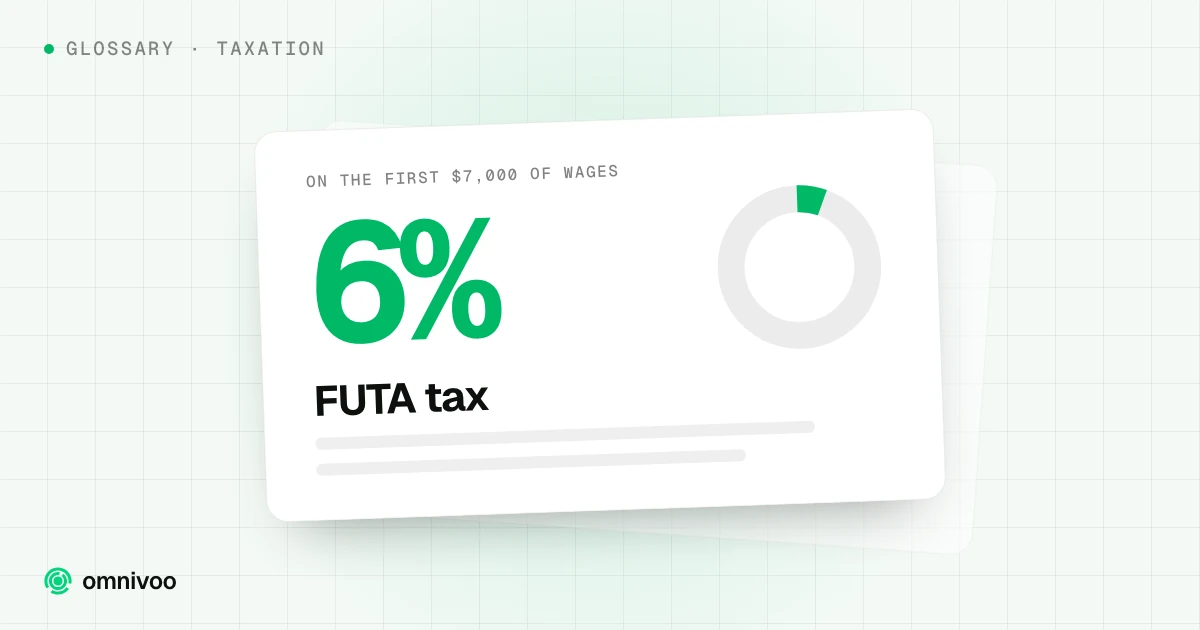
FUTA, the Federal Unemployment Tax Act, is a federal tax that employers pay to help fund unemployment compensation for workers who lose their jobs. It is an employer-only tax. According to IRS Topic 759, “the FUTA tax rate is 6.0%” and “the tax applies to the first $7,000 you paid to each employee as wages during the year.” Most employers do not pay the full 6.0 percent, because a credit for state unemployment tax brings the effective rate down sharply. FUTA is reported annually on Form 940, the Employer’s Annual Federal Unemployment (FUTA) Tax Return.
FUTA is levied on the employer, not the worker. Unlike income tax or the employee share of Social Security and Medicare, FUTA is never withheld from a paycheck. The employer computes the tax on the wage base and pays it directly.
The mechanics, per IRS Topic 759, are straightforward:
The 6.0 percent rate is rarely the amount an employer actually pays. The IRS states on Topic 759 that employers who pay their state unemployment tax in full and on time receive “a credit of up to 5.4% of FUTA taxable wages.” That credit reduces the federal rate to a net 0.6 percent. The IRS confirms the arithmetic on its FUTA credit reduction page: “Generally, employers may receive a credit of 5.4% when they file their Form 940 … to result in a net FUTA tax rate of 0.6% (6.0% - 5.4% = 0.6%).”
In a state that is in good standing with the federal unemployment fund, this means an employer’s FUTA cost is generally 0.6 percent on the first $7,000 per employee, or about $42 per employee per year. Employers in a credit reduction state pay more, because the state has an outstanding federal loan and part of the credit is taken away.
FUTA attaches to the employer-employee relationship. It applies to wages paid to employees and does not apply to amounts paid to independent contractors. The distinction tracks worker classification. A common-law employee generates FUTA liability for the employer, while a properly classified independent contractor does not.
This is one reason classification matters for tax cost. Worker misclassification, treating a true employee as a contractor, can leave a payer liable for back FUTA along with other unpaid employment taxes and penalties. FUTA sits alongside the other payroll tax obligations that ride with employment.
Omnivoo classifies each worker before payment, so US employers and payers know when a payment carries employment-tax obligations like FUTA and when it does not.
Collect W-8BEN and W-9, sign country-aware contracts, and pay contractors in 220+ countries and territories.
A common-law employee is a worker whose business has the right to control what will be done and how it will be done, even if the worker has freedom of action. Under the IRS common-law rules the determination weighs three categories of evidence: behavioral control, financial control, and the type of relationship between the parties.
The collective employer-side taxes and statutory contributions deducted or contributed alongside salary payments in India, including PF, ESI, professional tax, and TDS.
Worker misclassification is the treatment of a worker as an independent contractor when, under the applicable federal or state test, the worker should be classified as an employee.
Collect the right tax form before you pay, sign a country-aware contract, and pay contractors in 220+ countries and territories. $29 per contractor per month.
Get startedFull details in our Terms of Service →