
COMPLIANCE
EU AI Act and Contractor Hiring Systems: 2026 Compliance Guide
AI that recruits, evaluates, or monitors EU contractors is high-risk under the EU AI Act. Most rules apply from 2 August 2026. Here is your checklist.
Reviewed by Rohan Sasne on Jun 18, 2026
FICA is the federal payroll tax that funds Social Security and Medicare. On the employee side it is 6.2 percent for Social Security up to the annual wage base plus 1.45 percent for Medicare, for 7.65 percent total, and the employer matches each portion, so the combined rate is 15.3 percent. A 0.9 percent Additional Medicare Tax applies to high earners.
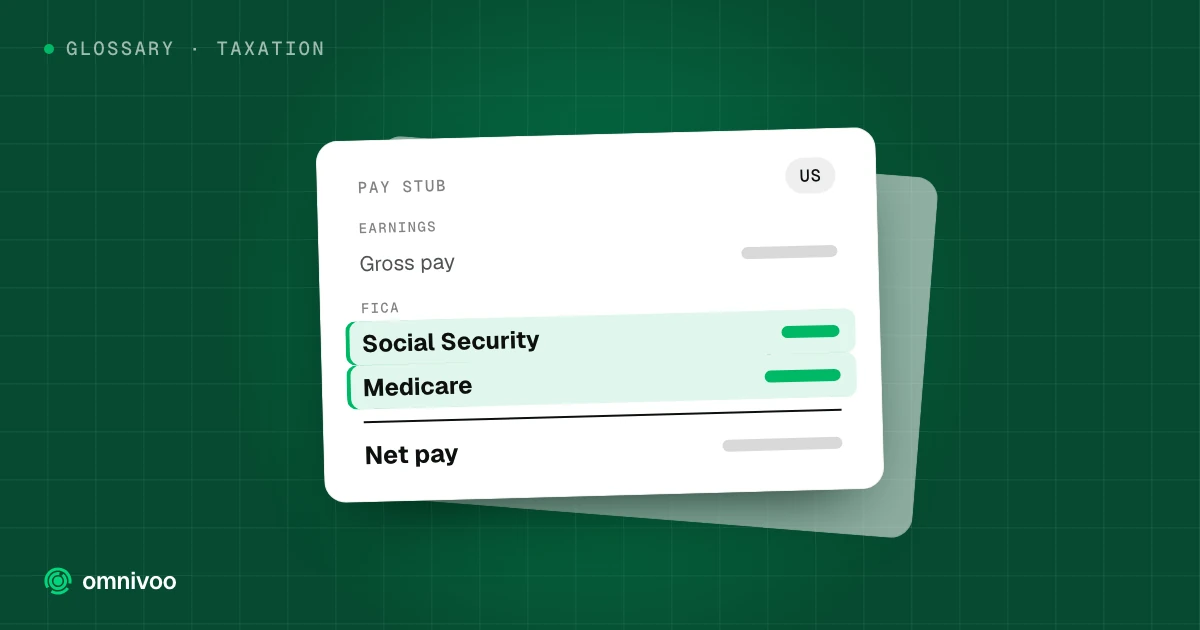
FICA, the Federal Insurance Contributions Act, is the US payroll tax that funds two federal programs: Social Security and Medicare. It is split into two pieces that each apply to wages. The employee pays a share, and the employer matches it. The IRS summarizes the rates on Tax Topic 751. For any US company that runs payroll for a common-law employee, FICA is the difference between gross pay and what actually lands in the bank, and it is a direct cost on the employer side as well.
FICA has a Social Security component and a Medicare component.
Adding the two employee pieces gives 7.65 percent withheld from the worker. The employer pays a matching 7.65 percent out of its own pocket. Together that is the 15.3 percent combined FICA rate.
The 6.2 percent Social Security tax stops at an annual ceiling, the wage base, which the government adjusts each year. The IRS states “For earnings in 2026, this base limit is $184,500” (Topic 751). Wages above that figure in the same calendar year are not subject to the 6.2 percent Social Security portion. The 1.45 percent Medicare portion keeps applying to every dollar of wages because Medicare has no cap.
High earners owe a further 0.9 percent Additional Medicare Tax on top of the standard 1.45 percent. Per Topic 751, an employer withholds this on “wages paid in excess of $200,000 in a calendar year, without regard to filing status.” This is an employee-only tax. There is no employer match, so the employer’s Medicare rate stays at 1.45 percent regardless of how much the employee earns.
FICA applies to the employer-employee relationship. The employer withholds the employee half and pays the employer half. A genuine independent contractor is not on payroll, so the engaging company does not pay an employer share for that worker. Instead the contractor pays self-employment tax, which covers both halves. The IRS states “The self-employment tax rate is 15.3%,” consisting of “12.4% for social security” and “2.9% for Medicare” (IRS self-employment tax page). The combined 15.3 percent matches the combined FICA rate, which is why misclassifying an employee as a contractor shifts the employer half of that cost onto the worker.
Omnivoo EOR is India-only, so US FICA does not apply to Omnivoo-employed staff. For US companies engaging contractors abroad, Omnivoo Contract Management keeps each worker correctly classified so the right tax regime, FICA for employees or self-employment tax for contractors, is applied to the relationship.
Collect W-8BEN and W-9, sign country-aware contracts, and pay contractors in 220+ countries and territories.
A common-law employee is a worker whose business has the right to control what will be done and how it will be done, even if the worker has freedom of action. Under the IRS common-law rules the determination weighs three categories of evidence: behavioral control, financial control, and the type of relationship between the parties.
Self-employment tax is the Social Security and Medicare tax that people who work for themselves pay on their net earnings, at a combined rate of 15.3 percent that splits into 12.4 percent for Social Security up to the annual wage base and 2.9 percent for Medicare with no cap, figured on Schedule SE of Form 1040.
Form W-2, Wage and Tax Statement, is the IRS information return a US employer files and furnishes for each employee to report wages paid and the income, Social Security, and Medicare taxes withheld during the calendar year. It is the employee counterpart to Form 1099-NEC, which reports payments to an independent contractor.
A gross-up is an upward adjustment to a payment so the recipient nets a target amount after taxes or fees are deducted, with the payer absorbing the added cost. The grossed-up figure is found by dividing the desired net by one minus the applicable rate.
Supplemental wages are payments an employer makes to an employee in addition to regular wages, such as bonuses, commissions, overtime pay, and severance, and they carry their own federal income tax withholding methods under IRS Publication 15. The optional flat rate is 22 percent, rising to a mandatory 37 percent on supplemental wages over 1 million dollars paid to an employee in a calendar year.
Collect the right tax form before you pay, sign a country-aware contract, and pay contractors in 220+ countries and territories. $29 per contractor per month.
Get startedFull details in our Terms of Service →