
No one is withholding for you
When you work as a W-2 employee, your tax shows up in the background. The employer deducts income tax and the employee share of Social Security and Medicare from each paycheck and sends it to the IRS for you. By the time you file, most of the year’s tax is already paid.
An independent contractor gets none of that. A US client that pays you as a contractor does not withhold anything. It sends you the full invoice amount and reports the total, and the responsibility to pay tax during the year shifts entirely onto you. You owe income tax on the profit and you owe self-employment tax, the contractor version of the Social Security and Medicare taxes an employer would otherwise withhold.
The US system still wants tax paid as income is earned, not in one lump at filing. So the IRS has you pay it yourself, in installments, through estimated taxes. This guide lays out the due dates you have to hit, with the IRS citations attached. A quick note before we start. This is general information, not tax or legal advice. Your exact dates and amounts turn on your situation, so confirm them with a qualified tax professional or against the current Form 1040-ES before you pay.
Four payments, not one
The IRS Estimated Taxes page explains the rhythm: “For estimated tax purposes, the year is divided into four payment periods,” each with its own due date. You figure and pay each installment on Form 1040-ES, which the IRS describes as the form individuals use “to figure and pay your estimated tax.”
So the practical shape is four payments spread across the year rather than a single settlement in April. Each one covers the income earned in its period.
The standard due dates
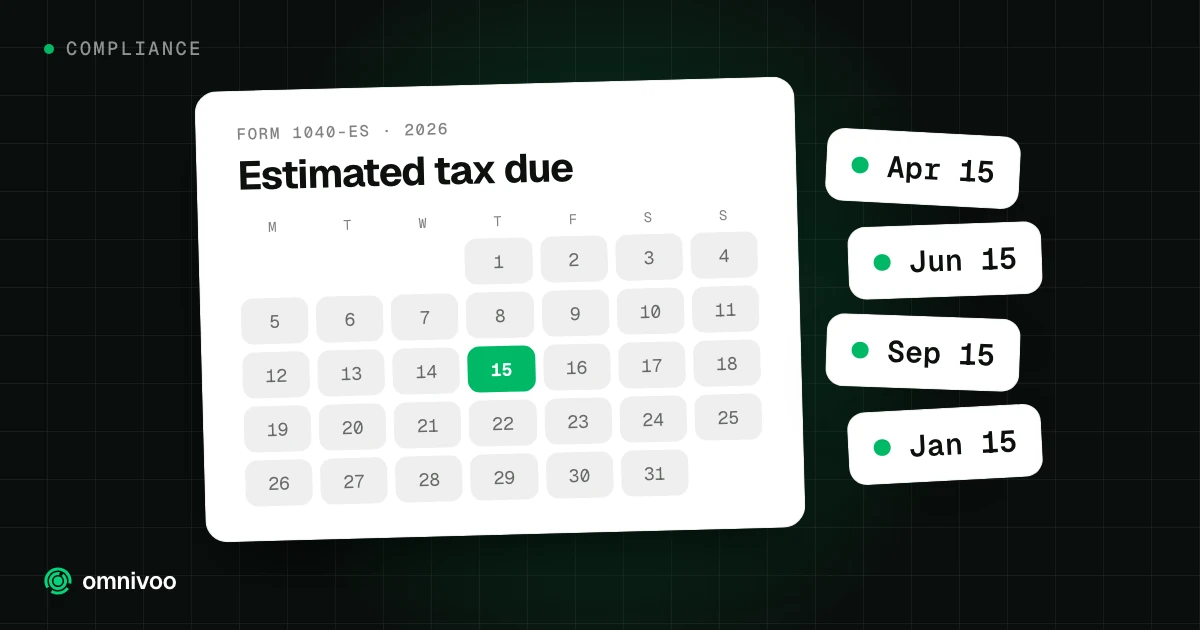
Per the IRS, the four payment periods and their due dates run in this order. The dates below are the standard dates the IRS pairs with each income period.
| Income period | Standard due date |
|---|---|
| January 1 to March 31 | April 15 |
| April 1 to May 31 | June 15 |
| June 1 to August 31 | September 15 |
| September 1 to December 31 | January 15 of the following year |
That last one is the part people miss. The fourth installment is not due in December with the rest of the year. It lands in mid January of the next year, so the September through December income gets its payment after the calendar turns.
These are the standard dates. The IRS publishes the exact dates for a given tax year on that year’s Form 1040-ES, and a date can move, which is the next thing to understand.
When a date falls on a weekend or holiday
A fixed date like April 15 does not always land on a business day. The IRS handles that with a simple rule. The Estimated Taxes page states:
“If the due date for an estimated tax payment falls on a Saturday, Sunday, or legal holiday, the payment will be on time if you make it on the next day that isn’t a Saturday, Sunday or holiday.”
So if September 15 is a Sunday, the payment is on time the following Monday. If January 15 collides with a legal holiday, it moves to the next open day. The shift is always forward to the next business day, never backward.
Because legal holidays move around and weekends fall on different dates each year, the safest move is to read the exact due dates printed on the current Form 1040-ES for the tax year you are paying, rather than assuming a particular shifted date. If you are paying for the 2026 tax year, confirm each of the four dates on the 2026 Form 1040-ES once the IRS publishes it. Treat the standard dates above as the anchor and apply the next business day rule to whichever ones land on a weekend or holiday.
Who actually has to pay
Not every contractor has to send quarterly checks, but most do. The IRS standard is a dollar threshold. From the Estimated Taxes page:
“Individuals, including sole proprietors, partners, and S corporation shareholders, generally have to make estimated tax payments if they expect to owe tax of $1,000 or more when their return is filed.”
If you are a full time contractor with no withholding anywhere, you almost certainly clear that bar once the income adds up, because nothing is being paid in on your behalf during the year.
There is an alternative if you also earn wages somewhere. Instead of cutting four separate checks, you can ask that employer to withhold more from your paychecks by adjusting your Form W-4, and let the extra withholding cover the contractor income. For a contractor with no wage job, that option is off the table, and the four installments are the path.
The penalty for getting it wrong
The reason the dates matter is the underpayment penalty. The IRS does not just want the right total by April. It wants enough paid in by each period’s due date. From the Estimated Taxes page:
“If you didn’t pay enough tax throughout the year, either through withholding or by making estimated tax payments, you may have to pay a penalty for underpayment of estimated tax.”
That penalty is figured on Form 2210, Underpayment of Estimated Tax by Individuals, Estates, and Trusts. The good news is that the IRS gives clear safe harbors. The same page states that most taxpayers avoid the penalty if they owe less than 1,000 dollars after subtracting withholding and credits, or if they paid at least 90 percent of the tax for the current year, or 100 percent of the tax shown on the prior year return, whichever is smaller.
In plain terms, if you pay in either 90 percent of this year’s tax or 100 percent of last year’s tax across the four installments, you are generally protected even if you owe more at filing. Paying on the standard due dates is how you stay inside that protection.
A simple way to stay on schedule
Three habits keep a contractor out of penalty territory.
- Set aside a slice of every payment. Because nothing is withheld, the tax money arrives mixed in with your income. Move a portion of each invoice into a separate account the day it lands, so the cash is there when a due date arrives.
- Calendar the four dates. Put April 15, June 15, September 15, and January 15 of the following year on your calendar now, and confirm the exact dates on the current Form 1040-ES in case any shift to the next business day.
- Use a safe harbor target. Aim each year to pay in at least 100 percent of last year’s tax, or 90 percent of this year’s, across the four installments. That target is the cleanest way to avoid the Form 2210 penalty.
Where the payment side gets cleaner
The estimated tax calendar is yours to manage as a contractor, and no platform changes that the IRS expects four payments from you. What a platform can change is the chaos on the other side of the relationship: getting paid on time, with the right tax form collected up front, so your records are clean when the due dates come.
Omnivoo Contract Management handles the hire end to end for 49 dollars per contractor per month. We collect the correct tax form, run the KYC, draft and manage the contract, and pay contractors in 220+ countries and territories. Transaction fees are passed through at cost, with competitive FX and no fee for contractors, cancel anytime, so what arrives in your account is predictable and documented.
Want clean payment records that make estimated tax season easier? See how Omnivoo Contract Management works end to end, or talk to our team.