
Why this guide exists
Thailand has become a steady source of design, development, content, and operations talent for US companies, helped by a large freelance population, English-capable professionals, and Bangkok-hours overlap with much of Asia. The hiring side is easy. The compliance side trips up US founders because Thailand has a US tax treaty, a 7 percent VAT regime, an e-tax invoice system, and a recent change to how residents are taxed on money they bring into the country.
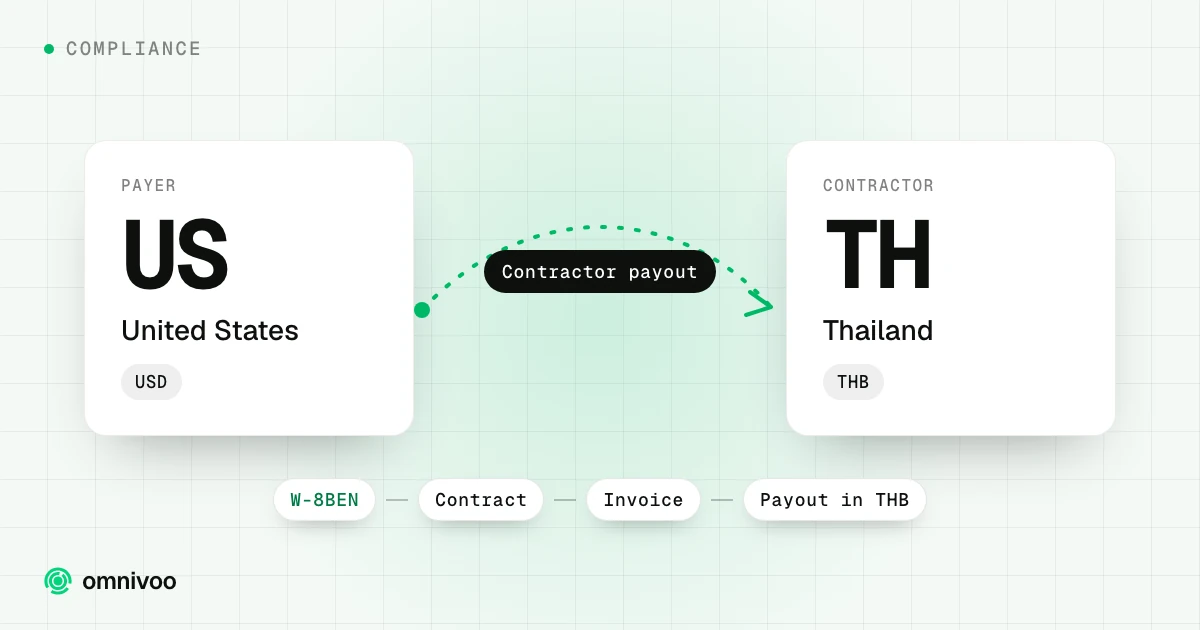
This guide covers the full stack for a US company paying contractors in Thailand. We look at the US side (W-8BEN, treaty application, 1042-S), the Thailand side (tax ID, VAT, e-tax invoice, social security, the remittance change), and the payment rail. By the end you should know exactly what to ask your contractor for and what each document is doing in the chain.
If you want to skip the assembly and let a platform run the whole stack, Omnivoo Contract Management handles SOW drafting, W-8BEN collection, invoice capture, and THB or USD payouts for $29 per contractor per month.
US side: what you need to do as the payer
Step 1. Collect a W-8BEN before the first payment
Before any invoice is paid, the contractor completes Form W-8BEN and returns it to you. The form certifies the contractor is the beneficial owner of the income, is a tax resident of Thailand, and is not a US person.
The W-8BEN is valid through the end of the third calendar year after signature and must be refreshed when it expires or when a relevant fact changes. If your contractor operates through a registered Thai company (a limited company), the form is W-8BEN-E, the entity equivalent. Before you pay, run through our W-8BEN collection checklist to make sure the form is complete.
Step 2. Confirm the work is performed in Thailand
Under IRS source of income rules for personal services, services income is sourced to where the services are physically performed. If your Thai contractor works entirely from Bangkok, Chiang Mai, or Phuket, the income is Thai source income from the US perspective.
The practical result: no withholding, no 1042-S, and no 1099-NEC, because the 1099-NEC is for US persons only. You keep the W-8BEN, the SOW, the invoice, and the payment receipt together as your documentation packet.
If the contractor visits the US for onsite work, the days physically worked inside the US are US source days that must be allocated and may trigger withholding plus a 1042-S. A simple onsite-days log keeps this clean.
Step 3. Know the treaty for the edge cases
Thailand is on the IRS A-to-Z list of US income tax treaties, so a treaty is in force. The full text and technical explanation are available through the US-Thailand tax treaty documents.
The treaty matters only when your payment generates US source income. For pure services performed in Thailand, the US has no withholding right under source rules, so the treaty does not change anything. Where it becomes relevant is US source royalties or income tied to US-performed days. If your SOW characterizes any portion of the fee as a royalty for transferred software or other intellectual property, the treaty’s royalty article is what the contractor relies on to reduce US withholding when claiming benefits, typically by filing Form 8233 or the W-8BEN.
The cleanest practice is to draft the SOW as a pure services agreement with full IP assignment for value already included in the fee, which avoids splitting the fee into a royalty component.
Thailand side: what your contractor handles
You as the US payer are not in scope for Thai taxes. The contractor is. Understanding the landscape helps you talk through invoice fields and documentation requests.
Tax ID and personal income tax
Thai taxpayers are identified by a 13-digit tax identification number issued by the Revenue Department, which for individuals is generally the national ID number. A freelancer files Thai personal income tax on their net income each year. This is the contractor’s obligation. You do not deduct Thai tax as a foreign payer with no Thai presence.
VAT and the registration threshold
Thailand’s VAT standard rate is 7 percent. A business must register for VAT once annual revenue exceeds THB 1.8 million, as administered by the Revenue Department. Exported services, meaning services rendered in Thailand but consumed abroad, are zero rated under the Revenue Code.
For a contractor exporting services to your US company, the supply is generally zero rated, so they do not add 7 percent to your invoice. The contractor documents the export treatment with the Revenue Department. As the US payer, you do not pay or recover Thai VAT.
The e-tax invoice system
Thailand’s Revenue Department operates an e-Tax Invoice and e-Receipt system that allows VAT-registered businesses to issue invoices and receipts electronically with a digital certificate. Whether your contractor uses it depends on their registration status and size. For you, it is the contractor’s concern, but it explains how a Thai invoice may arrive as a digitally signed file rather than a paper scan.
Social security and the remittance change
Self-employed Thais can contribute to the social security system on a voluntary basis, which again is the contractor’s choice and not your obligation.
One change worth flagging because contractors ask about it: effective January 1, 2024, under Departmental Instruction Por 161/2566, the Revenue Department changed its interpretation so that a Thai tax resident, meaning someone present in Thailand for 180 days or more in a tax year, is taxed on foreign-sourced income when it is brought into Thailand, regardless of which year it was earned. This affects how your contractor manages funds they remit home. It does not change your US obligations, but it is a reason a contractor may prefer to receive and hold USD.
Banking and PromptPay
Once a USD payment lands in the contractor’s Thai bank account, it is converted to THB at the bank’s rate. Thailand’s domestic real-time rail is PromptPay, which lets Thai recipients receive instant THB transfers. A payment platform that supports Thailand typically delivers THB into the contractor’s account through domestic rails, which is faster and cheaper than a SWIFT wire routed through correspondents on both sides.
The payment rail decision
There are four real options for paying a Thai contractor from a US bank account.
| Rail | Typical FX margin | Speed | Notes |
|---|---|---|---|
| US bank SWIFT wire | 2 to 4 percent | 1 to 3 business days | Sender fee plus correspondent deductions; bank receipt only |
| Wise USD to THB | Transparent, low single-digit | Same day to one day | Confirm current THB payout support |
| Payoneer USD to THB | Tiered, lower at volume | One business day | Common for freelancers serving US clients |
| Keep funds in USD | None at send | Same day | If the contractor holds a USD account and prefers dollars |
For most US companies paying one to ten Thai contractors, Wise or Payoneer is the cleanest option. A SWIFT wire is fine for a one-off larger payment. Always confirm current currency support with the provider before onboarding.
Misclassification risk in Thailand
Thailand’s Labour Protection Act governs the employment relationship and applies a substance test. A worker engaged on paper as a contractor can be treated as an employee if the relationship shows subordination, control, fixed hours, and integration into the business. Reclassification brings employee entitlements such as severance pay and statutory protections that do not apply to genuine independent contractors.
The exposure can reach the US principal even with no Thai entity if the contractor pursues a claim. The mitigations: a properly drafted services agreement that establishes the contractor relationship in substance, a scope tied to deliverables rather than time, evidence the contractor serves other clients, and a periodic review of worker misclassification risk.
For more depth, see our guide on drafting an SOW for global contractors. The Omnivoo Contract Management SOW templates build these protections in by default.
End-to-end workflow
Here is the clean version for a US company onboarding its first Thai contractor.
- Send the contractor a services agreement that defines deliverables, payment, IP assignment, and termination.
- Collect a signed W-8BEN before any payment moves, or a W-8BEN-E if they operate through a company.
- Confirm the contractor has a 13-digit tax ID and can issue a compliant invoice.
- Pick a payment rail (Wise, Payoneer, or comparable) and onboard the contractor’s THB or USD payout details.
- Pay the invoice on schedule. Keep the W-8BEN, SOW, invoice, and payment receipt together.
- Review the engagement quarterly for misclassification risk and refresh the W-8BEN every three years.
If you also pay contractors elsewhere in the region, see our guides on paying Indian, Indonesian, and Philippine contractors, plus the new guides on paying Japanese and Malaysian contractors. For the broader framework, see our guide on how to pay international contractors from the US.
When a platform pays for itself
A US founder paying one Thai contractor can do this manually. A US team paying five or more Thai contractors faces enough W-8BEN refreshes, invoice handling, and FX margin questions that a platform pays for itself within the first few months.
Omnivoo Contract Management costs $29 per contractor per month. We draft the services agreement with Thailand-aware IP and misclassification clauses, collect the W-8BEN, capture the invoice on every payment, run the FX payment through a THB or USD rail to avoid SWIFT leakage, and store the full packet for audit. Transaction fees are passed through at cost, with competitive FX, cancel anytime.
A simple sanity check
Three questions for every Thai contractor relationship.
- Is there a signed W-8BEN on file and is it less than three years old?
- Will all the work be performed in Thailand for the foreseeable future?
- Are we paying through a rail that lands THB via domestic banking, or USD if the contractor prefers, without SWIFT correspondent leakage?
If yes to all three, you are most of the way to a clean US-Thailand contractor payment stack. The remaining work is misclassification hygiene over time.
Want to skip the assembly entirely? See how Omnivoo Contract Management handles Thai contractors end to end, browse the how to pay contractors for the full picture, or talk to our team about your specific setup.