
Why this guide exists
Japan is a high-trust, high-skill market that US companies reach for when they need precision engineering, hardware-adjacent software, design, localization, or a Tokyo-hours presence. The hiring is straightforward. The paperwork around it confuses US founders because Japan layers a treaty, a Consumption Tax regime, and a relatively new invoice system on top of the usual contractor questions.
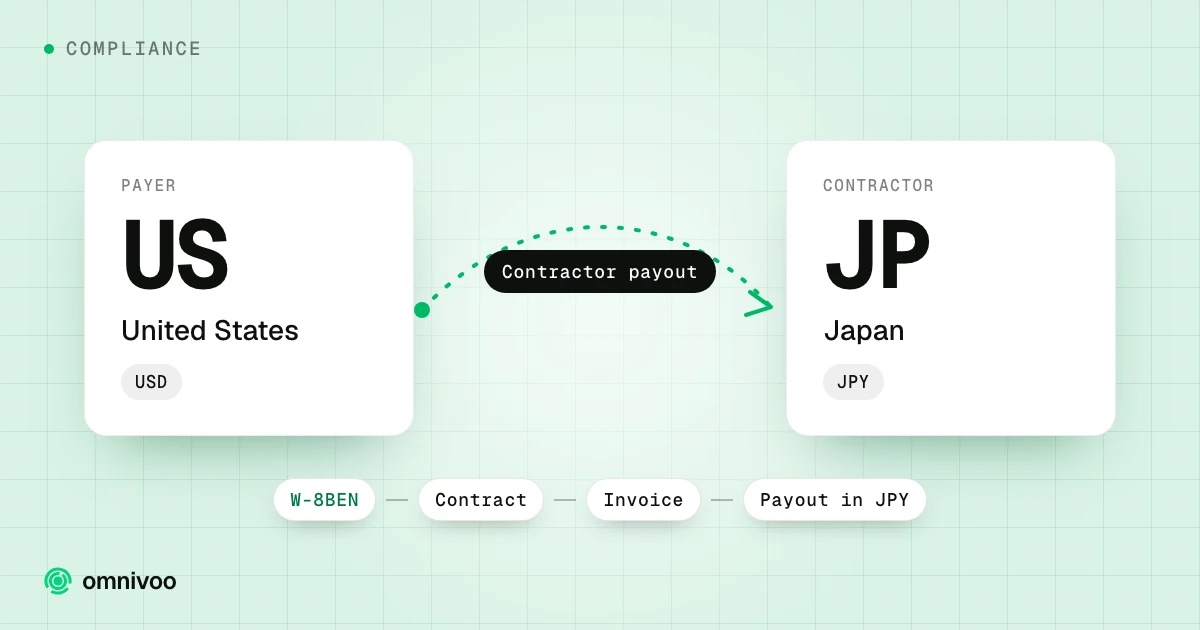
This guide covers the full stack for a US company paying contractors in Japan. We look at the US side (W-8BEN, treaty application, 1042-S), the Japan side (kojin jigyo, My Number, Consumption Tax, the Qualified Invoice System), and the payment rail. By the end you should know exactly what to ask your contractor for and what each document is doing in the chain.
If you want to skip the assembly and let a platform run the whole stack, Omnivoo Contract Management handles SOW drafting, W-8BEN collection, invoice capture, and JPY or USD payouts for $29 per contractor per month.
US side: what you need to do as the payer
Step 1. Collect a W-8BEN before the first payment
Before any invoice is paid, the contractor completes Form W-8BEN and returns it to you. The form certifies the contractor is the beneficial owner of the income, is a tax resident of Japan, and is not a US person.
The W-8BEN is valid through the end of the third calendar year after signature and must be refreshed when it expires or when a relevant fact changes, such as a new address or a change in beneficial ownership. If your contractor operates through a registered Japanese company (a kabushiki kaisha or godo kaisha), the form is W-8BEN-E, the entity equivalent. Use the free W-8BEN collection checklist to confirm you have the right form and fields before you pay.
Step 2. Confirm the work is performed in Japan
Under IRS source of income rules for personal services, services income is sourced to the place where the services are physically performed. If your Japanese contractor works entirely from Tokyo, Osaka, or Fukuoka, the income is Japanese source income from the US perspective.
The practical result: no withholding, no 1042-S, and no 1099-NEC, because the 1099-NEC is for US persons only. You keep the W-8BEN, the SOW, the invoice, and the payment receipt together as your documentation packet.
If the contractor flies to the US for an onsite sprint or a planning week, the days physically worked inside the US are US source days. Those days must be allocated and may trigger withholding plus a 1042-S. A simple onsite-days log keeps this clean.
Step 3. Know the treaty for the edge cases
Japan is on the IRS A-to-Z list of US income tax treaties, so a treaty is in force. The US-Japan tax treaty documents include the 2003 convention and a 2013 protocol. The US Department of State record for the 2013 protocol confirms it entered into force on August 30, 2019, with most changes effective for payments made on or after November 1, 2019.
The treaty matters only when your payment generates US source income. For pure services performed in Japan, the US has no withholding right under source rules, so the treaty is not in play. Where it becomes relevant is US source royalties or income tied to US-performed days. If your SOW characterizes any portion of the fee as a royalty for transferred software or other intellectual property, the treaty’s royalty article is what the contractor relies on to reduce or eliminate US withholding when claiming benefits.
The cleanest practice is to draft the SOW as a pure services agreement with full IP assignment for value already included in the fee, which avoids splitting the fee into a royalty component and keeps you out of the withholding question entirely.
Japan side: what your contractor handles
You as the US payer are not in scope for Japanese taxes. The contractor is. Understanding the landscape helps you have an informed conversation when they ask for specific invoice fields.
Kojin jigyo, My Number, and the tax return
A Japanese freelancer typically operates as a kojin jigyo (sole proprietor). They file a business-opening notification with the local tax office and choose between a blue return (aoiro shinkoku), which carries bookkeeping benefits and deductions, and a simpler white return (shiroiro shinkoku). Individuals are identified by My Number, a 12-digit individual number used across tax and social security. Sole proprietors generally enroll in the National Pension (kokumin nenkin) administered by the Japan Pension Service and in National Health Insurance (kokumin kenko hoken), rather than the employee schemes.
You do not need to track any of this. You only need to know the contractor is properly registered and can issue a valid invoice.
Consumption Tax and the Qualified Invoice System
Japan’s Consumption Tax (JCT) standard rate is 10 percent, with a reduced 8 percent rate for certain food and beverages, as administered by the National Tax Agency (NTA). Since October 1, 2023, Japan has operated the Qualified Invoice System (invoice seido). Under it, a business registers with the NTA as a Qualified Invoice Issuer and receives a 13-digit registration number that appears on its invoices. Buyers inside the JCT system can only credit input Consumption Tax against a Qualified Invoice.
For a contractor exporting services to your US company, the supply is generally treated as an export transaction outside the scope of JCT, so the contractor does not add 10 percent to your invoice. The contractor confirms the export treatment with their own advisor. As the US payer, you do not pay or recover JCT.
Zengin and Japanese banking
Once a USD payment lands in the contractor’s Japanese bank account, it is converted to JPY at the bank’s rate. Japan’s domestic interbank rail is the Zengin System, operated by the banking industry. A payment platform that supports Japan typically settles a USD-to-JPY payment by depositing JPY into the contractor’s account through domestic rails, which is faster and cheaper than a SWIFT wire routed through correspondents on both sides.
The payment rail decision
There are four real options for paying a Japanese contractor from a US bank account.
| Rail | Typical FX margin | Speed | Notes |
|---|---|---|---|
| US bank SWIFT wire | 2 to 4 percent | 1 to 3 business days | Sender fee plus correspondent deductions; bank receipt only |
| Wise USD to JPY | Transparent, low single-digit | Same day to one day | Wise supports sending JPY to Japanese bank accounts; confirm balance support |
| Payoneer USD to JPY | Tiered, lower at volume | One business day | Common for freelancers serving US clients |
| Keep funds in USD | None at send | Same day | If the contractor holds a USD account and prefers dollars |
For most US companies paying one to ten Japanese contractors, Wise or Payoneer is the cleanest option. A SWIFT wire is fine for a one-off larger payment where the percentage cost matters less. Always confirm current currency support with the provider before onboarding.
Misclassification risk in Japan
Japan’s Labour Standards Act, administered by the Ministry of Health, Labour and Welfare, defines a worker (rodosha) by the substance of the relationship rather than the contract label. The test looks at subordination, direction and control, fixed hours, integration into the company, and economic dependence. A contractor who in practice looks like an employee can be treated as a worker, which brings entitlements that do not apply to genuine independent contractors.
The exposure can reach the US principal even with no Japanese entity if the contractor pursues a claim. The mitigations are well established: a properly drafted services agreement that establishes the contractor relationship in substance, a scope tied to deliverables rather than time, evidence the contractor serves other clients, and a periodic review of misclassification risk at the six and twelve month checkpoints.
For more depth on structuring these contracts, see our guide on drafting an SOW for global contractors. The Omnivoo Contract Management SOW templates build these protections in by default, with a clear IP assignment clause and a governing law clause suited to cross-border work.
End-to-end workflow
Here is the clean version for a US company onboarding its first Japanese contractor.
- Send the contractor a services agreement that defines deliverables, payment, IP assignment, and termination, built on a master service agreement and a statement of work.
- Collect a signed W-8BEN before any payment moves, or a W-8BEN-E if they operate through a company.
- Confirm the contractor is registered as a kojin jigyo and can issue a compliant invoice with their registration number.
- Pick a payment rail (Wise, Payoneer, or comparable) and onboard the contractor’s JPY or USD payout details.
- Pay the invoice on schedule. Keep the W-8BEN, SOW, invoice, and payment receipt together as a packet.
- Review the engagement quarterly for misclassification risk and refresh the W-8BEN every three years.
If you also pay contractors elsewhere in the region, see our guides on paying Indian, Philippine, and Vietnamese contractors, plus the new guides on paying Thai and Malaysian contractors. For the broader framework, see our guide on how to pay international contractors from the US.
When a platform pays for itself
A US founder paying one Japanese contractor can do this manually. A US team paying five or more Japanese contractors faces enough W-8BEN refreshes, invoice handling, and FX margin questions that a platform pays for itself within the first few months.
Omnivoo Contract Management costs $29 per contractor per month. We draft the services agreement with Japan-aware IP and misclassification clauses, collect the W-8BEN, capture the invoice on every payment, run the FX payment through a JPY or USD rail to avoid SWIFT leakage, and store the full packet for audit. Transaction fees are passed through at cost, with competitive FX, cancel anytime.
A simple sanity check
Three questions for every Japanese contractor relationship.
- Is there a signed W-8BEN on file and is it less than three years old?
- Will all the work be performed in Japan for the foreseeable future?
- Are we paying through a rail that lands JPY via domestic banking, or USD if the contractor prefers, without SWIFT correspondent leakage?
If yes to all three, you are most of the way to a clean US-Japan contractor payment stack. The remaining work is misclassification hygiene over time.
Want to skip the assembly entirely? See how Omnivoo Contract Management handles Japanese contractors end to end, browse the how to pay contractors for the full picture, or talk to our team about your specific setup.